1754
Stourhead landscape garden
Henry Hoare II (owner and designer), with the architect Henry Flitcroft; Grotto by William Privet of Chilmark; later altered by Sir Richard Colt Hoare · Stourton, Wiltshire, England
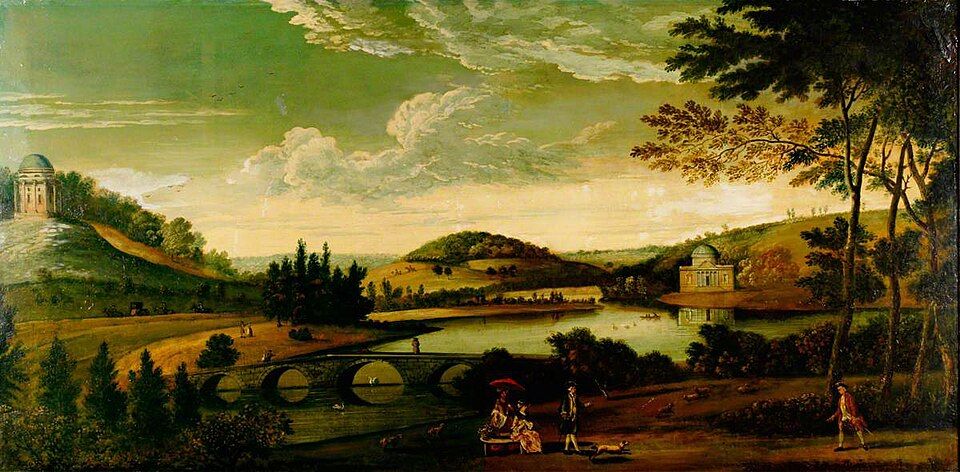
Henry Hoare II formed a lake from valley ponds and set a circuit walk past classical temples, largely by Henry Flitcroft, arranged for a sequence of views. Registered Grade I, it is a key surviving English landscape garden.
How it came about and changed
- 1717–1725
The Stourton family's estate passed in 1717 to the banker Henry Hoare I, who replaced the old manor with a Palladian house designed by Colen Campbell (c. 1721–24); walled gardens were laid out to its south. The Stour valley to the west was then a chain of ponds, each with a dam.13
- 1725–1741
Henry Hoare II inherited in 1725 and around 1733 extended the gardens with a formal terrace walk of Scotch firs west of the house.1
- 1741–1765
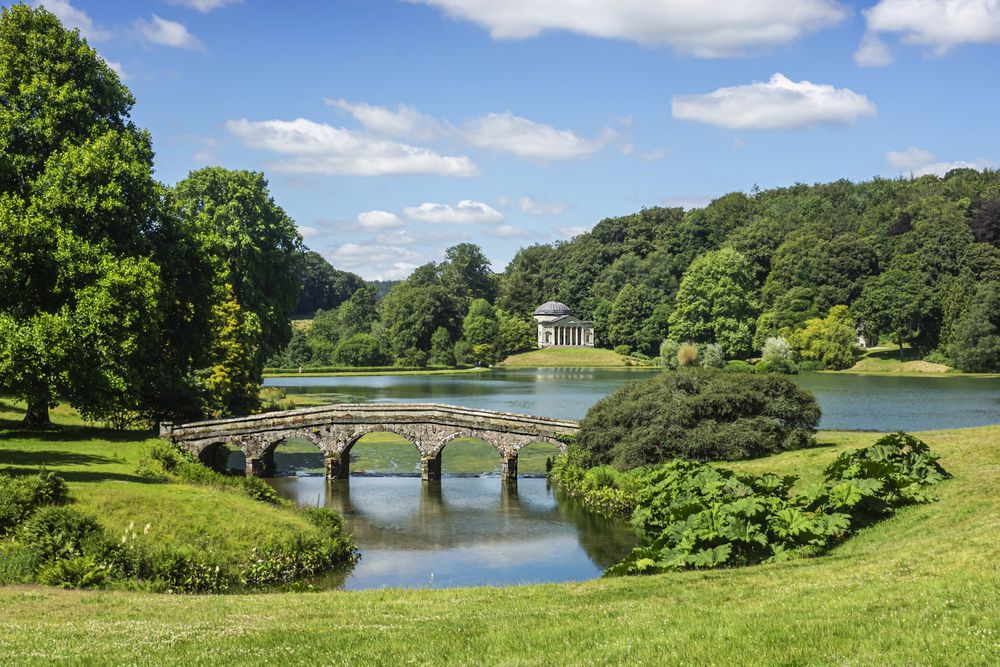
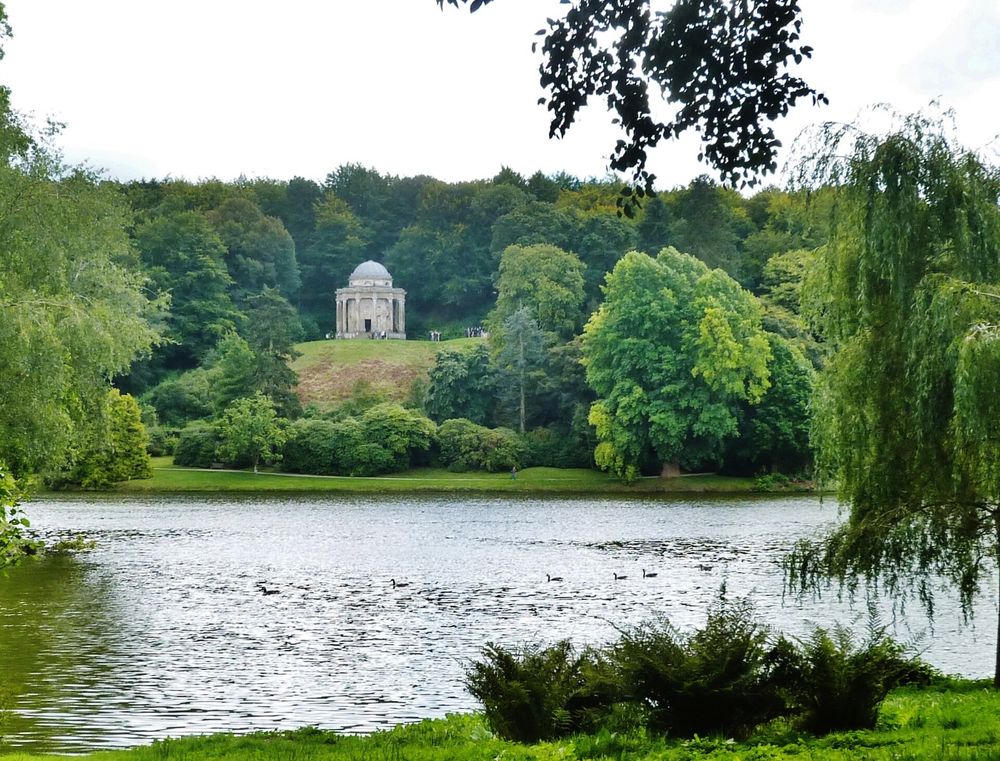
After returning from Italy in 1741, Henry Hoare II laid out the landscape garden: a lake formed from two existing ponds and a circuit walk past buildings mostly designed by Henry Flitcroft. The Temple of Flora (1744–46) was the first, followed by the Grotto (William Privet of Chilmark), the Pantheon (1753–54), the Palladian Bridge (1762), the Rock Arch (1762), the Temple of Apollo (1765) and the medieval Bristol High Cross, brought from Bristol in 1765. Planting aimed at pictorial contrasts of dark and light, initially carried out by a team of 50 gardeners.12
- 1762–c.1780
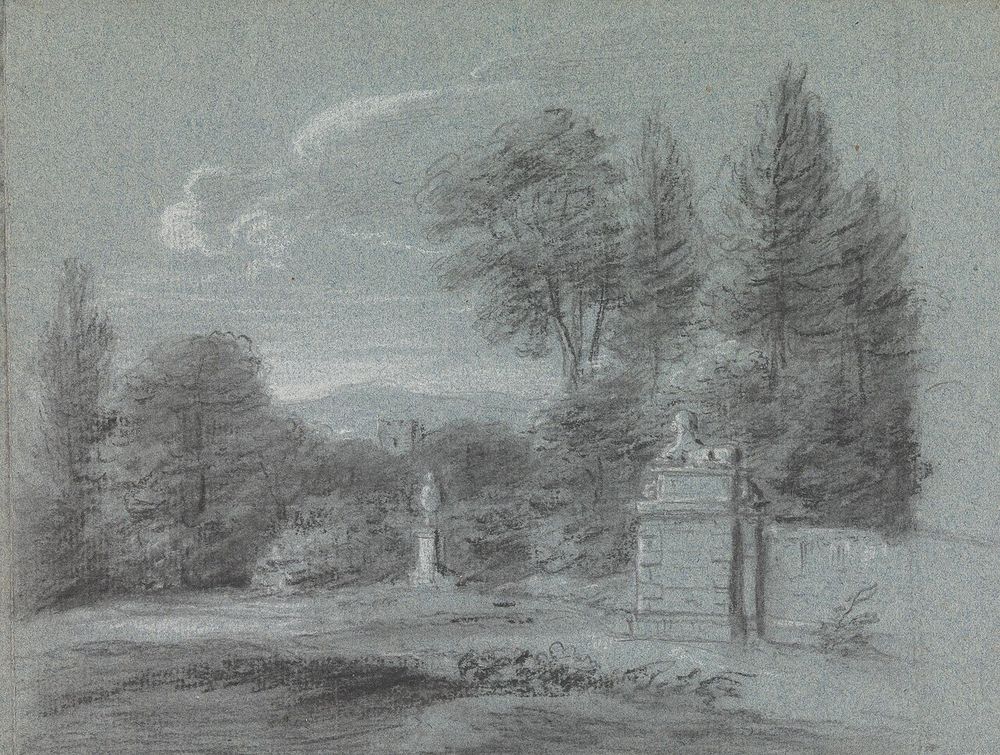
Alfred's Tower, conceived in 1762 as the focal point of a ride around the park and woods and designed by Flitcroft, was completed in the late 1770s; the Convent was added on a woodland ride in 1765. Coplestone Warre Bampfylde recorded the garden in drawings around 1770.1
- 1783–1838
Henry Hoare II handed Stourhead to his grandson Richard Colt Hoare (in 1783 per the National Trust). Between 1791 and 1815 Colt Hoare extended the house and park, moved the main approach, and removed several garden buildings (Turkish Tent, Gothick Greenhouse, Chinese Umbrella, Hermitage); he laid gravel paths and planted around 90,000 trees in 13 years, replacing many firs with broadleaves and introducing rhododendrons, including the invasive Rhododendron ponticum.12
- 1838–1946
Later Hoare owners added an iron bridge across the south-west arm of the lake (1860), rebuilt the obelisk, and added ornamental trees and a pinetum. The estate declined under Sir Henry Ainslie Hoare amid debt and agricultural depression, with heirloom sales from 1883; the house was gutted by fire on 16 April 1902 and rebuilt.13
- 1946–1973
Sir Henry Hoare gave the house and most of the grounds to the National Trust (1946 per the Register summary; the Trust's own page says ownership passed on his death in March 1947). The Trust first tidied and cleared overgrown areas and re-roofed the Temple of Apollo; in the 1950s–60s it concentrated on the plant collection, reopened some historic vistas and repaired dams and garden buildings.13
- 1973–present
In 1973 the National Trust appointed a committee to prepare a policy and restoration plan for the long-term preservation of the 18th-century landscape (report 1978); a restoration plan for the Grade I landscape followed in 1997. Recent work includes restoring the Pantheon's portico roof from 2014 and re-carving the Grotto inscription in 2016; dams and paths continue to be repaired.143



Approvals and legal steps
- 1946 (or 1947) Transfer of the house and most of the grounds to the National Trust, which now owns and manages most of the site.13
- Registration date not confirmed (see notes) Registered at Grade I on Historic England's Register of Parks and Gardens of Special Historic Interest (reference GD1440 as given by Parks & Gardens UK). Many garden buildings are separately listed, including Stourhead House, the Pantheon, the Temple of Flora, the Temple of Apollo, the Grotto, the Palladian Bridge, the Bristol High Cross and Alfred's Tower at Grade I.1
Funding
- 1717–1725 The National Trust states that the new house was funded by 'new money' from Hoare's Bank, and that Henry Hoare I partly invested the bank's large profits from trading South Sea Company shares during the South Sea Bubble (1720) in Stourhead. No source opened gives costs of the 18th-century garden works.3
- 2014 The National Trust began restoring the Pantheon's portico roof with funding from SITA Trust (amount not stated).4
- 2016 Re-carving of the Grotto inscription was paid for by funds donated by the Salisbury and South Wilts National Trust Association (amount not stated); the work was done by Cliveden Conservation.4
People
- Henry Hoare II (1705–1785) Owner and designer of the landscape garden
- Henry Flitcroft Architect of most garden buildings (Temple of Flora, Pantheon, Temple of Apollo, Alfred's Tower)
- William Privet of Chilmark Designer/builder of the Grotto (mid-18th century)
- Henry Hoare I (1677–1725) Banker who bought the estate in 1717 and built the house
- Colen Campbell Architect of the Palladian house (c. 1721–24)
- Sir Richard Colt Hoare (1758–1838) Heir who altered the garden and replanted extensively, 1791–1815
- Coplestone Warre Bampfylde Recorded the garden in drawings and paintings around 1770
- Sir Henry Hugh Arthur Hoare (1865–1947) Last private owner; gave Stourhead to the National Trust
- National Trust Owner and manager since 1946/1947; restoration policy from 1973
- Cliveden Conservation Re-carved the Grotto inscription (2016)
Sources for this page
- Parks & Gardens UK, Stourhead (including Register of Parks and Gardens summary)
- National Trust, History of the garden at Stourhead
- National Trust, History of Stourhead House
- National Trust, Conservation work at Stourhead
- Wikidata, Stourhead (Q301338)
Researched on 2026-11-19 from the sources listed; a fact that could not be confirmed in a source was left out. Pictures are public domain or under an open licence, credited as their file page asks.
The question it brings · interpretation
How does a single circuit route, with buildings placed to be seen across water and then reached, turn a valley into a sequence of composed views, and where would that sequencing help or hinder a public landscape today?
Each question is Field Method’s interpretation, not a claim made by the source.
The date
1754 marks completion of the Pantheon (built 1753–54, National Trust), the principal temple of the lakeside circuit; Henry Hoare II began laying out the landscape garden after returning from Italy in 1741, forming the lake from existing ponds (Register of Parks and Gardens summary via Parks & Gardens UK). Other key dates: Temple of Flora 1744–46; Palladian Bridge 1762; Temple of Apollo and Bristol High Cross 1765; Alfred's Tower completed late 1770s; Richard Colt Hoare's changes 1791–1815; National Trust ownership from 1946/1947; Trust restoration policy from 1973.