2004
Proyecto Urbano Integral (PUI) Nororiental, Medellín
City of Medellín with the Empresa de Desarrollo Urbano (EDU); design leadership Alejandro Echeverri · Medellín, Colombia
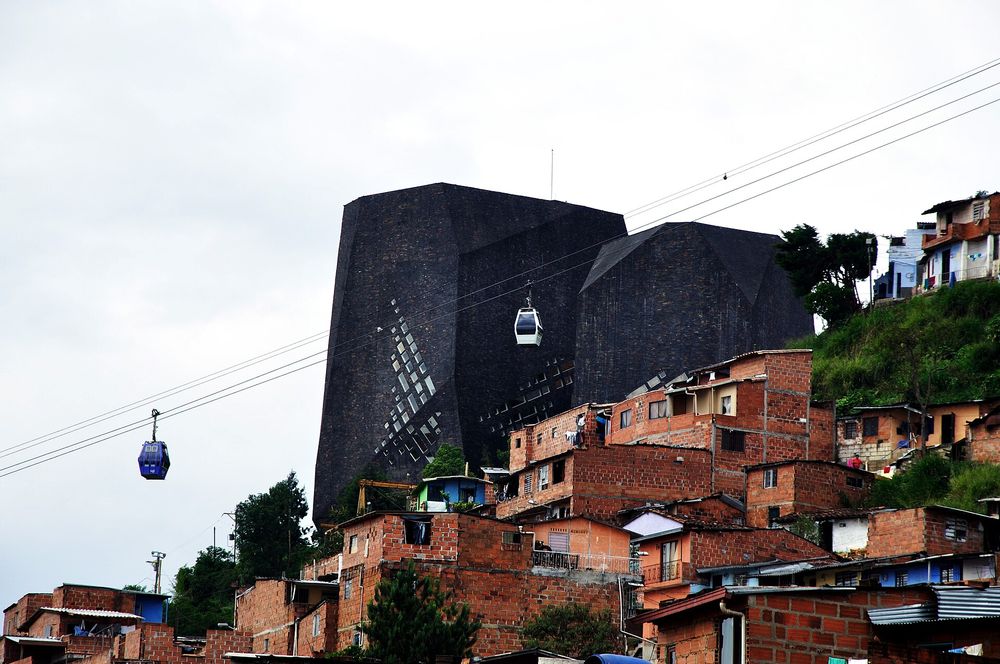
A city programme begun in 2004 along the route of Metrocable Line K through hillside informal settlements, adding public space, pedestrian bridges, stream works, housing and civic buildings, including a library park at Santo Domingo Savio opened in 2007.
How it came about and changed
- 20th century–2004
Arquitectura Viva describes how sectoral planning in 20th-century Medellín deepened spatial segregation and produced large marginal settlements on the city's slopes marked by violence; the city responded by channelling municipal investment through Proyectos Urbanos Integrales (PUI) based on physical intervention in the most conflict-affected areas, community participation and a territorial scale of action.2
- 2004
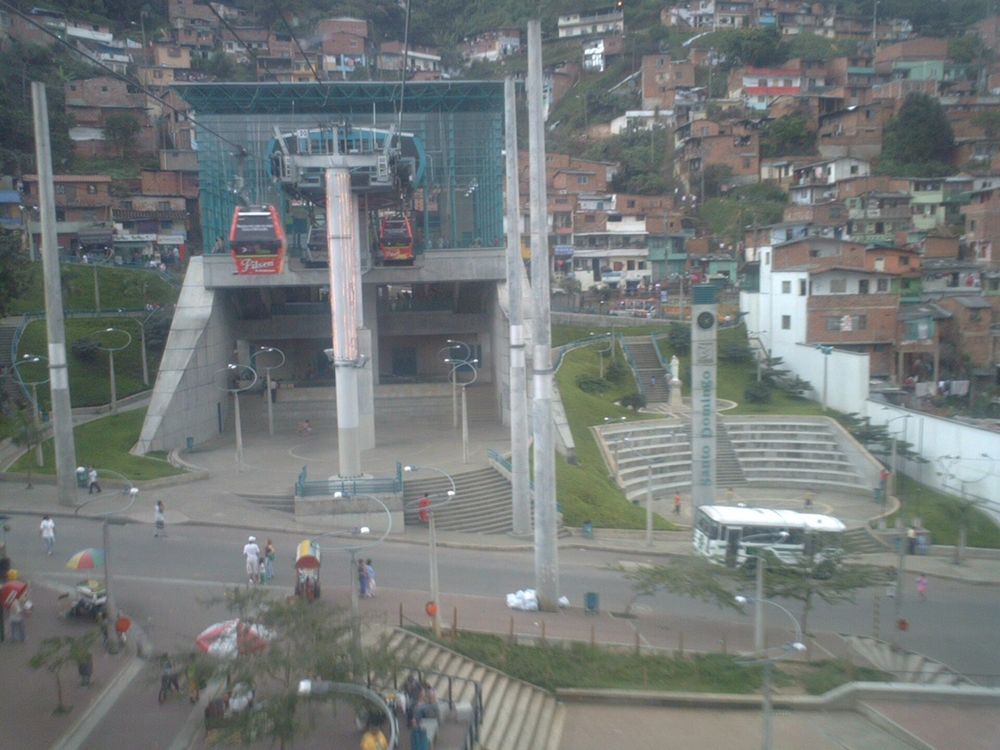
Metrocable Line K (Acevedo–Santo Domingo Savio) began commercial operation on 7 August 2004, linking Acevedo metro station (elevation 1,470 m) with the Santo Domingo Savio hill (1,750 m). The City of Medellín initiated the PUI Nororiental the same year to build on the opportunity created by the cable car, with architect Alejandro Echeverri and the agency Empresa de Desarrollo Urbano (EDU).521
- 2004–2008
The EDU's 2009 presentation shows the PUI's process: a shared diagnosis with the community (walks, mapping of micro-territories, 'imaginaries' workshops, neighbourhood assemblies) and works including the Paseo Carabobo and other urban walks, the Parque Biblioteca España, schools, a sports unit, and the Quebrada Juan Bobo pilot for housing consolidation, which combined new multi-family housing, resettlement without eviction, creek sanitation, slope stabilisation, footbridges and titling. Around the three hillside stations, about 9,000 m² of public space was created.32
- 2007
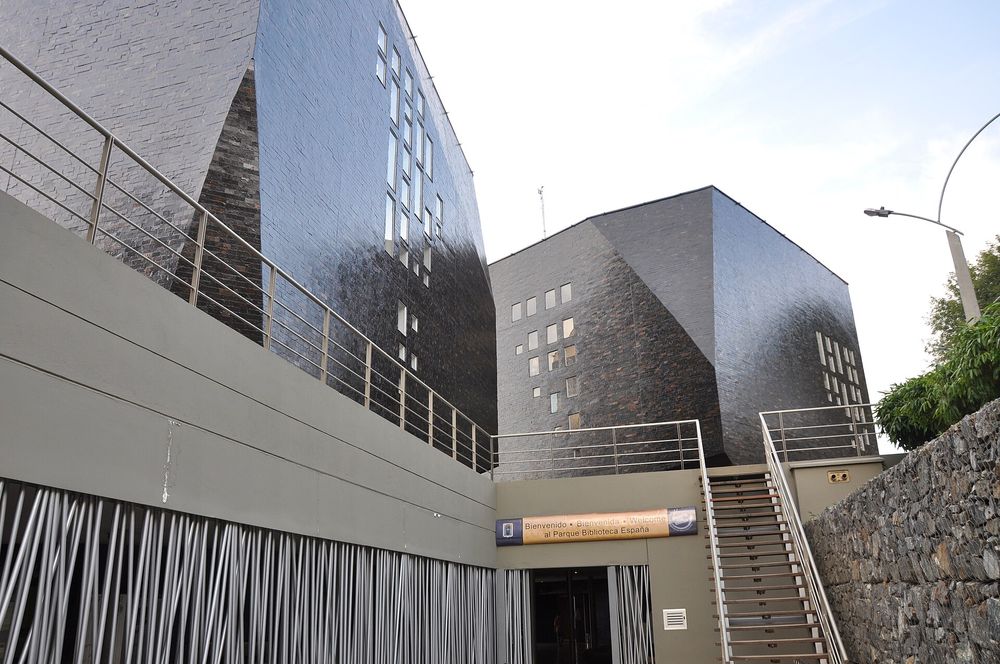
The Parque Biblioteca España in Santo Domingo Savio was inaugurated on 22 March 2007 in the presence of King Juan Carlos I and Queen Sofía of Spain.4
- 2008–2015
The EDU presentation marks an extension of the Nororiental intervention for 2008–2011. Harvard GSD gives the project's timeline as 2004–2015 and records that it won the Veronica Rudge Green Prize in Urban Design in 2013, awarded to the City of Medellín for its sponsorship with acknowledgement of Echeverri's design leadership and the EDU's role.31
- 2008–2026
The library showed damp in 2008 and detachments in 2010–2011; after a façade pathology study (2013–2014) it closed in August 2015, and the municipality and EDU went to court in 2017. A rehabilitation was put to the City Council in 2021. Library boxes 1 and 2 reopened on 18 June 2026 as the Parque Biblioteca Santo Domingo Savio, and the third box with the auditorium was reported complete on 21 October 2026.46
- 2019
After 15 years of service, Telemedellín reported that Line K had carried about 96 million passengers and moved about 46,000 passengers a day.5


Approvals and legal steps
- 2004–2008 (date not stated) For the Quebrada Juan Bobo pilot, the environmental authority redefined the regulatory creek setback from 10 m (4,000 m²) to 3 m (1,200 m²), which allowed housing consolidation along the creek.3
- 2021 The Secretaría de Infraestructura Física filed a Proyecto de Acuerdo with the Medellín City Council (budget committee) to commit future-year funds (vigencias futuras) for the library's rehabilitation.4
Funding
- 2004–2015 Harvard GSD states the City of Medellín sponsored the project and provided financial and administrative support; Arquitectura Viva describes the PUIs as the channel for municipal investment.12
- c. 2004–2008 The EDU presentation lists resources of the Área Metropolitana del Valle de Aburrá for the Juan Bobo environmental recovery, national, departmental and municipal resources for the new housing, and co-financing by the Empresa de Vivienda de Antioquia and the Alcaldía for the housing programme.3
- 2021 The Alcaldía estimated COP 30,800 million for the library's rehabilitation: COP 20,000 million for the building, COP 8,000 million for the surrounding public space, slope stabilisation and landscape, and COP 2,800 million for supervision (interventoría).4
- 2026 El Colombiano, citing figures presented by the Alcaldía in June 2026, reports the library's recovery cost COP 55,029 million, including the original contract, additional funds to finish it and more than COP 2,839 million to stabilise the slope; a COP 3,600 million contract with the EDU was signed in September 2025 to complete the remaining works.6
People
- City of Medellín (Alcaldía de Medellín) Initiator and sponsor of the PUI; recipient of the 2013 Veronica Rudge Green Prize (Harvard GSD)
- Empresa de Desarrollo Urbano (EDU) Municipal agency for design, management and execution of the PUI (Harvard GSD)
- Alejandro Echeverri Restrepo Design leadership of the PUI (Harvard GSD; Arquitectura Viva)
- Carlos Mario Rodríguez Osorio and Carlos Alberto Montoya Correa Architects of the PUI with Echeverri (Arquitectura Viva)
- Empresa de Transporte Masivo del Valle de Aburrá Limitada (Metro de Medellín) Metrocable Line K (Arquitectura Viva; Harvard GSD)
- César Augusto Hernández Correa Project management consultant (Arquitectura Viva)
- Área Metropolitana del Valle de Aburrá; Empresa de Vivienda de Antioquia Funders of components of the Juan Bobo pilot (EDU presentation)
- Residents of Comunas 1 and 2 (housing committee, community assemblies) Participants in the shared diagnosis and oversight of local works (EDU presentation)
Sources for this page
- Harvard University Graduate School of Design, Northeastern Urban Integration Project (Urban Design Case Study Archive)
- Arquitectura Viva, Metrocable Line and Northeast PUI
- Empresa de Desarrollo Urbano / Alcaldía de Medellín, hosted by Universidad de los Andes, Urbanismo Social (EDU presentation, 29 January 2009)
- Alcaldía de Medellín, Con la rehabilitación de su biblioteca, renace la esperanza en la zona nororiental de Medellín (29 March 2021)
- Telemedellín, Se cumplen 15 años de servicio del Metrocable Línea K
- El Colombiano, Por fin, el auditorio: la antigua Biblioteca España está completa tras 11 años (21 October 2026)
- Wikidata, Santo Domingo Savio station (Q2884387)
Researched on 2026-11-19 from the sources listed; a fact that could not be confirmed in a source was left out. Pictures are public domain or under an open licence, credited as their file page asks.
The question it brings · interpretation
When new transit reaches a steep neighbourhood, which paths, bridges and small public spaces would connect the station to daily routes, and how would you find out who is displaced by building them?
Each question is Field Method’s interpretation, not a claim made by the source.
The date
Year the City of Medellín initiated the project, which is also the year Metrocable Line K opened; works continued for several years (the EDU presentation shows 2004 to 2008). The España library park in the same district was inaugurated on 22 March 2007.
Checked against
- Harvard University Graduate School of Design, Northeastern Urban Integration Project
- Arquitectura Viva, Metrocable Line and Northeast PUI
- Empresa de Desarrollo Urbano / Alcaldía de Medellín, hosted by Universidad de los Andes, Urbanismo Social (EDU presentation, 29 January 2009)
- Alcaldía de Medellín, Con la rehabilitación de su biblioteca, renace la esperanza en la zona nororiental de Medellín (29 March 2021)
- Telemedellín (public television channel of Medellín), Se cumplen 15 años de servicio del Metrocable Línea K