1681
Canal du Midi
Pierre-Paul Riquet · Languedoc (Occitanie), France
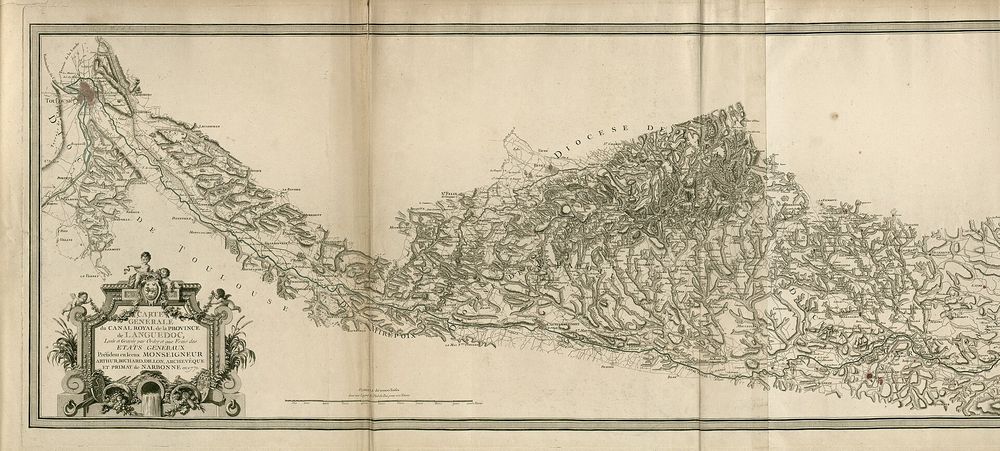
A canal from Toulouse towards the Mediterranean crossing a watershed at the Seuil de Naurouze, supplied by channels and the Saint-Ferréol reservoir collecting streams from the Montagne Noire. Up to 12,000 workers built it between 1667 and 1681.
How it came about and changed
- 1662–1666
Pierre-Paul Riquet proposed a canal linking the Atlantic and the Mediterranean, with a water supply drawn from the Montagne Noire to the summit at the Seuil de Naurouze. In January 1663 Louis XIV ordered commissioners of the Kingdom and the Province of Languedoc to assess the project; after Riquet's experimental trial the Commission of Inquiry approved it in November 1664, and the Edict of Saint-Germain of October 1666 authorised the canal and made Riquet adjudicatee for the works from Toulouse to Trèbes.21
- 1667–1672
Work began on 1 January 1667 in the Montagne Noire with the Rigole de la Plaine feeder channel; foundations of the Saint-Ferréol dam were begun on 18 April 1667 and those of the Embouchure lock at Toulouse on 17 November 1667. VNF dates the Saint-Ferréol reservoir to 1667–1672.21
- 1669–1681
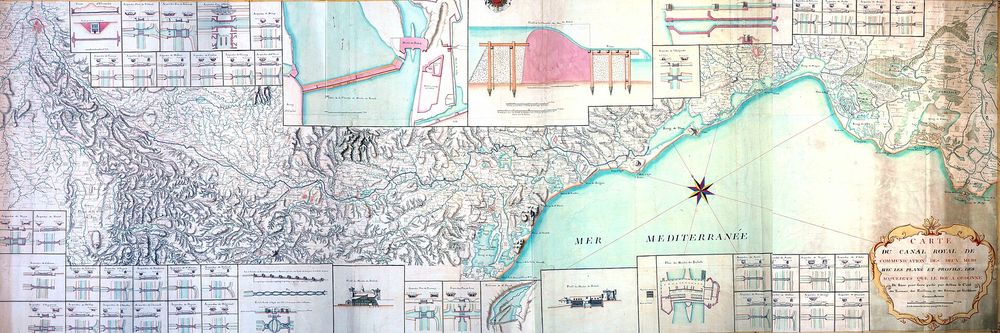
In January 1669 the second section, from Trèbes to the Thau lagoon, and the port of Sète were assigned to Riquet. The Toulouse–Castelnaudary section opened in 1674, the Fonseranes staircase locks near Béziers were built in 1677 and the Malpas tunnel was begun in November 1679. Riquet died on 1 October 1680; his son Jean-Mathias Riquet completed the works, and in May 1681 the canal was filled and a first convoy sailed from Toulouse to Sète.27
- 1686–1694
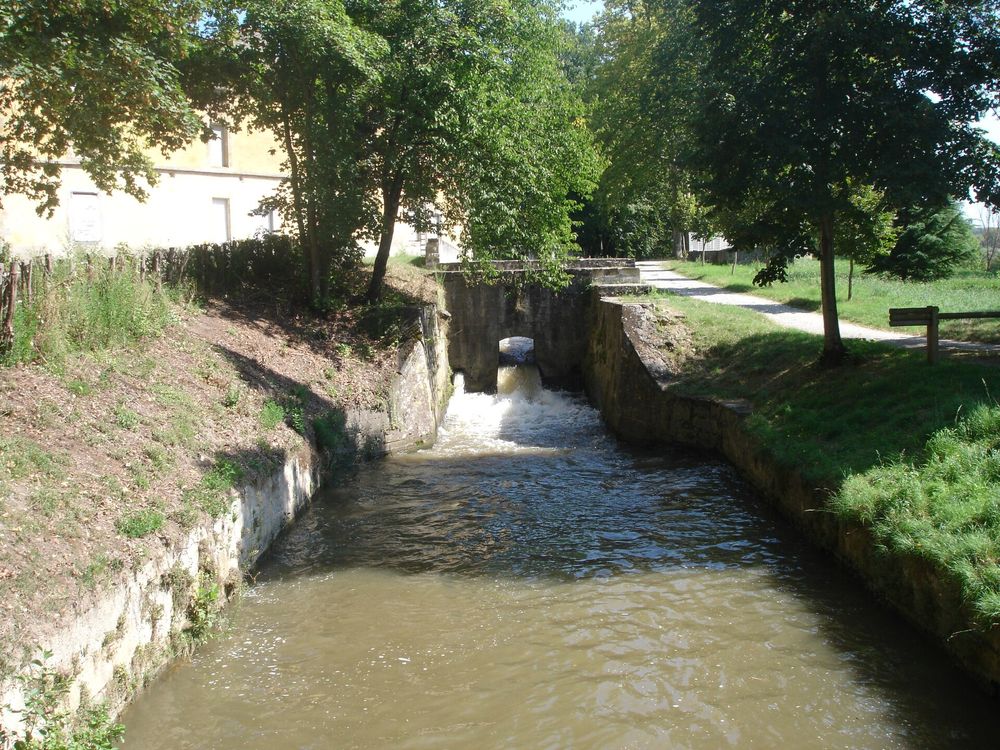
Silting and flaws appeared after opening, and on Vauban's recommendations works directed by Antoine de Niquet from 1686 to 1694 added aqueducts carrying streams over the canal, spillways, the Cammazes tunnel (Voûte Vauban) extending the Rigole de la Plaine, and a strengthened Saint-Ferréol dam; VNF treats 1694 as the date the canal was actually completed. The first trees, mainly willows to stabilise the banks, were planted in 1694.35
- 1767–1810
A 1767 planting programme lined the banks with mulberry and black poplar, and plane trees appeared after 1775. The Canal de Brienne in Toulouse (1768–1776), the Canal de Jonction and restored Canal de la Robine to Narbonne (1777–1787), the Lampy-Neuf reservoir (1777–1782) and a new route through Carcassonne (1787–1810) extended the system.53
- 1789–1898
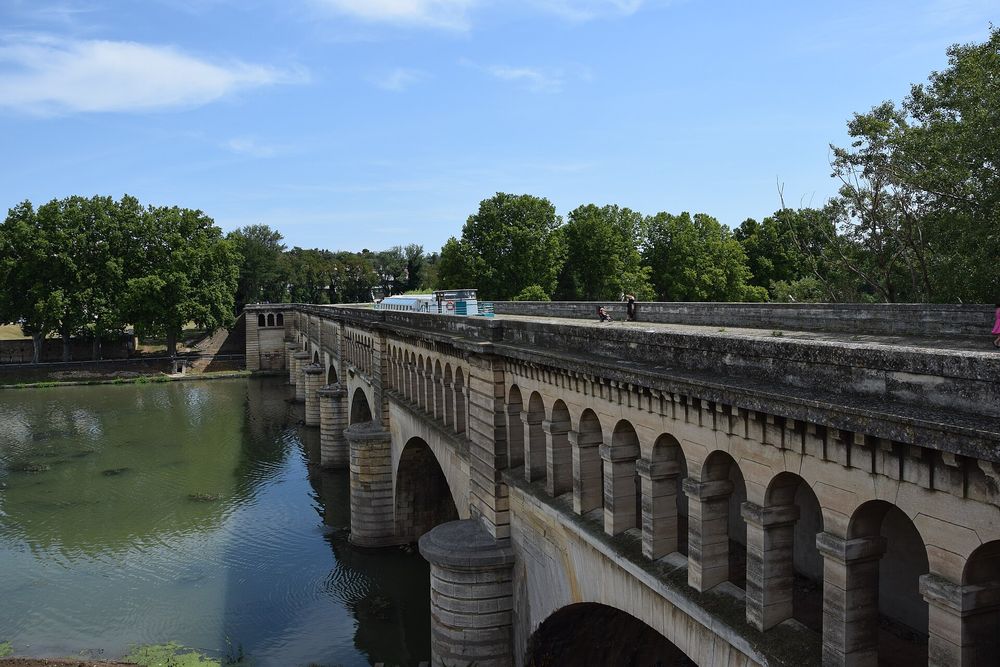
After the abolition of feudal rights the Canal Royal de Languedoc became the Canal du Midi (1792) and the Riquet family's shares were confiscated by the State (1793–1809). A decree of 10 March 1810 created the shareholder-owned Compagnie du Canal du Midi; from 1858 the canal was leased to the Compagnie des Chemins de Fer du Midi, whose tariffs favoured rail. The Canal de Garonne (1838–1856) completed the link to the Atlantic, and new structures such as the Ouvrages du Libron and the Orb aqueduct were built in 1854–1857. A law of November 1897 authorised the State to buy back the canal.43
- 1903–2010
Modernisation began in 1903 and resumed intermittently into the 1960s. Lengthening of locks to the Freycinet gauge (1977–1984) was halted in 1984, leaving the 17th-century lock chambers between Sanglier and Argens-Minervois (about 140 km) unaltered. Voies navigables de France (VNF) has managed the canal since 1991; the water-supply system was automated in the 1990s and some locks became self-service from 2010.34
- 1996–present
UNESCO inscribed the canal, its Montagne Noire water-supply system and the Brienne, Jonction and Robine canals on the World Heritage List on 7 December 1996. Since 2006 canker stain (Ceratocystis platani) has killed the canal's plane trees; VNF reports that more than 75% of the 42,000 plane trees have been felled and that replanting with seven species, led by the Turkey oak, has been under way since winter 2011–2012 with regional, departmental and patron support. Today about 60% of the water carried by the canal goes to irrigation.651



Approvals and legal steps
- 1663–1664 Royal order of January 1663 to assess the project; the Commission of Inquiry approved construction in November 1664.2
- 1666 Edict of Saint-Germain (October 1666) authorising the canal and appointing Riquet adjudicatee of the works from Toulouse to Trèbes; VNF's overview dates Riquet's appointment to 14 October 1666.21
- 1668 The fiefdom of the canal was put up for auction and acquired by Riquet, who thereby became responsible for maintenance and received its revenues.2
- 1669 Second section (Trèbes to the Thau lagoon) and the port of Sète assigned to Riquet on 23 January 1669.2
- 1810 Decree of 10 March 1810 establishing the Compagnie du Canal du Midi, with State oversight through the Conseil Général des Ponts et Chaussées.4
- 1897 Law of November 1897 authorising the State to buy back the Canal du Midi.4
- 1996 Inscription on the UNESCO World Heritage List (7 December 1996); VNF states the property meets four of the six cultural criteria, which it lists as 1, 2, 4 and 5.6
- 1996–2022 Protection as classified sites under the law of 2 May 1930 (canal and supply system classified 1996–2001; canal landscapes 2017; supply channels added 2022), so that any modification needs State authorisation; 46 structures are listed or classified as historic monuments under the law of 31 December 1913.6
Funding
- 1666–1681 VNF states that Riquet first used his own funds, then received support from the Trésor Royal and the Estates of Languedoc; the construction cost about 17,160,000 livres ('pounds' in the English page): 8,485,000 from the Trésor Royal, 8,070,000 from the Estates of Languedoc and 605,000 from Riquet. Languedoc financiers such as Pierre Louis Reich de Pennautier also assisted.2
- 1680s–1724 To pay Riquet's debts his heirs sold part of their shares (with a buy-back clause) to Reich de Pennautier and Antoine de Niquet; the Riquet heirs bought them back in 1724.4
- 1897 The State's buy-back price was set at 40 million French francs.4
- 2011–present Replanting of the banks after canker stain is funded by VNF with support from the Region, Departments and public and private patrons (no total stated).5
People
- Pierre-Paul Riquet Promoter, designer of the water-supply scheme and contractor (adjudicatee) for the works; owner of the canal fief from 1668; died 1 October 1680
- Louis XIV King who authorised the canal by the Edict of Saint-Germain (1666)
- Jean-Baptiste Colbert Controller-general of finances who brought the project to the King
- Jean-Mathias Riquet Riquet's eldest son, who completed the works in 1681
- François Andréossy Cartographer / hydraulics engineer assisting Riquet
- Emmanuel de l'Estang Architect engaged by Riquet, associated with the Répudre aqueduct
- Sébastien Le Prestre de Vauban Inspected the canal and recommended the consolidation works of 1686–1694
- Antoine de Niquet King's engineer who directed the Vauban works (1686–1694); later co-owner of canal shares
- Pierre Louis Reich de Pennautier Languedoc financier who helped fund the project and became a co-owner of shares
- Urbain Maguès and Achille Simoneau Engineers of the Ouvrages du Libron and the Orb aqueduct (1854–1857)
- Compagnie du Canal du Midi Shareholder company owning the canal from 1810
- Compagnie des Chemins de Fer du Midi Leased and operated the canal from 1858
- Voies navigables de France (VNF) Public body managing the canal since 1991
- About 12,000 workers Labour force on the construction, according to VNF
Sources for this page
- Voies navigables de France, with the Entente du Canal du Midi, The Canal du Midi: brief overview
- Voies navigables de France (canal-du-midi.com), Construction between 1666 and 1694
- Voies navigables de France (canal-du-midi.com), The major changes between 1694 and today
- Voies navigables de France (canal-du-midi.com), The Canal du Midi management
- Voies navigables de France (canal-du-midi.com), The canal trees over the years
- Voies navigables de France (canal-du-midi.com), A UNESCO World Heritage Site
- Linda Hall Library, Scientist of the Day: Pierre-Paul Riquet
- Wikidata, Canal du Midi (Q202494)
Researched on 2026-11-19 from the sources listed; a fact that could not be confirmed in a source was left out. Pictures are public domain or under an open licence, credited as their file page asks.
The question it brings · interpretation
Before fixing the line of any channel, swale or path, where is its water coming from at the highest point, and in the driest month?
Each question is Field Method’s interpretation, not a claim made by the source.
The date
Year the first boat sailed the canal after 14 years of work (1667-1681), per Voies navigables de France. Riquet died in 1680. The Réseau Vauban page gives 1683 for the opening.
Checked against
- Voies navigables de France, with the Entente du Canal du Midi, The Canal du Midi: brief overview
- Comité Régional du Tourisme et des Loisirs Occitanie, L'oeuvre de Pierre-Paul Riquet: histoire du canal du Midi
- Network of Vauban's major sites (Réseau Vauban), Cammazes
- Linda Hall Library, Scientist of the Day: Pierre-Paul Riquet