from 1560
Villa d'Este, Tivoli
Pirro Ligorio for Cardinal Ippolito II d'Este; built by court architect Alberto Galvani · Tivoli, Lazio, Italy
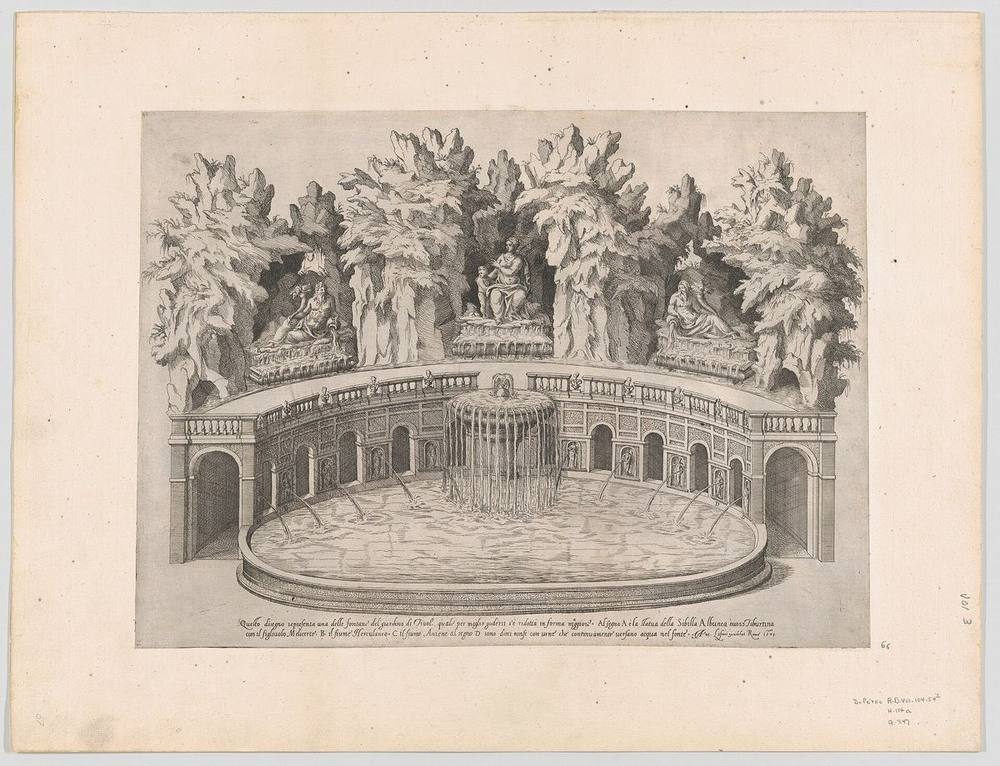
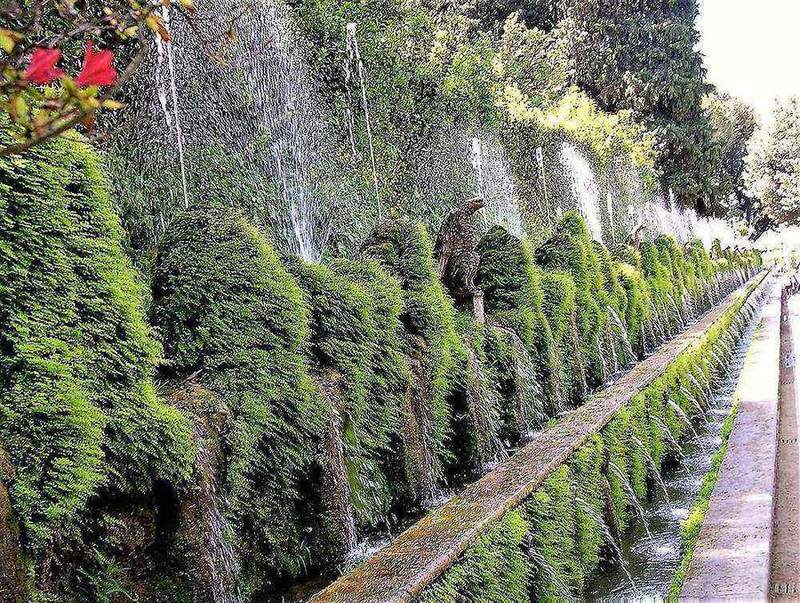
A palace garden stepped down two steep slopes to a level terrace, with fountains, grottoes and water themes fed by gravity. Italy's culture ministry says it served as a model for later gardens in Europe.
How it came about and changed
- 1550
Cardinal Ippolito II d'Este arrived in Tivoli on 9 September 1550 as governor of the town; the official residence assigned to him, part of the monastery of Santa Maria Maggiore, did not suit him and he decided to build a villa with gardens.31
- 1550s–c.1560
Over a little more than ten years the cardinal bought the land on the hillside below the monastery and demolished the buildings; he was removed from the circles of power in Tivoli and Rome for simony in 1555–59.3
- 1560–1565
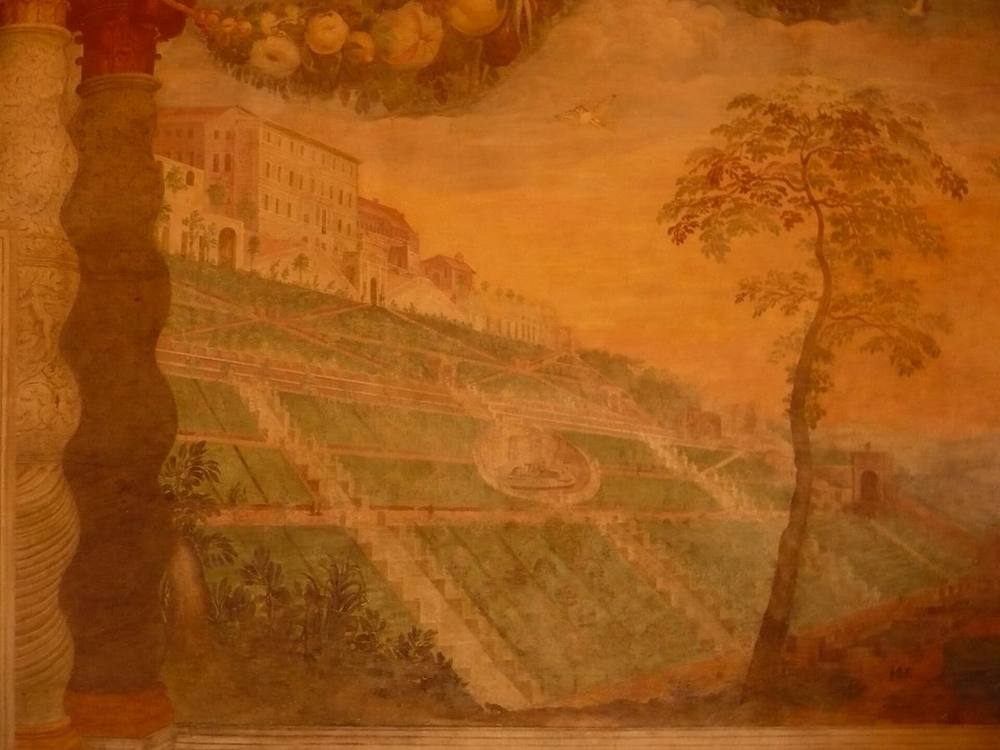
From 1560 work concentrated on the water supply: an aqueduct from Monte Sant'Angelo proved inadequate, so an underground canal beneath the town was dug to take water from the Anio (Aniene) in 1564–65. Between 1563 and 1565 the land was remodelled into a steep slope and a gentler north-east slope, with a terrace on the south-west supported by the old town wall.31
- 1565–1572
Design by Pirro Ligorio (with the cardinal and his secretary Marc-Antoine Muret, per ICOMOS), built by court architect Alberto Galvani. The monastery was converted into the palace (courtyard and loggia 1566–67), fountains such as the Rometta (1567–70, Curzio Maccarone) and the Fountain of the Dragons (for Pope Gregory XIII's visit, 1572) were built, and the palace was decorated by Roman Mannerist workshops. The villa was almost complete when Ippolito died in 1572, though much work remained unfinished.32
- 1572–1641
Cardinal Luigi d'Este completed work already started; after a period with the Dean of the College of Cardinals the villa returned in 1605 to Cardinal Alessandro d'Este, who began a large programme of repairs and changes to the garden and fountains. Works continued under the Dukes of Modena until 1641, including the Rotunda of the Cypresses (around 1640).3
- 1660–1670s
Cardinal Rinaldo I d'Este commissioned Gian Lorenzo Bernini's Fontana del Bicchierone (1660–61); from 1670 architect Mattia de Rossi carried out further work, including changes to the palace.31
- 18th–19th century
Decline began under Rinaldo II (1655–1736) and worsened after the property passed to the Habsburgs in 1803; Cardinal Gustav Adolf von Hohenlohe later restored it and hosted Franz Liszt.32
- 1920–1944
The Italian State acquired the villa (ICOMOS gives 1920; the site manager says between the 1920s and 1930s) and restored it in 1920–30, then again after bomb damage in 1944, before opening it to the public.32
- late 1980s–2001
A fountain restoration programme begun in the late 1980s stopped in 1990 because of polluted Aniene water and resumed in 1998 after a purification plant was built; the Soprintendenza also restored about 5,000 m2 of palace structures and decoration. The Central Restoration Institute studied fountain conservation from 1997.3
- 2001–present
Inscribed on the World Heritage List in 2001 (property 4.5 ha, buffer zone 7 ha). Since 2016 Villa d'Este has been managed with Villa Adriana and other Tivoli sites as the museum 'Villa Adriana e Villa d'Este' of the Ministry of Culture, recognised as a museum with special autonomy under DPCM 15 March 2024 no. 57.124




Approvals and legal steps
- 1550 Appointment of Cardinal Ippolito II d'Este as governor of Tivoli, which gave him his residence there and was the occasion for the project (an office, not a building permit).31
- 1920 Transfer to Italian State ownership (ICOMOS gives 1920; the site manager says purchased between the 1920s and 1930s).32
- 1939 / 1955–1956 / 1988 Protected as a listed monument under national Law no. 1089 of 1 June 1939 (protection of artistic and historic property) since 1988, and covered by landscape protection under Law no. 1497 of 29 June 1939 through decrees of 11 May 1955 and 29 September 1956 extending over the buffer zone; changes require prior permission of the Ministry.3
- 1999 Territorial Plan for the Landscape of Sector 7 (Monterotondo–Tivoli) approved by the Lazio Regional Council, Decision no. 4477 of 30 July 1999.3
- 2001 Inscription on the UNESCO World Heritage List (ref. 1025, criteria i, ii, iii, iv, vi).1
- 2016 / 2024 Ministerial decree D.M. 23 January 2016 no. 44 established 'Villa Adriana e Villa d'Este' as a museum of significant national interest; DPCM 15 March 2024 no. 57 recognises it as a museum with special autonomy (autonomy under art. 14(2) of decree-law 83/2014).4
Funding
- 1550–1572 Built for and at the expense of Cardinal Ippolito II d'Este as private patron; no amounts are given in the sources read.13
- 1572–1586 His heir Cardinal Luigi d'Este's financial resources only allowed him to complete work already started and carry out a few repairs (ICOMOS).3
- 2026 Current management is funded through the budget of the autonomous Istituto Villa Adriana e Villa d'Este, whose 2026 forecast budget lists PNRR (national recovery plan) projects for Villa d'Este, energy efficiency and accessibility.4
People
- Cardinal Ippolito II d'Este (1509–1572) Client and patron; governor of Tivoli from 1550
- Pirro Ligorio (1500–1583) Designer (painter-archaeologist-architect); ICOMOS says the design is 'traditionally attributed' to him
- Alberto Galvani Court architect who built the villa
- Marc-Antoine Muret Humanist secretary of the cardinal, named by ICOMOS as co-designer with Ligorio and the cardinal
- Raffaello da Firenze and Biasioto Builders of the garden-side loggia (1566–67)
- Curzio Maccarone Fountain-maker, Fountain of Rome (Rometta), 1567–70
- Luc Leclerc and Claude Venard French fountain-maker (Fountain of the Organ) and maker of the water organ
- Federico Zuccari, Girolamo Muziano, Livio Agresti, Cesare Nebbia Supervisors of the palace's painted decoration
- Gian Lorenzo Bernini Designer of the Fontana del Bicchierone (1660–61)
- Mattia de Rossi Architect of later works from 1670
- Cardinal Gustav Adolf von Hohenlohe 19th-century owner who restored the villa
- Italian Ministry of Culture; Istituto Villa Adriana e Villa d'Este Owner and current manager
Sources for this page
- Italian Ministry of Culture, UNESCO Office, Villa d'Este, Tivoli
- Istituto Villa Adriana e Villa d'Este (Italian Ministry of Culture), Villa d'Este
- ICOMOS / UNESCO World Heritage Centre (2001), Advisory Body Evaluation: Villa d'Este (Italy) No 1025
- Istituto Villa Adriana e Villa d'Este, Relazione al Bilancio di Previsione 2026
- Wikidata, Wikidata item Q746063 (Villa d'Este)
Researched on 2026-11-19 from the sources listed; a fact that could not be confirmed in a source was left out. Pictures are public domain or under an open licence, credited as their file page asks.
The question it brings · interpretation
If water had to move through your site by gravity alone, how might the grading plan and the sequence of spaces change?
Each question is Field Method’s interpretation, not a claim made by the source.
The date
Nominal year for ordering. The opened ministry pages say Ippolito II d'Este became governor of Tivoli in 1550, that from 1560 great efforts were made to supply water for the fountains and the design became clear only after 1560, and that the villa was almost complete at his death in 1572.