about 1570
Humayun's Tomb garden, Delhi
Mughal court (secondary accounts differ on the patron and architects) · Delhi, India
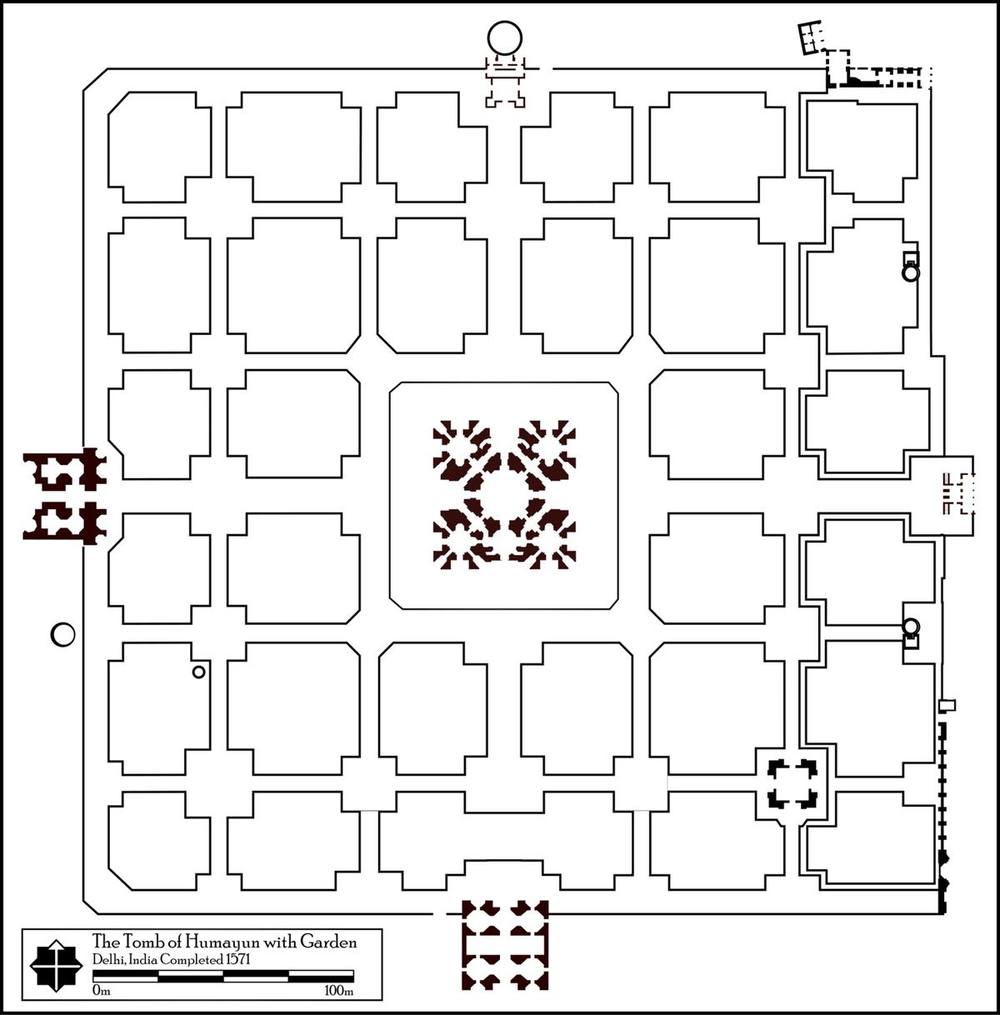
UNESCO records it as the first garden-tomb on the Indian subcontinent. Its char-bagh has four near-equal quadrants; the Aga Khan Trust for Culture and the Archaeological Survey of India restored its water channels, path edging and planting.
How it came about and changed
- c. 1565–1570s
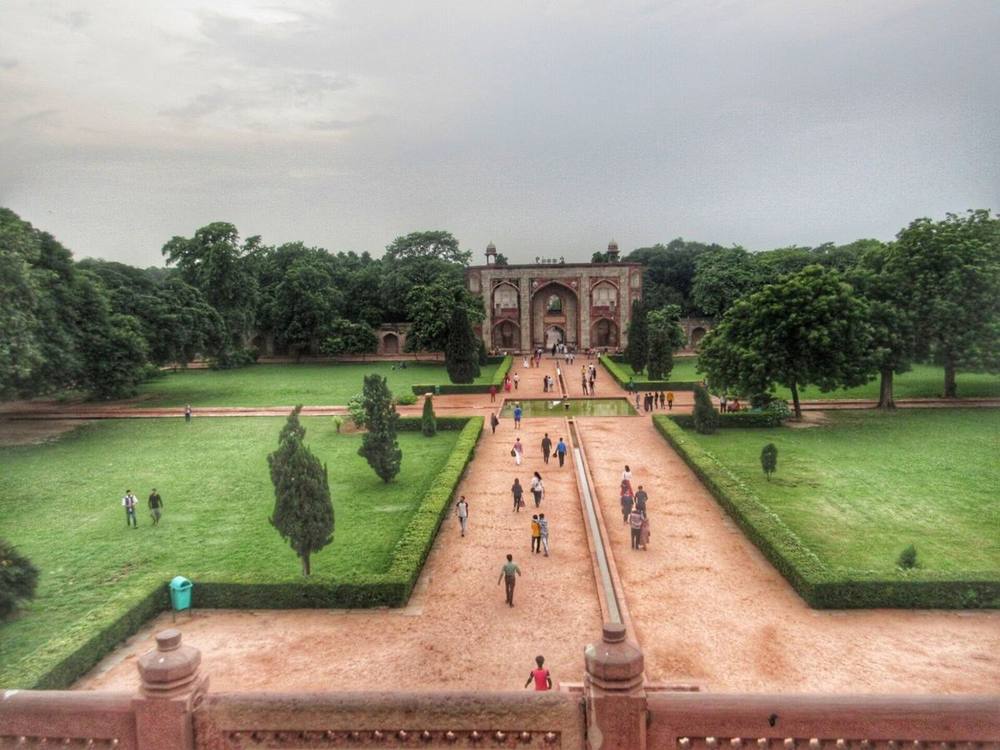
The tomb of the second Mughal emperor Humayun was built in the 1560s under the patronage of his son Akbar (UNESCO); AKTC's brief says it was built over nearly a decade beginning around 1565 (AH 973). UNESCO's short description gives 1570. The walled char bagh, divided into quarters by raised causeways with channels and pools, is described by UNESCO as the first garden-tomb on the Indian subcontinent.14
- 1570s–1857
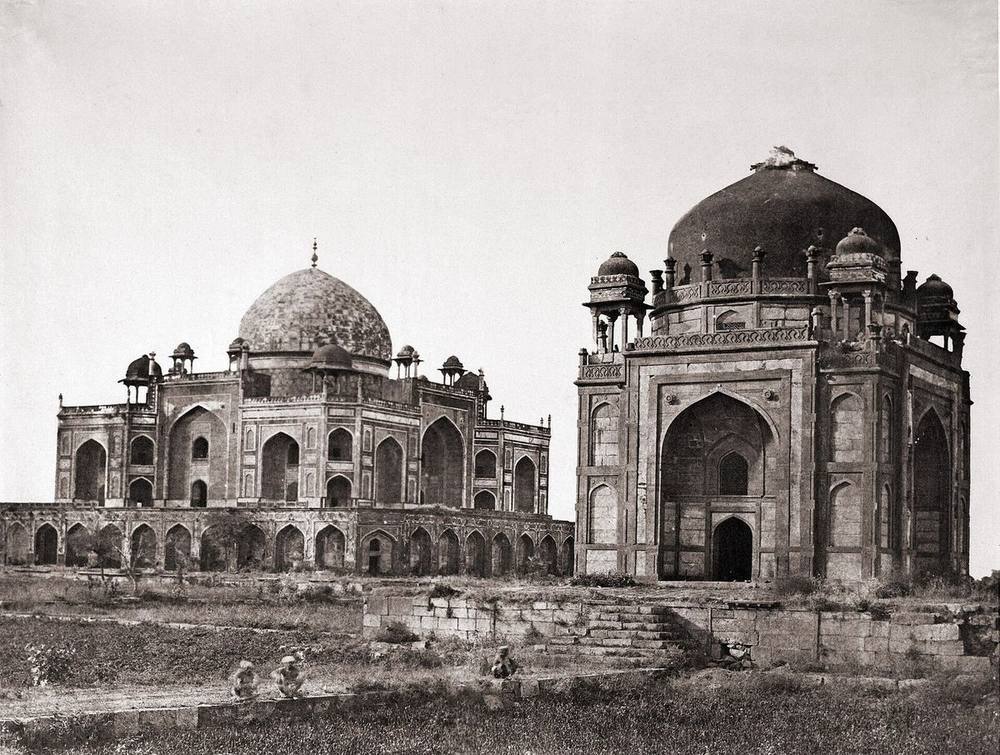
The tomb was a Mughal dynastic burial place and pilgrimage site: Akbar made nine recorded visits, later emperors continued the visits, and over 150 Mughal family members are buried in its cells. The last Mughal ruler, Bahadur Shah Zafar, took refuge here when facing arrest by British forces.31
- 1903–1917
Archival research for the 2000s restoration found a detailed record of significant work done in the garden in 1903–11; pathways have been surfaced with brick aggregate and rolled since the 1903 intervention, and sandstone benches of a design first procured in 1917 were later reproduced.4
- 1993
Humayun's Tomb was inscribed on the World Heritage List under criteria (ii) and (iv); AKTC states the ICOMOS recommendation at inscription was that the gardens should be restored.12
- 1997–2004
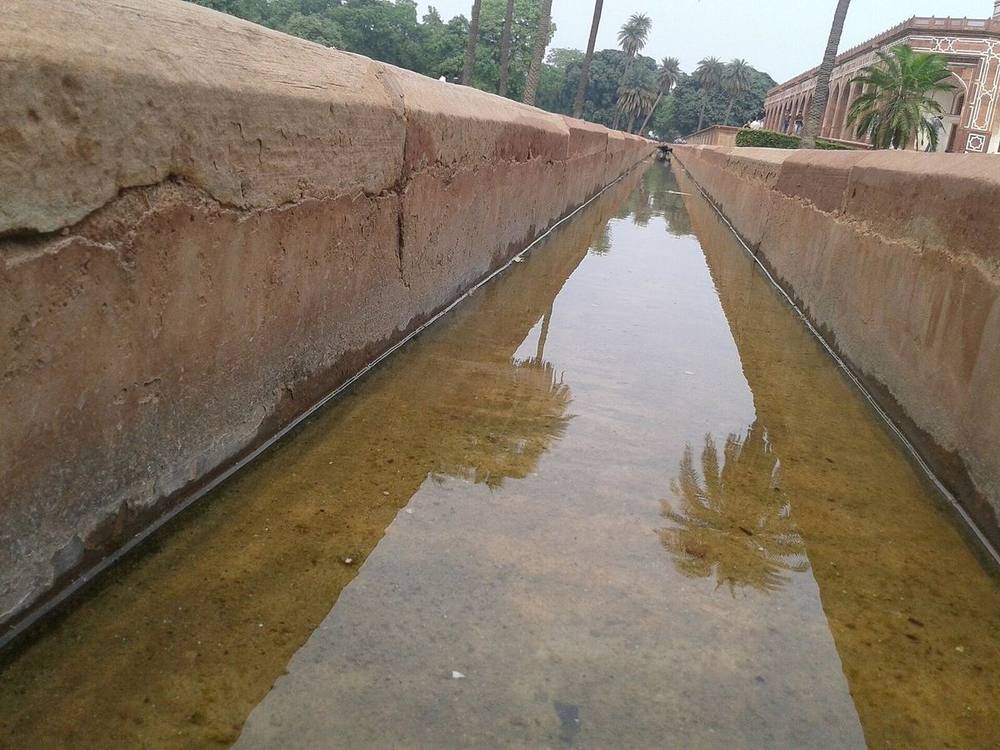
The Aga Khan Trust for Culture, with the Archaeological Survey of India under the aegis of the National Culture Fund, restored the char bagh: excavation and archival research, removal of about 12,000 cubic metres of earth, resetting edging stones, rebuilding channels and fountains so water flows again, rainwater harvesting with recharge pits and de-silted wells, and replanting with species named in Mughal sources. Site work began in 2000 and was completed in March 2003; the restoration was formally marked with the Prime Minister of India on 27 November 2004.24
- 2007–2013 and later
AKTC began conservation of the mausoleum and attached structures in 2007 with ASI, removing 20th-century cement and concrete repairs and using lime mortar and traditional craft methods; an ASI core committee reviewed the works. An interpretation centre at the site entrance followed.31
- 2016
AKTC, through the ASI, proposed extending the World Heritage property to include 16th-century garden-tombs standing in Sundar Nursery and a buffer zone; the UNESCO record now gives the property as 232bis with an area of 27.04 ha.51



Approvals and legal steps
- 1958 (Act) The site is managed by the Archaeological Survey of India and protected under the Ancient Monuments and Archaeological Sites and Remains Act 1958 and Rules 1959, as amended in 2010, among other laws listed by UNESCO. The date it was first declared a protected monument is not given in the sources read.1
- 1993 Inscription on the UNESCO World Heritage List, criteria (ii) and (iv).1
- 1997–2003 The garden restoration was carried out under an agreement between AKTC and the ASI under the aegis of the National Culture Fund; AKTC quotes the agreement as making the ASI responsible for compliance with regulations and heritage norms for protected monuments.43
- 2016 Boundary extension and buffer zone proposed to UNESCO through the ASI (AKTC account). The UNESCO decision itself (reported as 40 COM 8B.39) could not be opened from this environment.51
Funding
- 1560s AKTC's programme brief gives an estimated construction cost of 15 lakhs (1.5 million rupees), presented as an estimate; UNESCO attributes patronage to Akbar.41
- 1997–2003 AKTC states the garden restoration was a gift of the Aga Khan for the 50th anniversary of India's independence and the first privately funded restoration of a World Heritage Site in India; the April 2003 brief describes it as a US$ 650,000 restoration project, with roles for the National Culture Fund, the Indo-British Fiftieth Anniversary Trust and the Oberoi Group (which supported the illumination).34
- 2007 onward Conservation of the tomb was undertaken by AKTC with co-funding from the Sir Dorabji Tata Trust, in partnership with the ASI. No amount is given in the sources read.3
People
- Akbar Mughal emperor; patron of the tomb according to UNESCO
- Haji Begum Humayun's widow; AKTC brief says construction was 'probably overseen' by her
- Mirak Mirza Ghiyas Architect, a Persian from Herat, per AKTC brief
- Aga Khan Trust for Culture (AKTC) Funded and implemented the 1997–2003 garden restoration and the conservation programme from 2007
- Archaeological Survey of India (ASI) Site manager and statutory authority; partner in restoration
- National Culture Fund Framework under whose aegis the restoration was carried out
- Indo-British Fiftieth Anniversary Trust Party to the garden restoration (AKTC brief)
- Oberoi Group Supported the illumination system
- Sir Dorabji Tata Trust Co-funder of tomb conservation from 2007
Sources for this page
- UNESCO World Heritage Centre (UNESCO open data portal), World Heritage List open dataset (whc001), records 232 and 425
- Aga Khan Trust for Culture, Nizamuddin Urban Renewal Initiative, Humayun's Tomb: Garden Restoration
- Aga Khan Trust for Culture, Nizamuddin Urban Renewal Initiative, Humayun's Tomb (conservation)
- Aga Khan Trust for Culture, Historic Cities Support Programme, The Revitalisation of the Gardens of Emperor Humayun's Tomb, Delhi, India: Programme Brief (April 2003)
- Aga Khan Trust for Culture, Nizamuddin Urban Renewal Initiative, Extension to World Heritage Site
- Wikidata, Humayun's Tomb (Q189648)
Researched on 2026-11-19 from the sources listed; a fact that could not be confirmed in a source was left out. Pictures are public domain or under an open licence, credited as their file page asks.
The question it brings · interpretation
When a garden's geometry is carried by its water channels and path levels, what should a restoration recover first: the flowing water, the grades, or the planting?
Each question is Field Method’s interpretation, not a claim made by the source.
The date
Construction. The short description in UNESCO's World Heritage record says built in 1570; the same record's justification text says the 1560s. Wikipedia (secondary, citing the Archaeological Survey of India) gives 1565 to 1572. The year is shown as approximate.
Checked against
- UNESCO World Heritage Centre (UNESCO open data portal), World Heritage List open dataset (whc001), record 232: Humayun's Tomb, Delhi
- Aga Khan Trust for Culture, Nizamuddin Urban Renewal Initiative, Humayun's Tomb: Garden Restoration
- Aga Khan Trust for Culture, Nizamuddin Urban Renewal Initiative, Humayun's Tomb conservation
- Wikipedia (secondary source), Humayun's Tomb