1653
Taj Mahal garden (charbagh) and Mehtab Bagh
Commissioned by the Mughal emperor Shah Jahan; designed and built by a board of court architects and craftsmen (the official site credits Ustad Isa, among others; attribution is uncertain) · Agra, India
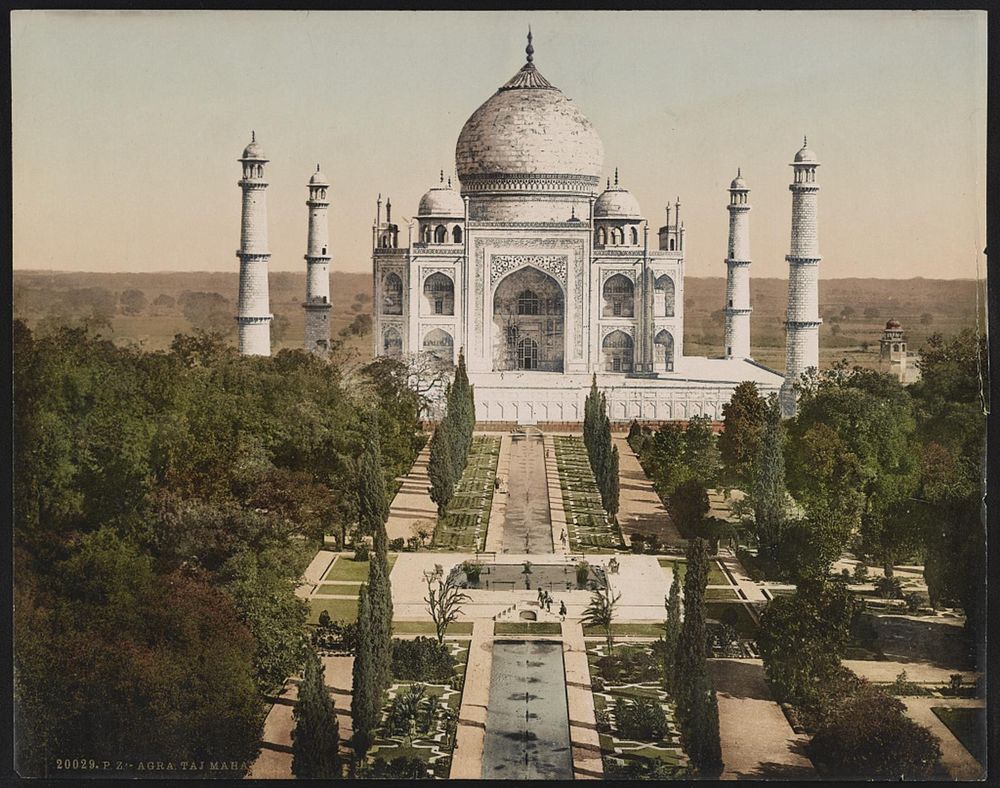
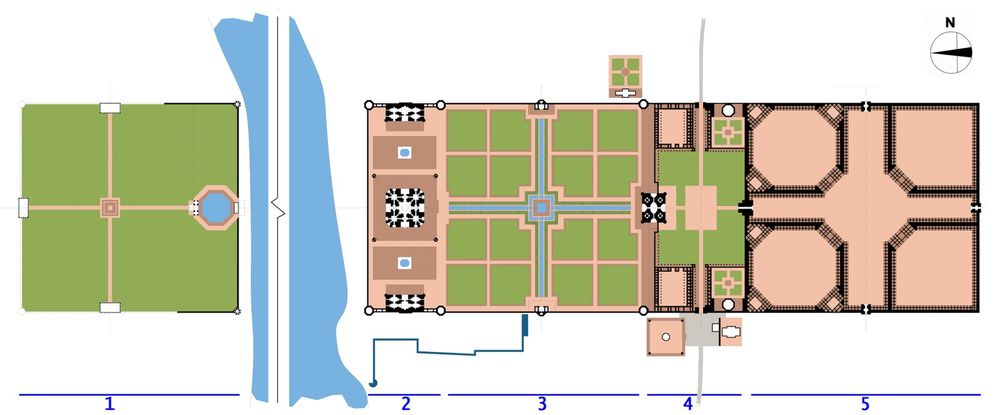
The Taj Mahal sets its tomb at the river edge of a walled four-part garden. Excavations of the Mehtab Bagh across the Yamuna from 1993 showed a matching garden aligned with it, placing the river inside one designed landscape.
How it came about and changed
- 1631–1632
After the death of Mumtaz Mahal in 1631, Shah Jahan began the tomb complex on the south bank of the Yamuna at Agra, where riverfront havelis were being turned into garden tombs; the official site says choosing the site took nearly six months and that work began about 1631.32
- c. 1631–1653
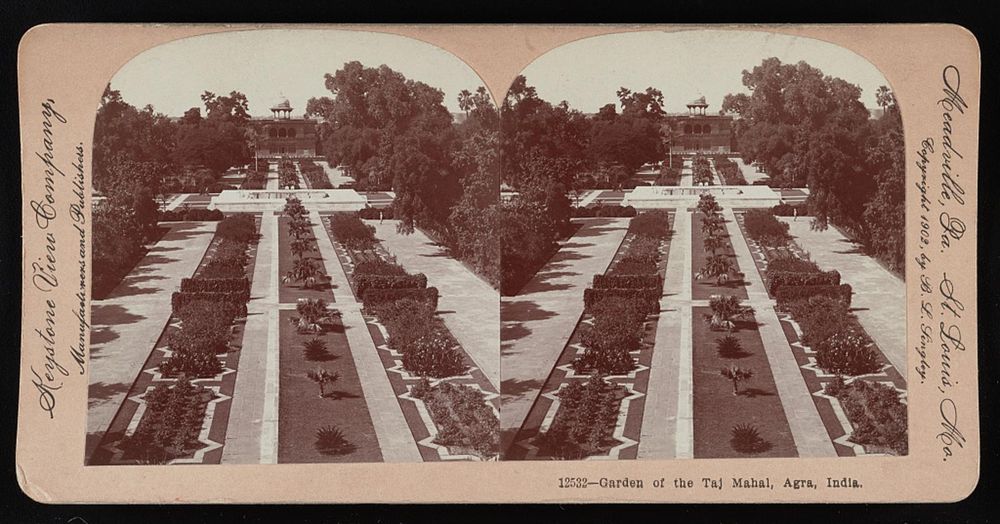
The mausoleum was completed in 1648 and the outlying buildings and gardens in 1653, according to the official Taj Mahal site, using a labour force of about 20,000; Moynihan gives 1643 for the Taj's completion. The garden was laid out as a cross-axial chahar bagh with a raised central marble tank, the mausoleum set at its river edge on a terrace, and water lifted from the Yamuna and carried by an aqueduct and pipes to fountains and channels.215
- by 1652
Across the river, Shah Jahan's Mahtab Bagh (Moonlight Garden), with an octagonal pool and pavilion on its riverfront terrace, was laid out on the Taj axis to view the tomb. In a letter dated December 1652 Prince Aurangzeb reported that the garden had been completely flooded, while the octagonal pool and pavilion were in good condition.5
- 17th–19th centuries
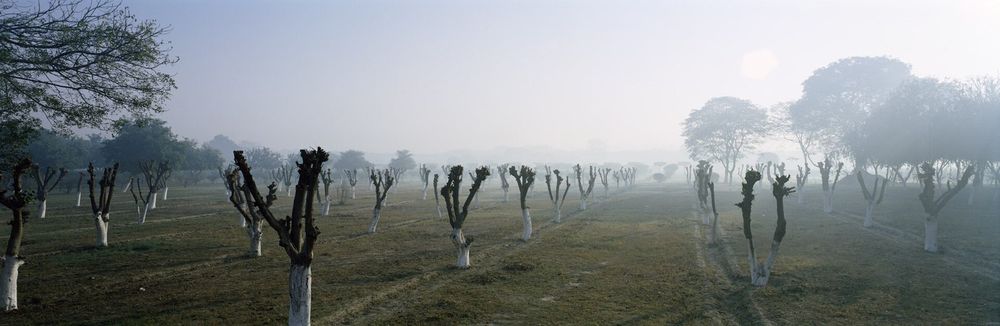
The Mahtab Bagh appears to have been largely abandoned after flooding, perhaps as early as the 17th century, and was later used as a camping ground in the British period; its octagonal pool was buried under two to three metres of silt. Parts of the Taj buildings decayed and were damaged around 1857; the first recorded repair of the garden fountains was in 1867.531
- c. 1900–1910
Lord Curzon ordered a large restoration completed in 1908; the official site says the garden was remodelled at this time with British-style lawns still in place today. Marble benches were added around the central tank in 1907–08, some earthenware pipes were replaced with cast iron in 1903, and a drinking fountain was added in 1909–10.31
- 1983–1999
The Taj Mahal was inscribed as a UNESCO World Heritage Site in 1983. The ASI's Agra Circle excavated the Mahtab Bagh in 1993–94 (octagonal tank) and 1995–96 (adjacent pavilions); a Sackler Gallery–ASI project directed by Elizabeth Moynihan documented the site from October 1996, including archaeobotanical work, and in 1998–99 the ASI Horticulture Department planted about seven thousand saplings in the Mahtab Bagh in line with the Supreme Court's greenbelt ruling.45
- Present
The Archaeological Survey of India's Horticulture Department maintains the gardens and uses the old aqueduct area as offices and a nursery; part of the water supply still uses the old aqueduct tanks, now filled from wells by electric pumps.1


Approvals and legal steps
- 1983 Inscription of the Taj Mahal on the UNESCO World Heritage List (stated on the official Uttar Pradesh Taj Mahal site; the UNESCO page could not be opened).4
- 1996 Supreme Court of India, M.C. Mehta v. Union of India (judgment of 30 December 1996, Kuldip Singh and Faizan Uddin JJ.) on air pollution in the Taj Trapezium Zone (TTZ): it ordered the 292 listed industries to switch from coke/coal to natural gas or relocate outside the TTZ, and records that a green belt recommended by NEERI had been set up around the Taj under the Court's monitoring. Moynihan records that the ASI planted the Mahtab Bagh in 1998–99 in keeping with the Court's greenbelt ruling.65
Funding
- 1631–1653 The complex was commissioned by Emperor Shah Jahan; the official site attributes it to the wealth of the Mughal treasury of the period but gives no amount.2
- 1996–2000 The Mahtab Bagh documentation was sponsored by the Arthur M. Sackler Gallery (Smithsonian) in cooperation with the ASI; a team member was trained on a grant from the Indo-U.S. Subcommission on Education and Culture.5
People
- Shah Jahan Mughal emperor; patron who commissioned the Taj complex and the Mahtab Bagh
- Mumtaz Mahal Empress for whom the tomb was built
- Ustad Isha Khan Named as chief architect on the official site's history page; its creation-history page credits a board of architects including Ustad Isa (attribution uncertain)
- Muhammad Hanif; Mir Abdul Karim; Mukkarimat Khan Supervisor of masons; managers of finance and daily production (official site)
- Prince Aurangzeb Inspected the Taj and reported flood damage to the Mahtab Bagh, December 1652
- Lord Curzon Viceroy who ordered the restoration completed in 1908
- Colonel Rowlatt Undertook the first recorded repair of the fountains, 1867
- Archaeological Survey of India (Agra Circle; Horticulture Department) Excavation of the Mehtab Bagh (1993–96) and management of the gardens
- P. B. S. Sengar ASI superintending archaeologist who directed the original Mahtab Bagh excavations (1994–95)
- Elizabeth B. Moynihan Devised and directed the Sackler–ASI Mahtab Bagh project; editor of The Moonlight Garden (2000)
- James L. Wescoat Jr.; David L. Lentz Waterworks/landscape and archaeobotany researchers on the Sackler–ASI project
- Ebba Koch Architectural historian whose riverfront-garden interpretation and measurements are cited by the official site
Sources for this page
- Department of Tourism, Government of Uttar Pradesh, Taj Garden
- Department of Tourism, Government of Uttar Pradesh, Creation History of Taj Mahal
- Department of Tourism, Government of Uttar Pradesh, History of the Taj Mahal
- Department of Tourism, Government of Uttar Pradesh, Overview
- Arthur M. Sackler Gallery, Smithsonian Institution / University of Washington Press (PDF via Smithsonian National Museum of Asian Art archive), The Moonlight Garden: New Discoveries at the Taj Mahal, ed. Elizabeth B. Moynihan (2000)
- Supreme Court of India, M.C. Mehta v. Union of India & Ors., judgment of 30 December 1996
- Wikidata, Taj Mahal (Q9141)
- Wikidata, Mehtab Bagh (Q12061618)
Researched on 2026-11-19 from the sources listed; a fact that could not be confirmed in a source was left out. Pictures are public domain or under an open licence, credited as their file page asks.
The question it brings · interpretation
When a river runs through the middle of a composition rather than past it, how do you design both banks, and the flood regime between them, as one landscape?
Each question is Field Method’s interpretation, not a claim made by the source.
The date
1653: completion of the outlying buildings and gardens of the Taj complex according to the Government of Uttar Pradesh's official Taj Mahal site (construction began about 1631, mausoleum completed 1648). Moynihan (Sackler Gallery, 2000) gives 1643 for the completion of the Taj and cites Aurangzeb's letter of December 1652 describing the flooded Mahtab Bagh, so the Moonlight Garden existed by 1652. Other dates: Curzon restoration completed 1908; UNESCO inscription 1983; ASI excavations of the Mahtab Bagh 1993–96; Supreme Court Taj Trapezium judgment 30 December 1996.
Checked against
- Department of Tourism, Government of Uttar Pradesh (official Taj Mahal website), Taj Garden
- Department of Tourism, Government of Uttar Pradesh, Creation History of Taj Mahal
- Arthur M. Sackler Gallery, Smithsonian Institution, with University of Washington Press, The Moonlight Garden: New Discoveries at the Taj Mahal (ed. Elizabeth B. Moynihan, 2000)