1920
Skogskyrkogården (Woodland Cemetery)
Gunnar Asplund and Sigurd Lewerentz (competition 1915, landscape and buildings); client: City of Stockholm · Stockholm, Sweden
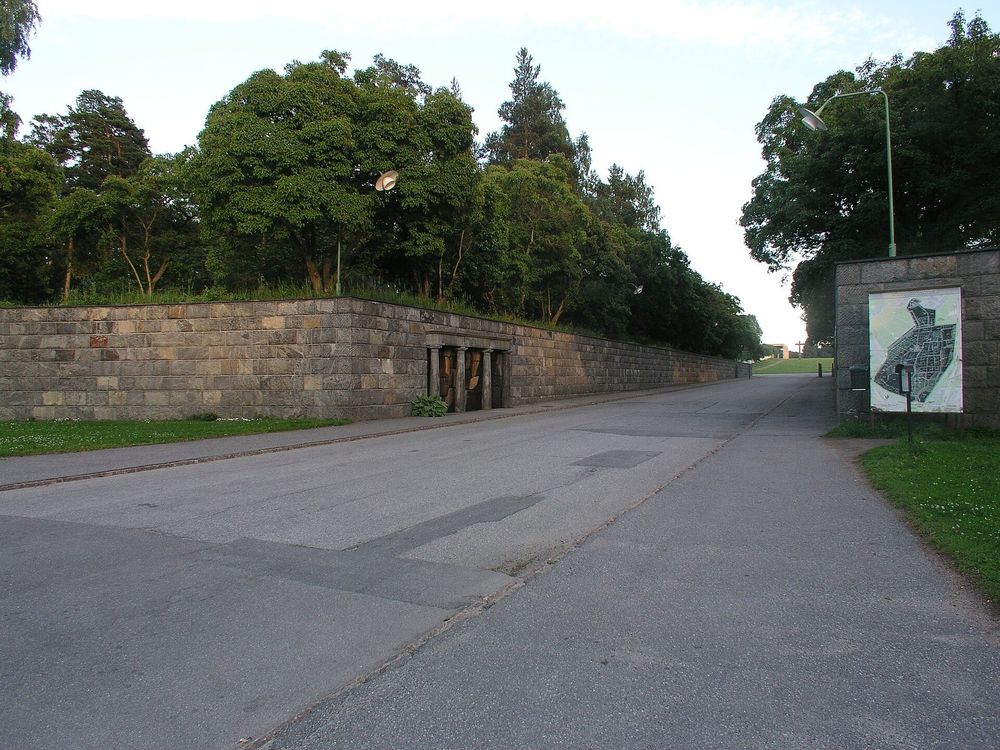
Gunnar Asplund and Sigurd Lewerentz won Stockholm's 1914–15 competition and laid out this cemetery mainly from 1917 to 1940, keeping the pine forest and terrain and making graves equal. It was inscribed as World Heritage in 1994.
How it came about and changed
- 1895–1912
The City of Stockholm, one of only two Swedish municipalities responsible for cemeteries, completed Södra begravningsplatsen in 1895; with rapid population growth it decided in 1912 to expand it and acquired 85 hectares.12
- 1914–1916
In autumn 1914 the city announced an international design competition whose brief called for a dignified, artistic site without large monuments, equal-sized graves, and preservation of the forest and natural surroundings as far as possible. Gunnar Asplund and Sigurd Lewerentz won in 1915 with 'Tallum'; the plans were adapted in 1916 and, because of the economic difficulties of the 1910s, revised and simplified several times.1211
- 1917–1925
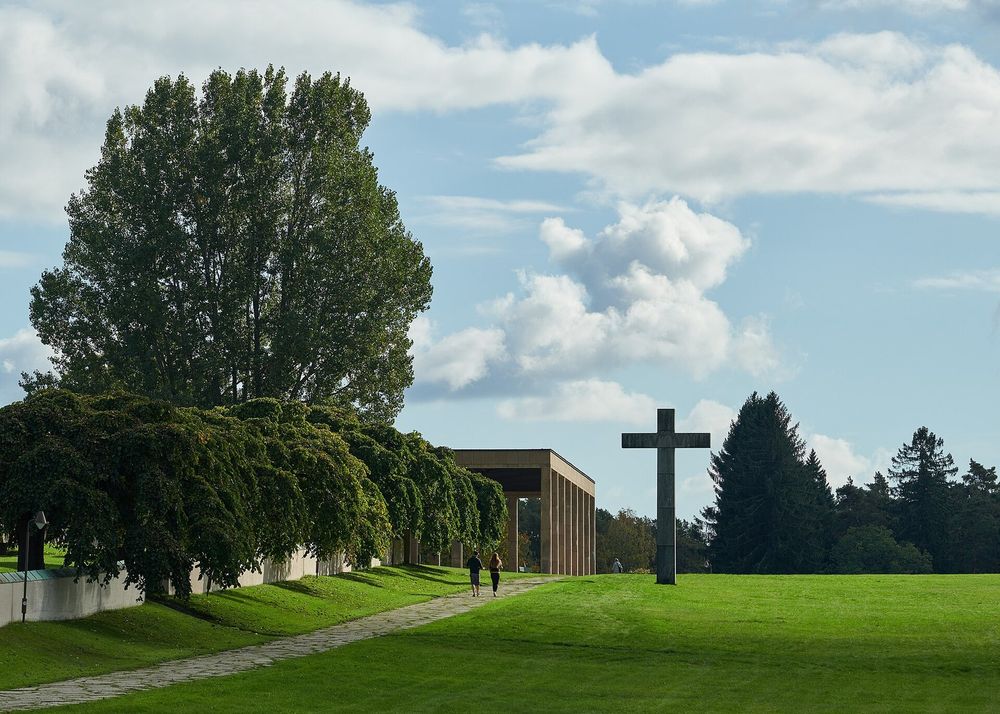
Landscaping and a small chapel began in 1917 on land of old pine forest and gravel pits. The new South Cemetery was inaugurated in 1920 with Asplund's Woodland Chapel and renamed Skogskyrkogården in 1921; the Tallum Pavilion service building (now Visitor Center) followed in 1923 and Lewerentz's Chapel of Resurrection in 1925.1211
- 1923–1935
The perimeter stone wall designed by Lewerentz was built by hand between 1923 and 1932 as a public works project for the unemployed. Lewerentz's open entrance landscape and the Almhöjden meditation grove with its elms and staircase were completed between 1930 and about 1935.652
- 1936–1940
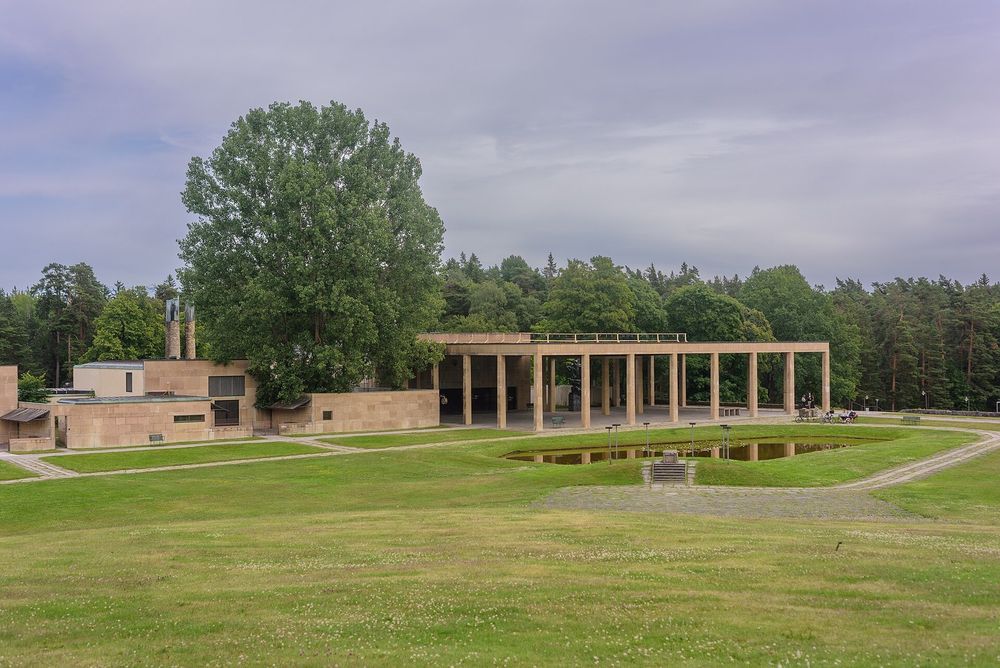
The large Woodland Crematorium with the chapels of Faith, Hope and the Holy Cross and the Monument Hall had been postponed mainly for financial reasons; Lewerentz and Asplund co-designed it until 1936, when the city gave the project to Asplund alone. It was inaugurated in 1940, and Asplund died that October.92
- 1957–1972
Lewerentz returned to design service buildings by the Chapel of Resurrection (1957) and the Memorial Grove for ashes (1961), to which Göran Bergquist and Jan Wahlman later added a pond; the southern section was extended in 1972 by Jan Wahlman, bringing the wall to 4.2 km. In the 1970s the crematorium was renovated under Hans Asplund.2810
- 1994–1995
Inscribed on the UNESCO World Heritage List in 1994 (site no. 558) and awarded the Carlo Scarpa International Prize for Gardens in 1995. The area is also designated a national interest (riksintresse) for cultural heritage conservation.2311
- 2009–2015
A competition in 2009 for a new crematorium was won by Johan Celsing with Müller Illien Landschaftsarchitekten ('A Stone in the Forest'); the building was inaugurated in 2014 and in operation by 2015, its exhaust routed to the old crematorium chimneys.72
- ongoing; 2025–2027
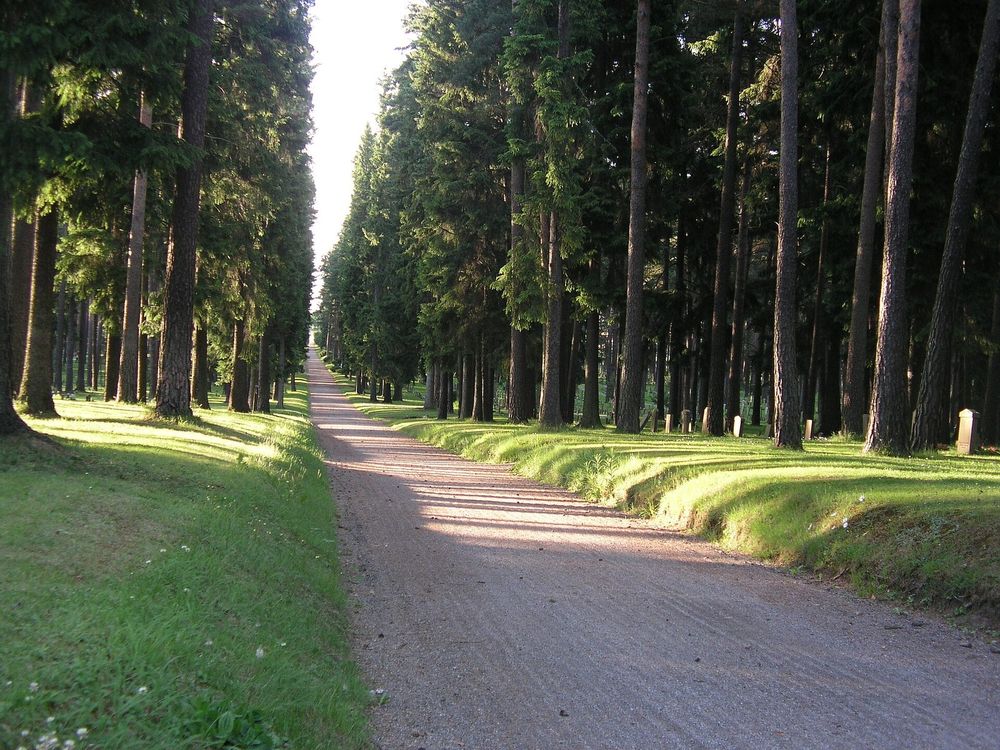
The roughly 9,000 old pines, planted in the 1800s for timber, are maintained tree by tree and replaced with seedlings grown from the healthiest trees. The Woodland Crematorium and its chapels closed for a major renovation by the Cemetery Administration (contractor M3 Bygg), begun in February 2025 and expected to finish in the second half of 2027.4109



Approvals and legal steps
- 1912 City of Stockholm decision to expand Södra begravningsplatsen and acquisition of 85 hectares.12
- 1914–1915 City-run international architectural competition; the jury's choice of 'Tallum' set the design.1
- 1994 Inscription on the UNESCO World Heritage List (no. 558).32
- not stated Designated an area of national interest (riksintresse) for Swedish cultural heritage conservation.11
Funding
- 1912–1940 The City of Stockholm, responsible for cemeteries in the municipality, commissioned and built the cemetery; economic hardship in the 1910s forced repeated simplification, and the crematorium's construction was postponed mainly for financial reasons.19
- 1923–1932 The wall was built as a government-initiated public works (unemployment relief) project, built by hand by unemployed workers of many trades.61
- 2023 Tidningen Sten (2024) reports that in autumn 2023 the City of Stockholm granted nearly 300 million kronor, to be set aside via the burial fee (begravningsavgift), for renovation of the Woodland Crematorium and its three chapels.12
People
- Gunnar Asplund Architect; co-winner of the 1915 competition; Woodland Chapel (1920), Tallum Pavilion (1923), Woodland Crematorium (1940, sole architect from 1936)
- Sigurd Lewerentz Architect; co-winner of the 1915 competition; much of the landscape, Chapel of Resurrection (1925), wall, entrance landscape and Almhöjden (1930–1935), Memorial Grove (1961)
- City of Stockholm (Cemetery Administration, Kyrkogårdsförvaltningen) Client, owner and manager
- Jan Wahlman Architect of the 1972 southern extension; later work at the Memorial Grove with Göran Bergquist
- Göran Bergquist Architect; added the pond at the Memorial Grove
- Hans Asplund Led the 1970s renovation of the Woodland Crematorium
- Johan Celsing with Müller Illien Landschaftsarchitekten Designers of the New Crematorium (competition 2009, inaugurated 2014)
- Sven Erixson, Bror Hjorth, Ivar Johnsson, Carl Milles Artists who contributed artistic decoration to the buildings
- M3 Bygg Contractor for the 2025–2027 crematorium renovation
Sources for this page
- City of Stockholm, The History of Skogskyrkogården
- City of Stockholm, Timeline (outdoor exhibition)
- City of Stockholm, World Heritage Site Skogskyrkogården
- City of Stockholm, The pine trees
- City of Stockholm, Almhöjden
- City of Stockholm, The Wall
- City of Stockholm, The New Crematorium
- City of Stockholm, Memorial grove
- City of Stockholm, The Woodland Crematorium
- City of Stockholm (Stockholm växer), Renovation of the Woodland Crematorium
- Stockholmskällan, City of Stockholm, Skogskyrkogården (Stockholms Spår)
- Tidningen Sten (sten.se), Hanteras varsamt (Projekt Skogskyrkogården), Tidningen Sten no. 2, 2024, by Petter Eklund
- Wikidata, Skogskyrkogården (Q213988)
Researched on 2026-11-19 from the sources listed; a fact that could not be confirmed in a source was left out. Pictures are public domain or under an open licence, credited as their file page asks.
The question it brings · interpretation
How can a commemorative landscape let existing forest and landform, rather than monuments, carry the meaning of the place?
Each question is Field Method’s interpretation, not a claim made by the source.
The date
1920 marks the inauguration of the new South Cemetery with Asplund's Woodland Chapel (City of Stockholm, official Skogskyrkogården history and timeline pages). Other key dates: land acquired 1912; competition 1914–1915 won by Asplund and Lewerentz ('Tallum'); landscape construction from 1917; renamed Skogskyrkogården 1921; Chapel of Resurrection 1925; entrance landscape and Almhöjden 1930–1935; Woodland Crematorium 1940; Memorial Grove 1961; UNESCO World Heritage 1994. The site was laid out mainly 1917–1940 (Stockholmskällan).