15th c.
Dry garden at Ryoan-ji, Kyoto
Designer unknown; attributions are disputed · Kyoto, Japan
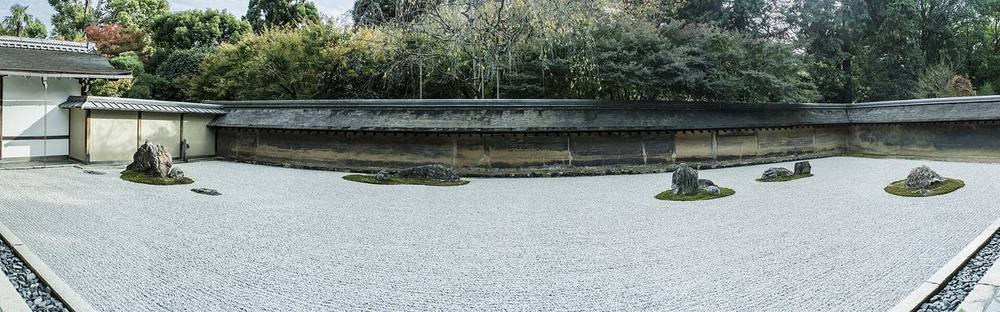
A dry landscape (karesansui) garden of fifteen rocks in five groups set in raked white gravel, on the south side of the abbot's hall. Its designer is unknown and its date is uncertain.
How it came about and changed
- 11th–12th century
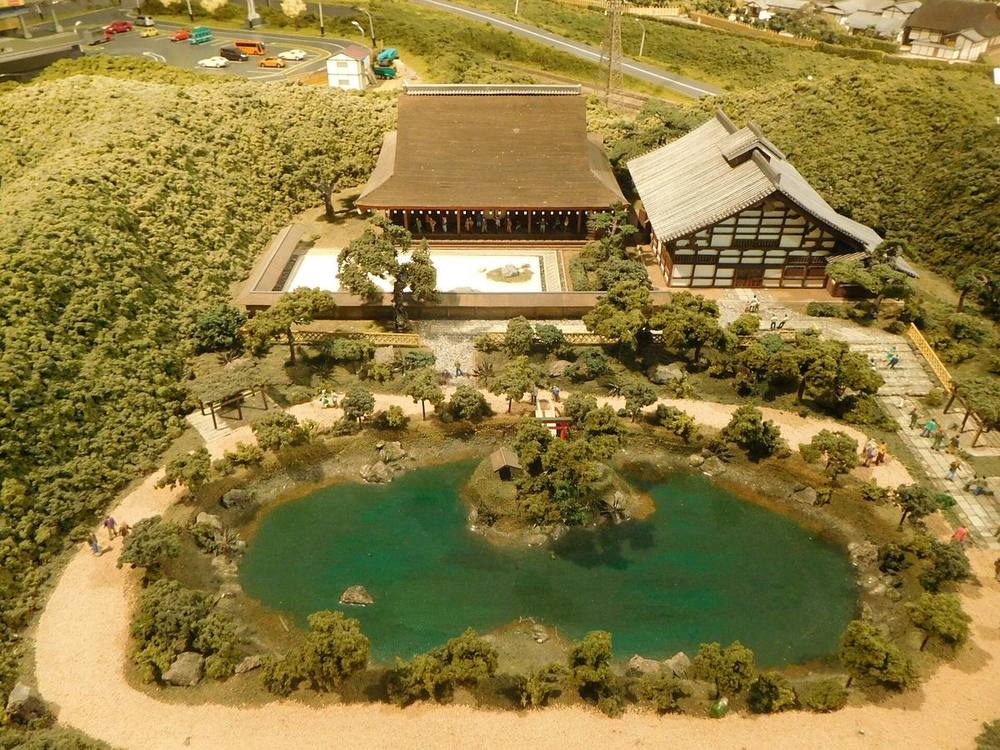
Bowdoin's guide says the site holds a large pond garden (Kyoyochi), a remnant of a Fujiwara estate of the eleventh or twelfth century. The nomination dossier says Ryoan-ji was established on the site of an aristocrat's villa, and that the pond-centred Ryoan-ji Teien is a remnant of that villa period.74
- 1450
The villa was converted into a Zen (Rinzai) temple. Bowdoin names Hosokawa Katsumoto as the man who acquired the property in 1450 and built the temple, possibly reconstructing an older one.17
- 1467–1488
Katsumoto's temple burned in the Onin War (1467–77). In 1488 the hojo (abbot's quarters) was restored and other buildings were repaired; Bowdoin says the rebuilding was by Katsumoto's son Masamoto, and that the dry garden may have been made then.173
- mid-15th century to c. 1500 (disputed)
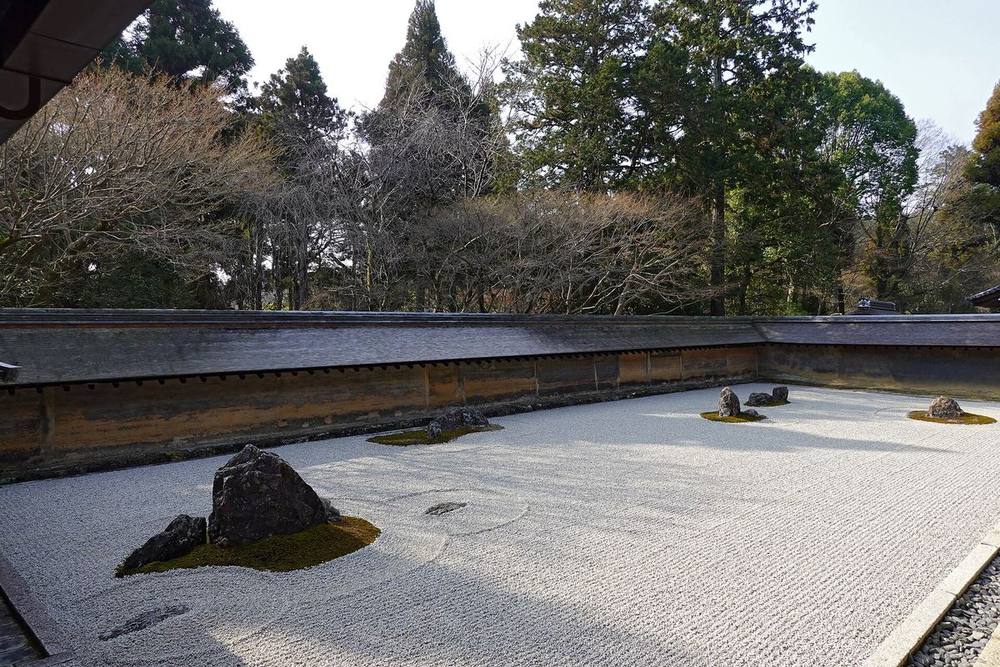
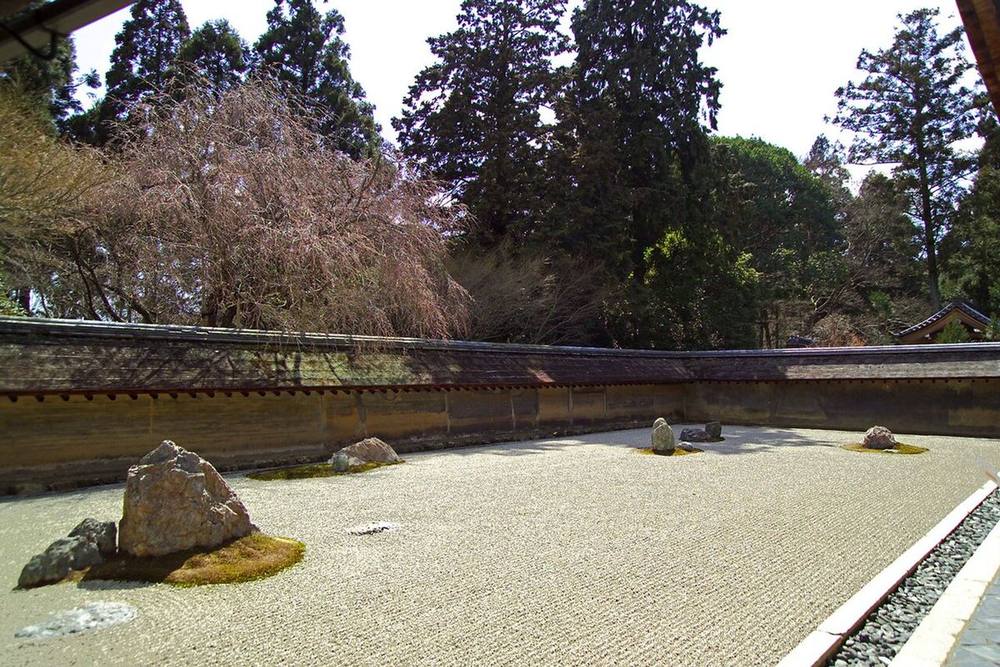
The rock garden south of the hojo is officially described as thought to date from the mid-15th century: about 250 m² of white gravel with 15 rocks in five groups, enclosed by earthen walls on three sides. Its date and designer are uncertain (see notes).1437
- 1797
Fire destroyed the temple buildings. The hojo of the sub-temple Seigen-in, built in 1606, was moved to Ryoan-ji and is the present hojo (main hall).14
- late 18th–early 19th century
Bowdoin's guide states that, although the garden was probably created in the fifteenth century, its current form may date only to the late eighteenth or early nineteenth century.7
- 1924 and 1955
The national inventory in the World Heritage nomination dates the designation of the hojo garden (now a Special Place of Scenic Beauty) to 9 December 1924, and the designation of the pond garden (Ryoan-ji Teien) as a Place of Scenic Beauty to 3 February 1955. The hojo was designated an Important Cultural Property on 15 June 1967.5
- 1976–1977
Heavy rain in 1976 brought down part of the earthen wall. In 1977 excavation and repair followed, and the wall's roof was changed from tile back to wooden shingle (kokera) as a restoration.4
- 1994–present
In December 1994 Ryoan-ji was inscribed with 16 other properties as Historic Monuments of Ancient Kyoto. The temple, as owner, manages the site day to day. National and local agencies oversee it, led by the Agency for Cultural Affairs.23



Approvals and legal steps
- 1924 (9 December) National designation of the Ryoan-ji hojo garden, now listed as a Special Place of Scenic Beauty and also a Historic Site. The date is from the national inventory in the 1994 nomination; the law in force in 1924 and the date of the upgrade to 'Special' status were not confirmed.563
- 1950 Gardens and sites in the World Heritage nomination are protected under the Law for the Protection of Cultural Properties 1950. Under that law the owners must manage, repair and open the property, alterations need national government approval, and the state subsidises repair.3
- 1955 (3 February) The pond garden (Ryoan-ji Teien, around Kyoyochi) was designated a Place of Scenic Beauty.5
- 1967 (15 June) The hojo (main hall, 1606) and its entrance were designated Important Cultural Properties.5
- 1994 (December) Inscription on the World Heritage List as part of Historic Monuments of Ancient Kyoto (Kyoto, Uji and Otsu Cities), at the 18th session of the World Heritage Committee in Thailand. ICOMOS recommended inscription under criteria ii and iv.23
Funding
- 1950–present Under the 1950 Law for the Protection of Cultural Properties, the national government subsidises the cost of repairing and managing designated properties and provides technical guidance. ICOMOS states this for the nominated Kyoto properties generally; no amounts are given.3
People
- Hosokawa Katsumoto Acquired the property in 1450 and founded the Zen temple (Bowdoin)
- Hosokawa Masamoto Rebuilt the temple in 1488 after the Onin War (Bowdoin)
- Kotaro and Seijiro Kyoto garden workers (kawaramono) whose names are inscribed on one rock; proposed but unconfirmed as makers of the garden (Bowdoin)
- Soami Painter traditionally proposed as designer; attribution speculative (Bowdoin)
- Ryoan-ji (Rinzai Zen temple, Myoshin-ji branch) Owner and day-to-day manager
- Agency for Cultural Affairs (Bunka-cho) Lead national agency for conservation and management
Sources for this page
- City of Kyoto, Preservation of Cultural Properties Section, World Heritage Historic Monuments of Ancient Kyoto: O. Ryoan-ji
- City of Kyoto, World Heritage (overview of Historic Monuments of Ancient Kyoto)
- ICOMOS / UNESCO World Heritage Centre, Advisory Body Evaluation: Historic Monuments of Ancient Kyoto (No. 688)
- Agency for Cultural Affairs, Japan (Bunka Isan Online), World Heritage nomination of Historic Monuments of Ancient Kyoto: 3(b) description, O Ryoan-ji (in Japanese)
- Agency for Cultural Affairs, Japan (Bunka Isan Online), World Heritage nomination: Appendix 6a-O, inventory of buildings and gardens designated by the national government (in Japanese)
- Agency for Cultural Affairs, Japan (Bunka Isan Online), World Heritage nomination: 2(b) legal protection, Table 3 (in Japanese)
- Bowdoin College, The Japanese Garden: Ryoan-ji
- Wikidata, Ryōan-ji (Q587371)
- City of Kyoto, 龍安寺周辺エリア (Ryoan-ji area landscape guide, in Japanese)
Researched on 2026-11-19 from the sources listed; a fact that could not be confirmed in a source was left out. Pictures are public domain or under an open licence, credited as their file page asks.
The question it brings · interpretation
If a garden of fifteen rocks and gravel carries no known author and no agreed meaning, how much of your own design could be removed before it stopped working?
Each question is Field Method’s interpretation, not a claim made by the source.
The date
No exact year is established. 1475 is a nominal year for ordering only. The City of Kyoto says the garden is thought to date from the mid-15th century (temple founded 1450); Bowdoin College says probably 15th century, possibly made when the temple was rebuilt in 1488, and notes the present form may be as late as the late 18th or early 19th century.