date disputed (2,000 years per UNESCO; about 1650 per recent archaeology)
Rice Terraces of the Philippine Cordilleras
Ifugao people · Ifugao, Cordillera mountain range, northern Luzon, Philippines
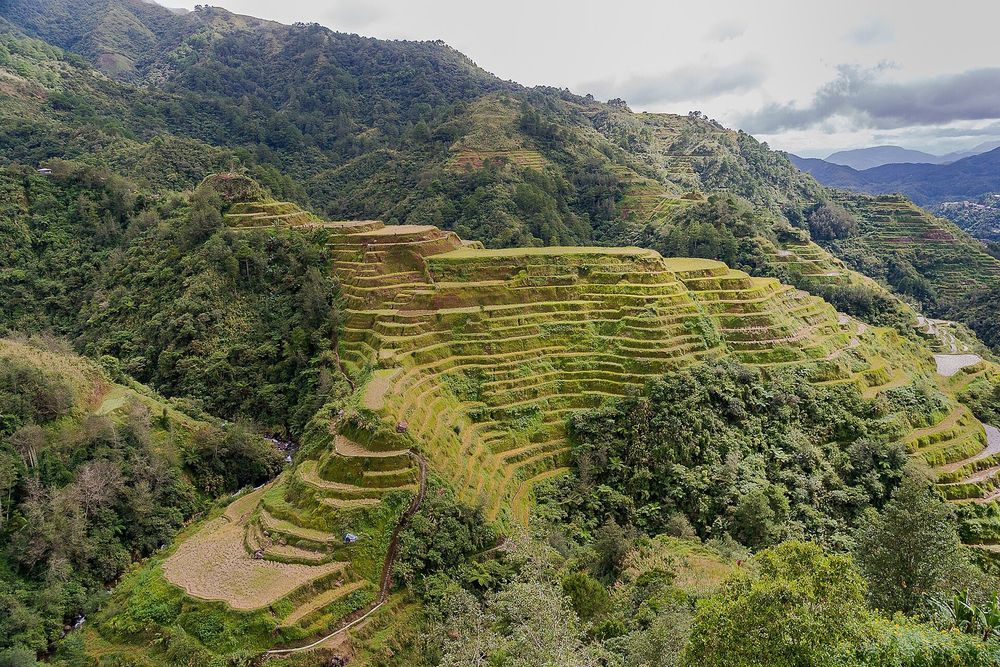
Stone- and mud-walled pond fields cut along steep mountain contours, irrigated with water harvested from forested mountain tops and kept working by cooperative community labour and ritual; UNESCO gives their age as two millennia, which recent archaeology disputes.
How it came about and changed
- uncertain (pre-Hispanic to c. 1600s)
Philippine textbooks and UNESCO have described the terraces as about 2,000 years old, an estimate going back to early-twentieth-century anthropologists Roy Franklin Barton and H. Otley Beyer, who reckoned it from how long construction might have taken. Archaeological work by the Ifugao Archaeological Project in the Kiangan area found the earliest rice remains in terrace sediments about 675 years old, a marked increase only around 470–530 years ago, and clear wet-rice evidence from about 1650; the authors argue that the large-scale wet-rice terraces developed as a local response to Spanish conquest, while smaller earlier terraces likely grew taro.32
- 2017–2019
The late-origin interpretation is contested: in September 2017 the Archaeology Division of the National Museum issued a statement signed by eight researchers disagreeing that the terraces are as young as claimed and calling for region-wide research, since the excavations focused on Kiangan. The peer-reviewed synthesis was published in the Journal of Field Archaeology in 2019.32
- ongoing (traditional system)
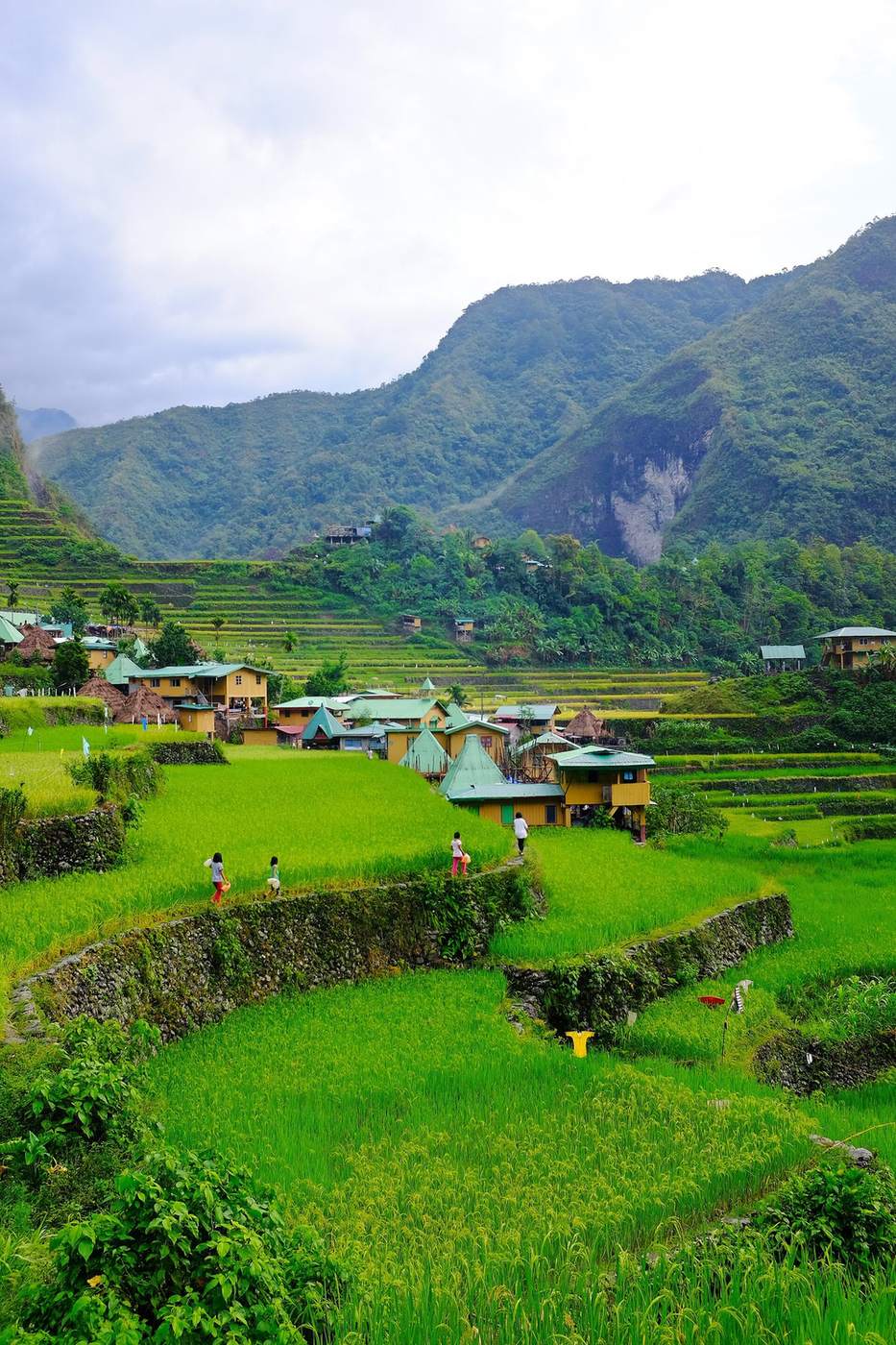
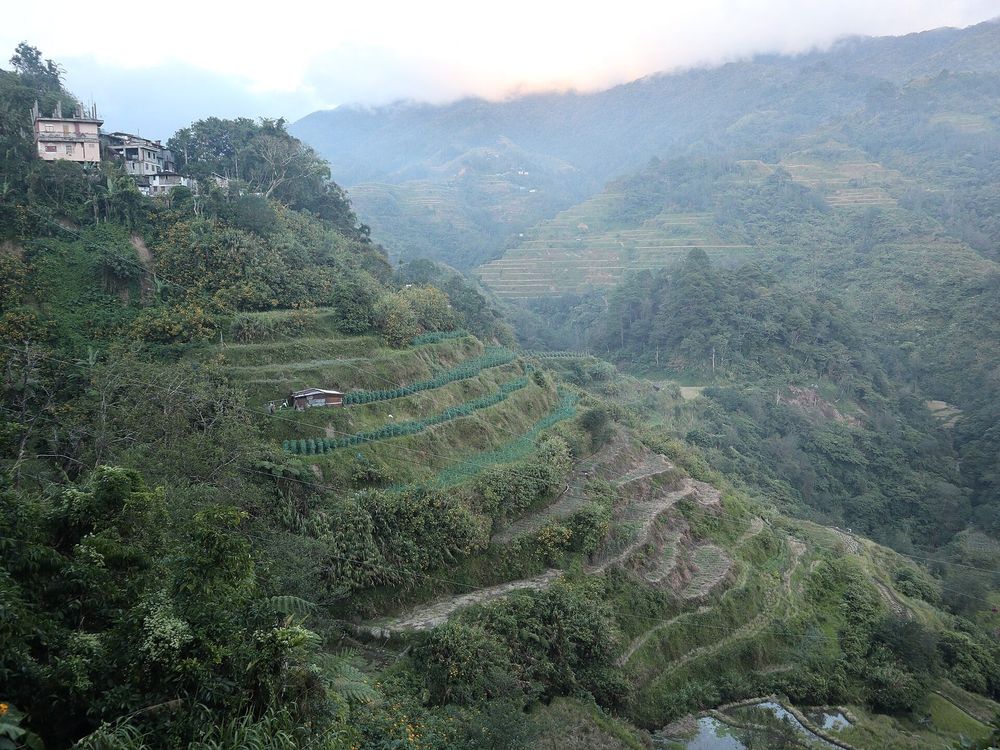
The terraces are a living agricultural landscape maintained by Ifugao communities through family inheritance and customary law; FAO describes a landscape organised in five components: woodlots and communal forests, swidden farms, rice terraces, settlements, and water bodies and irrigation systems.64
- 1973–1978
Presidential Decree 260 (1 August 1973) declared the Ifugao Rice Terraces of Banaue a National Cultural Treasure under the supervision of the National Museum with the Department of Tourism; a second decree, PD 1505 (1978), is also cited as declaring the terraces National Cultural Treasures.54
- 1995
Five terrace clusters in four Ifugao municipalities were inscribed on the UNESCO World Heritage List as the Rice Terraces of the Philippine Cordilleras, and an agency was created to oversee them, renamed over successive administrations (Ifugao Terraces Commission, Banaue Rice Terraces Task Force, IRT Cultural and Heritage Office) before the provincial government settled on the Ifugao Cultural Heritage Office (ICHO).43
- 2001–2012
The World Heritage Committee placed the property on the List of World Heritage in Danger in 2001; after coordinated efforts by stakeholders it was removed from that list in 2012.4
- 2004–2011
The Ifugao Rice Terraces were one of the pilot systems of FAO's Globally Important Agricultural Heritage Systems (GIAHS) project and are listed by FAO as designated in 2011.64
- 2009–present
The terraces are protected under the National Cultural Heritage Act (Republic Act 10066 of 2009). ICHO administers the IRT Master Plan 2015–2024; the Ifugao State University's GIAHS Research and Development Center, with Kanazawa University and JICA support, runs research and training, and the NGO Save the Ifugao Terraces Movement (SITMo) works with archaeologists on education. Drivers of change named in the literature include education, tourism and changing ways of life.43


Approvals and legal steps
- 1973 Presidential Decree No. 260 (1 August 1973), issued by Ferdinand E. Marcos, declared the Ifugao Rice Terraces of Banaue (with other sites) National Cultural Treasures under R.A. 4846, with preservation under the National Museum in collaboration with the Department of Tourism.5
- 1978 Presidential Decree No. 1505 (1978), cited as a second declaration of the terraces as National Cultural Treasures (text not opened).4
- 1995 Inscription on the UNESCO World Heritage List (no. 722).34
- 2001 Placed on the List of World Heritage in Danger.4
- 2009 Protection under Republic Act No. 10066, the National Cultural Heritage Act of 2009.4
- 2011 Designated a Globally Important Agricultural Heritage System by FAO.6
- 2012 Removed from the List of World Heritage in Danger.4
Funding
- 1973 PD 260 authorised appropriations of P500,000 for the National Museum and P500,000 for the National Historical Commission from the National Treasury to carry out the decree (covering all the sites it named, not the terraces alone), with later funds to come from the annual budget.5
- c. 2020 The provincial government uses a Rice Terraces Conservation Fund drawn from the revenue of the 200 kW Ambangal mini-hydroelectric plant in Kiangan for irrigation development and cultural interventions; municipal governments and national agencies (National Irrigation Authority, Department of Agriculture, DENR) also allocate funds for terrace conservation.4
- c. 2020 Companies including Universal Harvester Inc., Carmeldre, Toshiba Corporation, Mitsui & Co. and Black Pencil have provided money for rehabilitation; JICA supports a Forestland Management Project and the Ifugao Satoyama Meister Training Program; Italy (Muyong Project), Taiwan and the Netherlands (Netherlands Funds-in-Trust) have given financial support.4
People
- Ifugao people Builders, owners and cultivators of the terraces, maintaining them through family inheritance and customary law
- Stephen B. Acabado Archaeologist (UCLA); lead of the Ifugao Archaeological Project, whose dating argues for a later origin of wet-rice terracing
- Ifugao Archaeological Project (IAP) Research collaboration launched in 2012
- Save the Ifugao Terraces Movement (SITMo) Non-profit cultural conservation group (Marlon Martin, chief operating officer)
- Ifugao Cultural Heritage Office (ICHO) Provincial office administering the IRT Master Plan 2015–2024
- National Museum of the Philippines Supervising agency under PD 260; its Archaeology Division disputed the late-origin dating in 2017
- Ifugao State University (GIAHS Research and Development Center) Research and training on terrace conservation
- Roy Franklin Barton and H. Otley Beyer Early-twentieth-century anthropologists behind the 2,000-year age estimate
- FAO GIAHS programme Designated the terraces an agricultural heritage system
Sources for this page
- UNESCO World Heritage Centre, Rice Terraces of the Philippine Cordilleras (World Heritage List no. 722)
- University of Nevada, Las Vegas, Digital Scholarship, The Short History of the Ifugao Rice Terraces: A Local Response to the Spanish Conquest (Acabado et al., Journal of Field Archaeology 44(3), 2019), repository record and abstract
- Archaeology magazine, Archaeological Institute of America, One Grain at a Time (Letter from the Philippines, May/June 2018)
- University of Tsukuba repository, Nature-Culture Interaction at the Rice Terraces of Ifugao Province, Philippines (Eulalie D. Dulnuan, Journal of World Heritage Studies, Special Issue 2020)
- The Lawphil Project, Arellano Law Foundation, Presidential Decree No. 260, August 1, 1973
- Food and Agriculture Organization of the United Nations, Ifugao Rice Terraces (GIAHS)
- Wikidata, Rice Terraces of the Philippine Cordilleras (Q1503858)
Researched on 2026-11-19 from the sources listed; a fact that could not be confirmed in a source was left out. Pictures are public domain or under an open licence, credited as their file page asks.
The question it brings · interpretation
Where is the forest or catchment that feeds your site's water, and is the community that maintains it part of the design?
Each question is Field Method’s interpretation, not a claim made by the source.
The date
Nominal year for ordering only, reflecting UNESCO's description of the terraces as about 2,000 years old. That age is disputed: Acabado and colleagues (Journal of Field Archaeology, 2019) argue the shift to wet-rice terracing is recent and linked to the Spanish intrusion into the northern highlands.
Checked against
- UNESCO World Heritage Centre, Rice Terraces of the Philippine Cordilleras (World Heritage List no. 722)
- University of Nevada, Las Vegas, Digital Scholarship, The Short History of the Ifugao Rice Terraces: A Local Response to the Spanish Conquest (Acabado et al., Journal of Field Archaeology 44(3), 2019), repository record and abstract
- Archaeology magazine, Archaeological Institute of America, One Grain at a Time (Letter from the Philippines, May/June 2018)