1914
Park Güell
Antoni Gaudí (architect) for Eusebi Güell (client); bench by Josep Maria Jujol; Francesc Berenguer (assistant, show house) · Barcelona, Spain
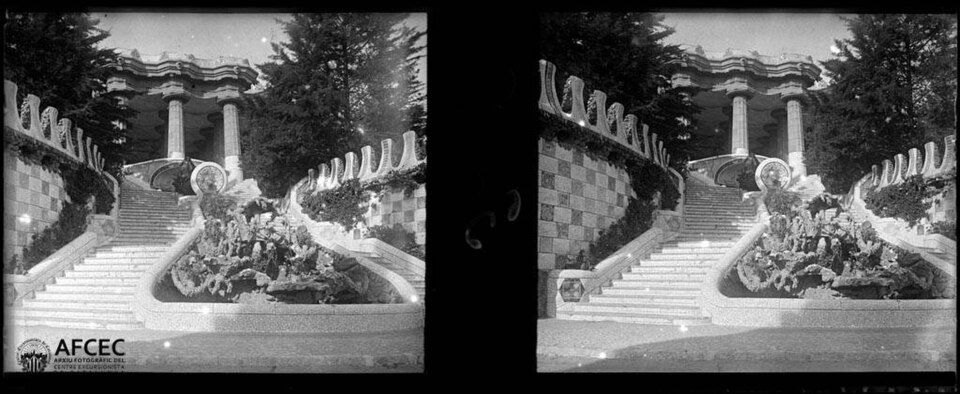
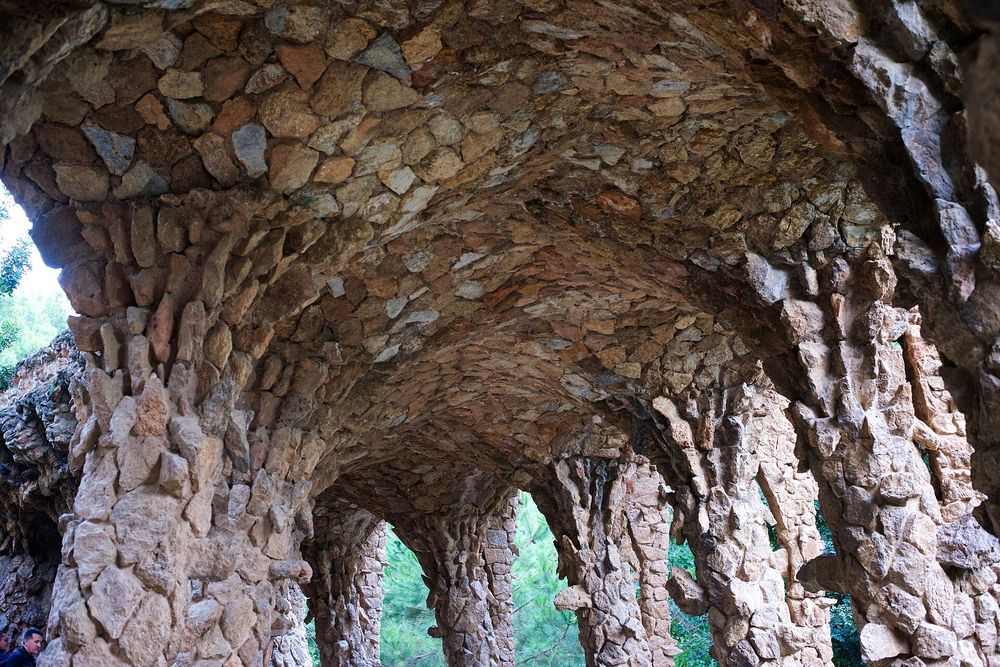
Gaudí laid out Eusebi Güell's failed residential estate on a steep hillside with viaducts, stairs and water storage fitted to the slope, keeping existing trees. Barcelona bought it and opened it as a public park in 1926.
How it came about and changed
- Before 1900
The site, known as the Muntanya Pelada (bare mountain), had long been dry-farmed with vineyards, olive groves and orchards and was progressively abandoned; Güell acquired the large property, which included an older mansion (Casa Larrard).41
- 1900
Eusebi Güell commissioned Antoni Gaudí to plan a residential estate for well-off families modelled on British residential parks, with about 60 triangular plots, a network of paths, viaducts and steps, and strict building rules (one-sixth of each plot buildable; heights placed to keep sea views and sunlight).12
- 1900–1914
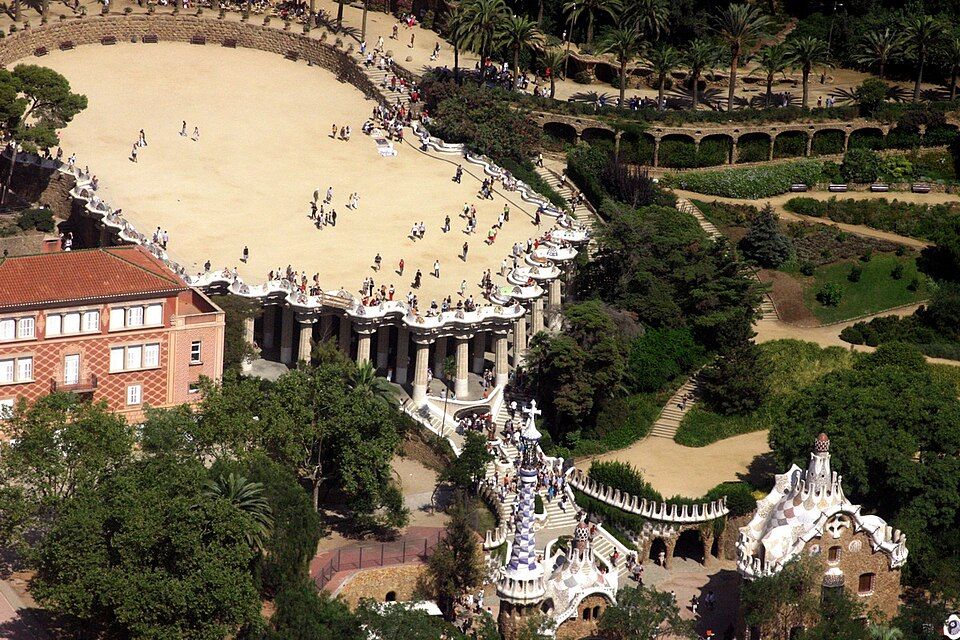
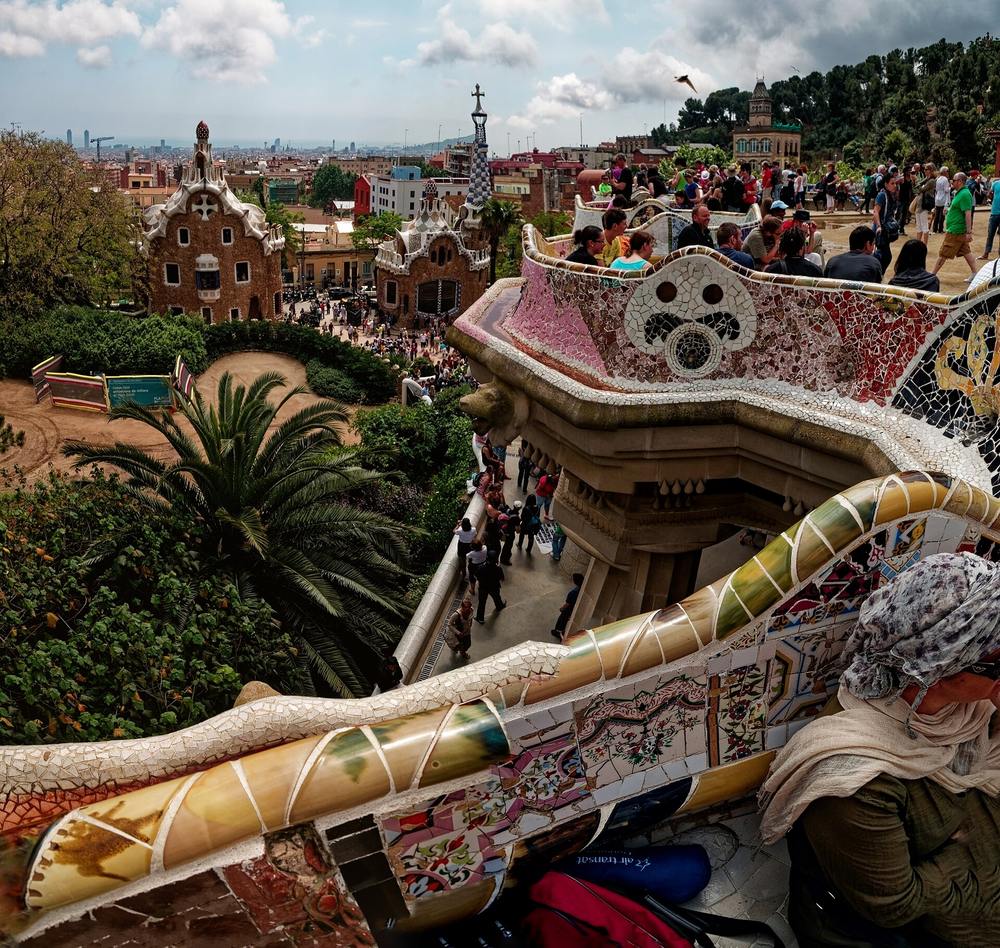
Earthworks began in October 1900. By January 1903 the two entrance pavilions, main stairway, shelter, enclosure, viaducts, part of the great esplanade and the drainage system were built; the hypostyle room was covered by 1907 and the tiled bench around the square finished in 1914. Gaudí kept existing carob and olive trees, added drought-tolerant Mediterranean species and built water collection and storage systems.1
- 1902–1914
The first plot was bought in 1902 by Martí Trias i Domènech; the contractor Josep Pardo i Casanovas built a show house designed by Francesc Berenguer. Güell moved into Casa Larrard in 1907. Restrictive sale conditions under emphyteutic contracts, poor transport and exclusivity left only two of the sixty houses built, and works were abandoned in 1914; the great square was used for civic and Catalanist events.12
- 1918–1926
After Güell's death in 1918 his heirs offered the park to the City Council, which agreed the purchase at its plenary of 26 May 1922; it opened as a municipal park in 1926. The Güell house became the Baldiri Reixac school and part of the grounds a municipal flower nursery.17
- 1960s
Aleppo pines and drought-resistant shrubs were planted on the upper slopes, giving the park its semi-forested look but partly choking earlier olive and carob trees. Gaudí's former house opened as the Gaudí House Museum in 1963.41
- 2009–2010
Storms in 2009 and snow in 2010 damaged many trees; the city then adopted new planting criteria: removing fast-growing invasive plants, opening the canopy, and where possible restoring species present in the early 20th century such as fruit trees.4
- 2018–present
The 2017–2022 Strategic Plan for Park Güell, approved in 2018, set out 198 actions to foster local use and reduce overcrowding, with a consultative Promotion and Monitoring Group (June 2018) and a Technical Secretariat. Access to the monumental zone is ticketed and capped at 1,400 visitors per hour, with free access for registered residents.56



Approvals and legal steps
- 1922 Barcelona City Council plenary of 26 May 1922 agreed to purchase the park from Güell's heirs.1
- 1969 Declared a historic-artistic monument by Decree of 24 July 1969 (BOE 20 August 1969); the park's own site describes this as recognition as a Monument of Cultural Interest.83
- 1984 Inscribed on the World Heritage List with Palau Güell and Casa Milà as works of Antoni Gaudí, on ICOMOS's recommendation under criteria (i), (ii) and (iv); the property was extended in 2005 to seven works.93
- 2005 The Catalan Department of Culture opened a procedure (Resolution CLT/2853/2005 of 24 August) to define the park's protection buffer (entorno de protección) under Catalan Law 9/1993 on cultural heritage.8
- 2018 The City Council approved the government measure '2017–2022 Strategic Plan for Park Güell'.5
Funding
- 1900–1914 The estate was a private development by Eusebi Güell on land he had acquired, to be financed by selling plots; the sales failed and only two houses were built.1
- 1922 Barcelona City Council bought the park from Güell's heirs.17
- Present Non-resident visitors buy tickets to enter the monumental zone; registered residents and nearby schools have free access.6
People
- Eusebi Güell Industrialist, client and developer
- Antoni Gaudí Architect who designed the estate and its landscape
- Josep Maria Jujol Gaudí's collaborator; the trencadís bench around the square (per barcelona.cat)
- Francesc Berenguer Gaudí's assistant; designed the show house
- Josep Pardo i Casanovas Works contractor
- Martí Trias i Domènech First plot buyer (1902)
- Juli Batllevell Architect of the Trias villa
- Barcelona City Council (Ajuntament de Barcelona) Owner since 1922 and manager; Manager's Office for Urban Ecology coordinates the Park Güell Technical Secretariat
- Friends of Gaudí Opened the Gaudí House Museum in 1963
Sources for this page
- Park Güell (Barcelona City Council), Over a hundred years of history
- Park Güell (Barcelona City Council), Gaudí and Güell
- Park Güell (Barcelona City Council), World Heritage Site
- Park Güell (Barcelona City Council), Nature and biodiversity
- Park Güell (Barcelona City Council), Park governance
- Park Güell (Barcelona City Council), Why are the access points regulated?
- Ajuntament de Barcelona, Park Güell (parques y jardines)
- Boletín Oficial del Estado, Resolución CLT/2853/2005, de 24 de agosto, de incoación de expediente para la delimitación del entorno de protección del Parque Güell (BOE-A-2005-18354)
- ICOMOS / UNESCO World Heritage Centre, ICOMOS evaluation No. 320: Architectural works of Gaudí
- Wikidata, Park Güell (Q212867)
Researched on 2026-11-19 from the sources listed; a fact that could not be confirmed in a source was left out. Pictures are public domain or under an open licence, credited as their file page asks.
The question it brings · interpretation
How can infrastructure built to fit a steep site, such as viaducts, terraces and stormwater storage, become the main experience of a landscape rather than a hidden service?
Each question is Field Method’s interpretation, not a claim made by the source.
The date
1914 marks the end of construction: the tiled bench around the great square was completed and works were abandoned that year (Park Güell official site, 'Over a hundred years of history'). Other dates: Gaudí commissioned 1900; earthworks began October 1900; City Council agreed purchase 26 May 1922; opened as a municipal park 1926; declared a historic-artistic monument 1969; World Heritage 1984.
Checked against
- Park Güell (Barcelona City Council), Over a hundred years of history
- Park Güell (Barcelona City Council), World Heritage Site
- ICOMOS / UNESCO World Heritage Centre, ICOMOS evaluation No. 320: Architectural works of Gaudí (Parque Güell, Palacio Güell, Casa Milà)
- Park Güell (Barcelona City Council), Park governance
- Park Güell (Barcelona City Council), Why are the access points regulated?