late 13th c. to 1319
Generalife, Alhambra
Nasrid court of Granada (Muhammad I, Muhammad II, Ismail I) · Granada, Spain
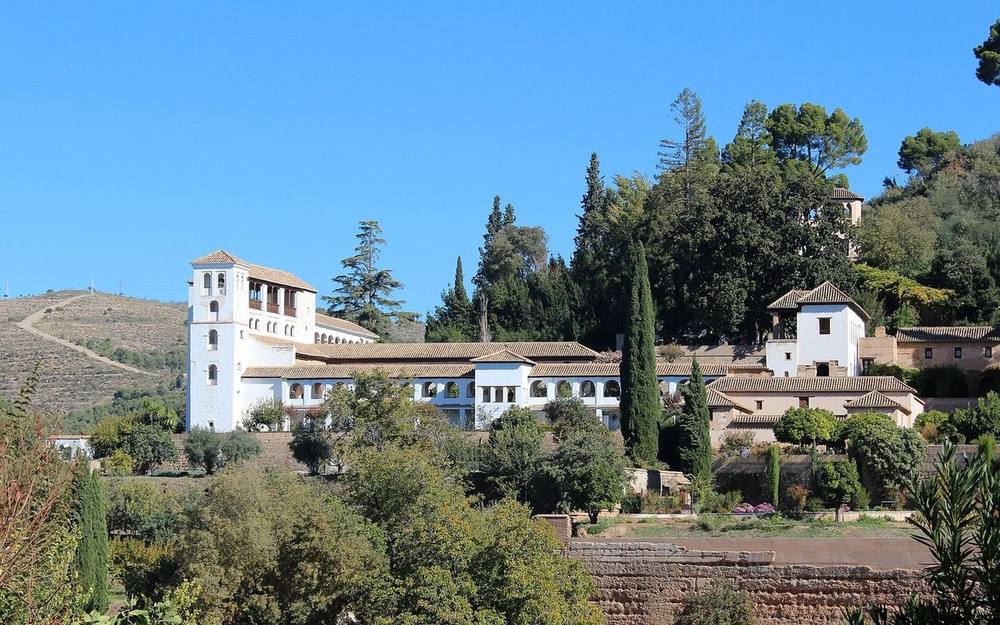
A Nasrid country estate outside the Alhambra where the Acequia Real, a canal opened in 1238, runs through the central garden court and waters its planting; the orchards around it supplied the palaces.
How it came about and changed
- 1238
Muhammad I (Ibn al-Ahmar), founder of the Nasrid dynasty, opened the Acequia Real (Royal Canal) from upstream on the river Darro, the water supply that later made the Generalife's gardens and orchards possible.1
- late 13th century (c. 1273–1302)
The Patronato currently attributes the almunia (country estate) to Muhammad II in the last third of the 13th century; it was a rural retreat for the sultans outside the walls of the Alhambra, combining palace, gardens and productive orchards (huertas) that supplied the palaces.12
- early 14th century (1302–1324)
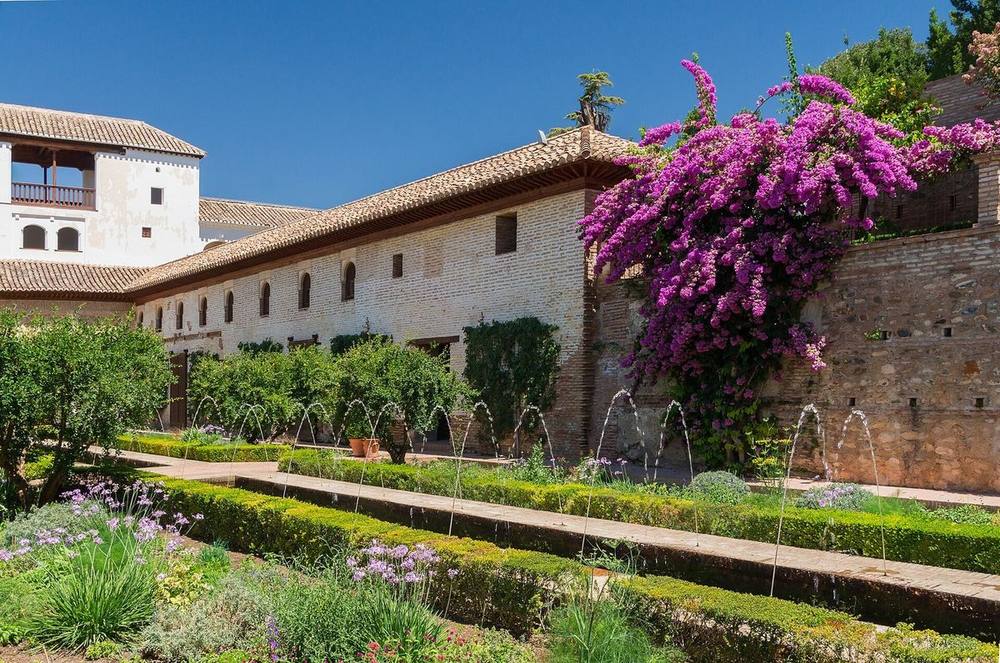
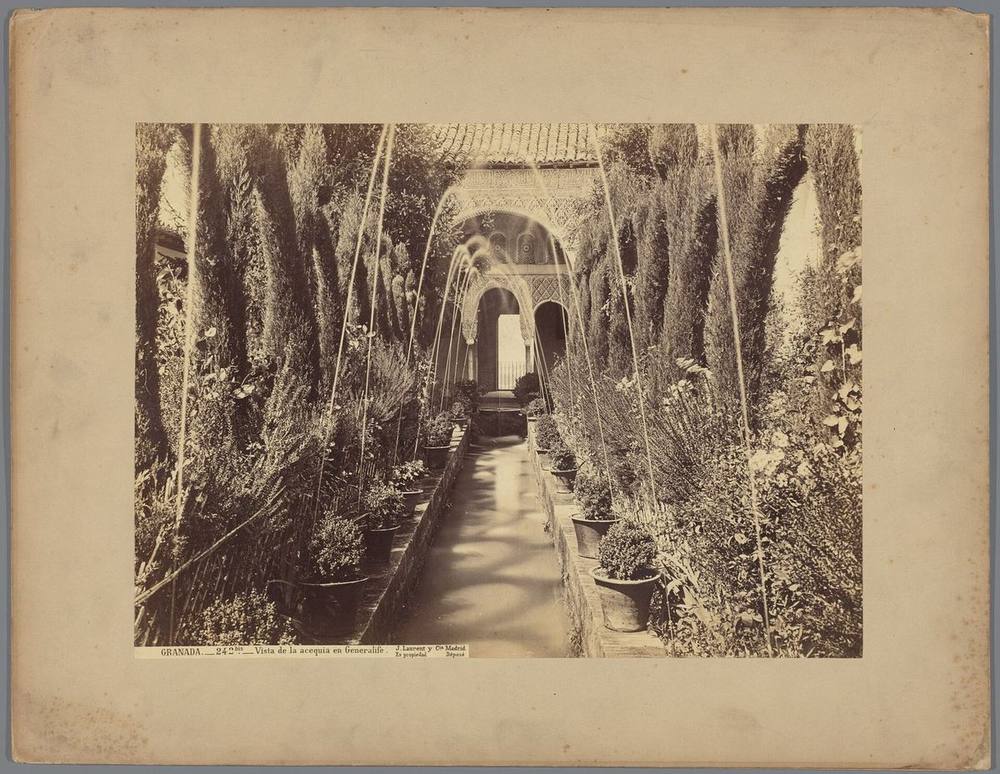
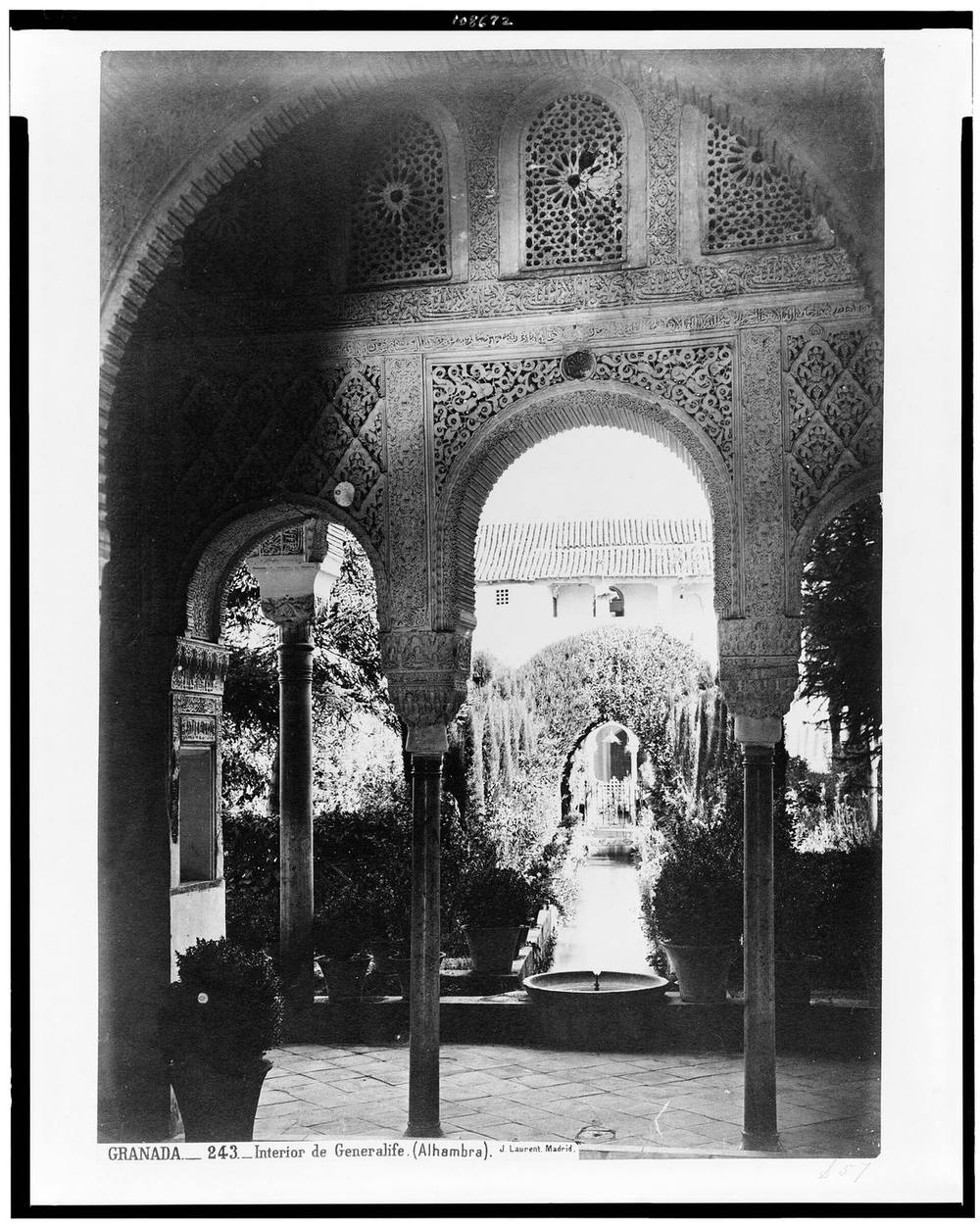
Muhammad III is credited with building or completing the palace and Abu l-Walid Isma'il (Ismail I) with finishing and decorating it; an inscription dates this redecoration to 1319. The Patio de la Acequia's walls date from the 14th century.7102
- late 15th century – 1921
After the Christian conquest of Granada (1492) the estate was held by the Granada-Venegas family, later the marqueses de Campotéjar, as alcaides for almost four centuries. The Patio de la Sultana (Patio del Ciprés) was remodelled repeatedly from the 16th century; a garden there is dated 1571, and the Jardines Altos (upper gardens) were laid out between 1854 and 1870.328
- 1826–1921
The 'Pleito del Generalife', a lawsuit between the State (begun in 1826 by the prosecutor of Fernando VII's private patrimony) and the Campotéjar house over ownership, ran for almost a century; a judgment favourable to the State was given on 30 August 1912, and the case ended with an out-of-court settlement in 1921.54
- 1921–1925
The Generalife passed to the State in 1921 and was run by a separate Patronato del Generalife, which opened it to visitors (an entrance fee and opening hours were set on 1 April 1922) and commissioned survey and repair work from the architect Eladio Laredo.4
- 1925–1934
After the Patronato del Generalife was dissolved in 1925, the Generalife was attached to the Alhambra under the conservation architect Leopoldo Torres Balbás, who consolidated and restored the palace and orchards intensively in 1925–1926 and continued to 1934, removing some later Christian-era additions; he created the rose garden (Rosaleda) in 1931.13
- 1950s
The Jardines Nuevos (New Gardens) and the garden of the open-air theatre were planted in 1952 and 1953 under the conservation architect Francisco Prieto-Moreno. A fire in 1958 damaged the northern part of the palace; the subsequent works are described in Jesús Bermúdez Pareja's 'El Generalife después del incendio de 1958' (Cuadernos de la Alhambra 1, 1965).3810
- 1984–present
The Generalife is part of the UNESCO World Heritage property 'Alhambra, Generalife and Albayzín, Granada' (inscribed 1984, extended 1994). It is protected, administered and conserved by the Patronato de la Alhambra y Generalife, an agency of the Andalusian regional government's Consejería de Cultura y Deporte; in 2025–2026 the Patronato marked the centenary of its creation with the exhibition 'Jardines del Generalife y la Alhambra. El milagro que nació del agua'.63




Approvals and legal steps
- 1912 Judgment of 30 August 1912 in favour of the State in the Pleito del Generalife (the ownership lawsuit begun in 1826).45
- 1921 Royal Decree of 25 August 1921 approving the settlement (transacción) of the lawsuit between the State and the Casa de los Marqueses de Campotéjar; settlement deed executed 6 September 1921 by Juan de Dios de la Sala, Director General de lo Contencioso del Estado, and the Marqués de Campotéjar; possession handed over on 2 October 1921, and the act of delivery to the new Patronato signed on 2 November 1921.45
- 1921 Royal Decree of 12 October 1921 constituting the Patronato del Generalife for the administration, custody and conservation of the Generalife and naming its members; the transfer was published in the Gaceta de Madrid of 15 October 1921 (no. 288).45
- 1925 Royal Decree of 14 March 1925 dissolving the Patronato del Generalife, and Royal Order of 29 April 1925 attaching the Generalife to the Ministry of Public Instruction, with the Alhambra's conservation architect Leopoldo Torres Balbás taking charge.4
- 1984 / 1994 UNESCO World Heritage inscription of the Alhambra and Generalife (1984), extended in 1994 to the property 'Alhambra, Generalife and Albayzín, Granada', criteria (i)(iii)(iv).6
Funding
- late 13th–14th century Built and decorated as a royal country estate of the Nasrid sultans (Muhammad II / Muhammad III, Ismail I); no figures are documented in the sources read.17
- 1921–1922 After the transfer to the State, the Patronato del Generalife drew up its first budget on 7 November 1921 (prepared by Antonio Gallego Burín and Fernando Vílchez) and on 1 April 1922 introduced an entrance fee of 50 céntimos de peseta.4
- 1921 The State acquired the property through the settlement of the lawsuit rather than a purchase documented in the sources read; the Campotéjar family's agreement was linked to tacit arrangements about export of movable cultural goods (per the Patronato's exhibition text).4
People
- Muhammad I (Ibn al-Ahmar) Nasrid sultan; opened the Acequia Real (1238) that supplies the Generalife
- Muhammad II Nasrid sultan; to whom the Patronato currently attributes the almunia (last third of 13th century)
- Muhammad III Nasrid sultan; credited with building the palace (attribution debated)
- Ismail I (Abu l-Walid Isma'il) Nasrid sultan; finished and decorated the palace, inscription dated 1319
- Ibn al-Jayyab (Abu l-Hasan Ali ibn al-Jayyab) Vizier and poet; verses inscribed on the palace walls
- Granada-Venegas family / marqueses de Campotéjar Alcaides and holders of the estate for almost four centuries, until 1921
- Benigno de la Vega-Inclán, Marqués de la Vega-Inclán Royal Commissioner for Tourism; exercised the high inspection of the Patronato del Generalife (1921–1925)
- Eladio Laredo Architect; survey (planimetría) and works for the Patronato del Generalife, 1922–1924
- Francisco de Paula Valladar; Antonio Gallego Burín; Fernando Vílchez; José Palanco Romero Members of the Patronato del Generalife (1921–1925)
- Leopoldo Torres Balbás Conservation architect of the Alhambra (1923–1936); restored the Generalife 1925–1934 and created the Rosaleda (1931)
- Manuel López Bueno Draughtsman; measured survey of the Generalife under Torres Balbás
- Francisco Prieto-Moreno Later conservation architect of the Alhambra; axonometric drawings of the Generalife; period of the Jardines Nuevos (1952–1953)
- Patronato de la Alhambra y Generalife Current managing agency (Junta de Andalucía, Consejería de Cultura y Deporte)
Sources for this page
- Patronato de la Alhambra y Generalife, Reseña bibliográfica del libro El Generalife de Torres Balbás
- Patronato de la Alhambra y Generalife, Un paseo por el Generalife
- Patronato de la Alhambra y Generalife, La exposición 'El milagro que nació del agua' profundiza en los valores históricos y patrimoniales de los jardines del Generalife y la Alhambra (press release)
- Patronato de la Alhambra y Generalife, El Generalife y la Casa de los Tiros (exhibition texts, 'Momentos clave del Patronato')
- Archivo Histórico Provincial de Granada, Junta de Andalucía, Acta de entrega del Generalife (Documento del mes, abril–junio 2014)
- UNESCO World Heritage Centre (UNESCO open data), Alhambra, Generalife and Albayzín, Granada (World Heritage List record 314)
- Bibliotheca Alexandrina, Writing and Scripts Center, Inscriptions of Generalife (Mohamed Abdel Moneim El Gamal), Abgadiyat
- Universidad de Granada (hosted by medomed.org), El Generalife después de la expulsión de los moriscos (Manuel Casares Porcel, José Tito Rojo)
- Wikidata, Generalife (Wikidata item Q525811)
- Wikipedia (pointer only), Generalife
Researched on 2026-11-19 from the sources listed; a fact that could not be confirmed in a source was left out. Pictures are public domain or under an open licence, credited as their file page asks.
The question it brings · interpretation
If the supply channel ran visibly through the middle of your garden, as it does in the Patio de la Acequia, what would that change about where you place planting, paths and places to sit?
Each question is Field Method’s interpretation, not a claim made by the source.
The date
Nominal year for ordering. The Patronato attributes the estate to Muhammad II in the last third of the 13th century, on the Acequia Real opened in 1238; 1319 is the remodelling of the Patio de la Acequia under Ismail I, recorded by an inscription.
Checked against
- Patronato de la Alhambra y Generalife, Reseña bibliográfica del libro Generalife de Torres Balbás
- Patronato de la Alhambra y Generalife, Un paseo por el Generalife
- Patronato de la Alhambra y Generalife, La exposición 'El milagro que nació del agua' se inaugura en la Alhambra (nota de prensa)
- Wikipedia (encyclopaedia, second source only), Generalife