2005
Cheonggyecheon restoration
Seoul Metropolitan Government; SeoAhn Total Landscape (landscape architect) · Seoul, South Korea
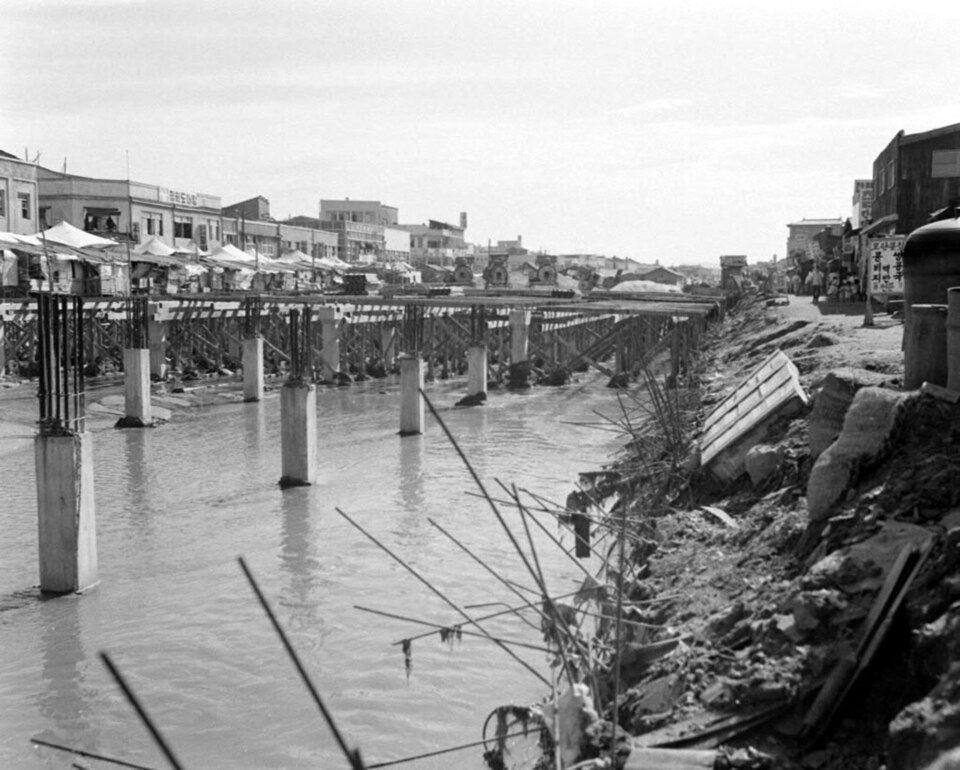
Seoul removed an elevated expressway and the concrete deck over a covered stream and reopened the waterway through the city centre. Flow is maintained with pumped, treated water from the Han River and subway pump stations.
How it came about and changed
- 1760
Under the Joseon dynasty about 200,000 people were mobilised to widen the stream and build stone embankments (SMG presentation).4
- 1949–1950s
A 1949 dredging plan was halted by the Korean War; afterwards refugees built shacks along the banks and the polluted stream became a symbol of poverty.5
- 1955–1977
Covering began with about 136 m above Gwangtonggyo in 1955, then Gwanggyo to Cheonggye 6-ga (May 1958–December 1961), Cheonggye 6-ga to 8-ga (1965–1967) and Cheonggye 8-ga to Sindap railway bridge (1970–1977); residents were relocated and heritage such as Gwangtonggyo bridge was damaged.5
- 1967–1971
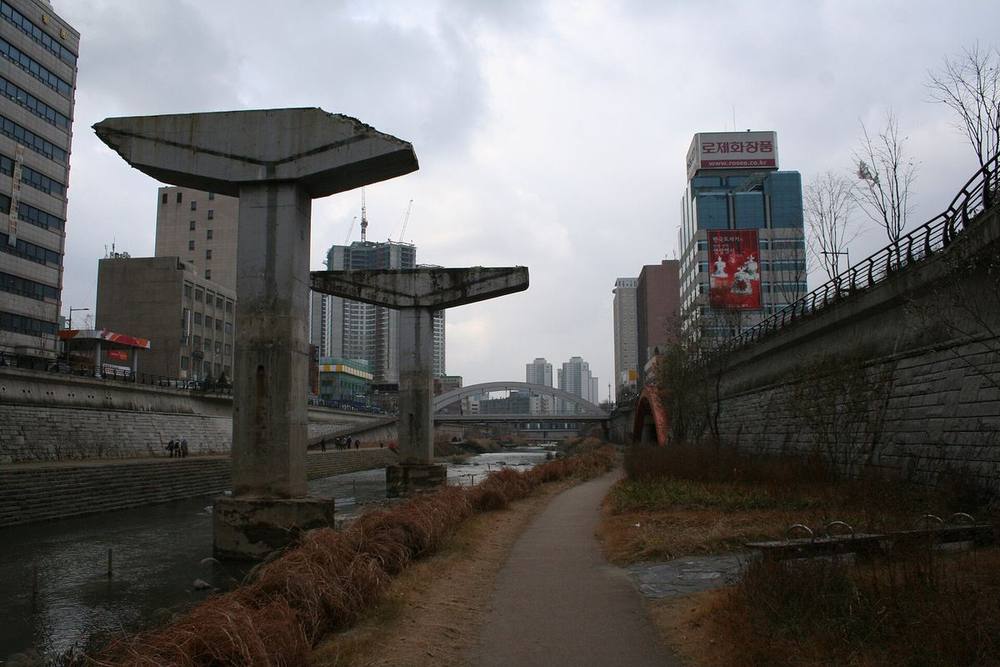
The Cheonggye elevated highway, 5.6 km long and 16 m wide from Gwanggyo to Majang-dong, was built from 15 August 1967 to 15 August 1971 (Seoul Facilities Corporation; an SMG presentation gives 1967–1976).54
- 1990s–2000
Safety studies found the deteriorating structure deficient; only small cars were allowed from 1997, and a 2000 Korean Society of Civil Engineering study estimated major repair costs.2
- 2002–2003
Mayor Lee Myung-bak took office on 2 July 2002 and the Cheonggyecheon Restoration Promotion Headquarters began work the same day; the Seoul Development Institute's Restoration Research Support Group (1 July 2002–30 June 2006) and a Citizens' Committee prepared plans, with a symposium (November 2002), public hearing (20 February 2003) and over 4,200 meetings with merchants per LAF.71
- 2003–2005
Construction ran from 1 July 2003 to 30 September 2005 in three sections: demolition of the elevated road and deck from July 2003, construction from 2004, landscaping from May 2005, water supply tests from June 2005, and grand opening on 1 October 2005. Civil engineers led phase 1; landscape architects SeoAhn Total Landscape oversaw the later stages.9231
- 2005–present
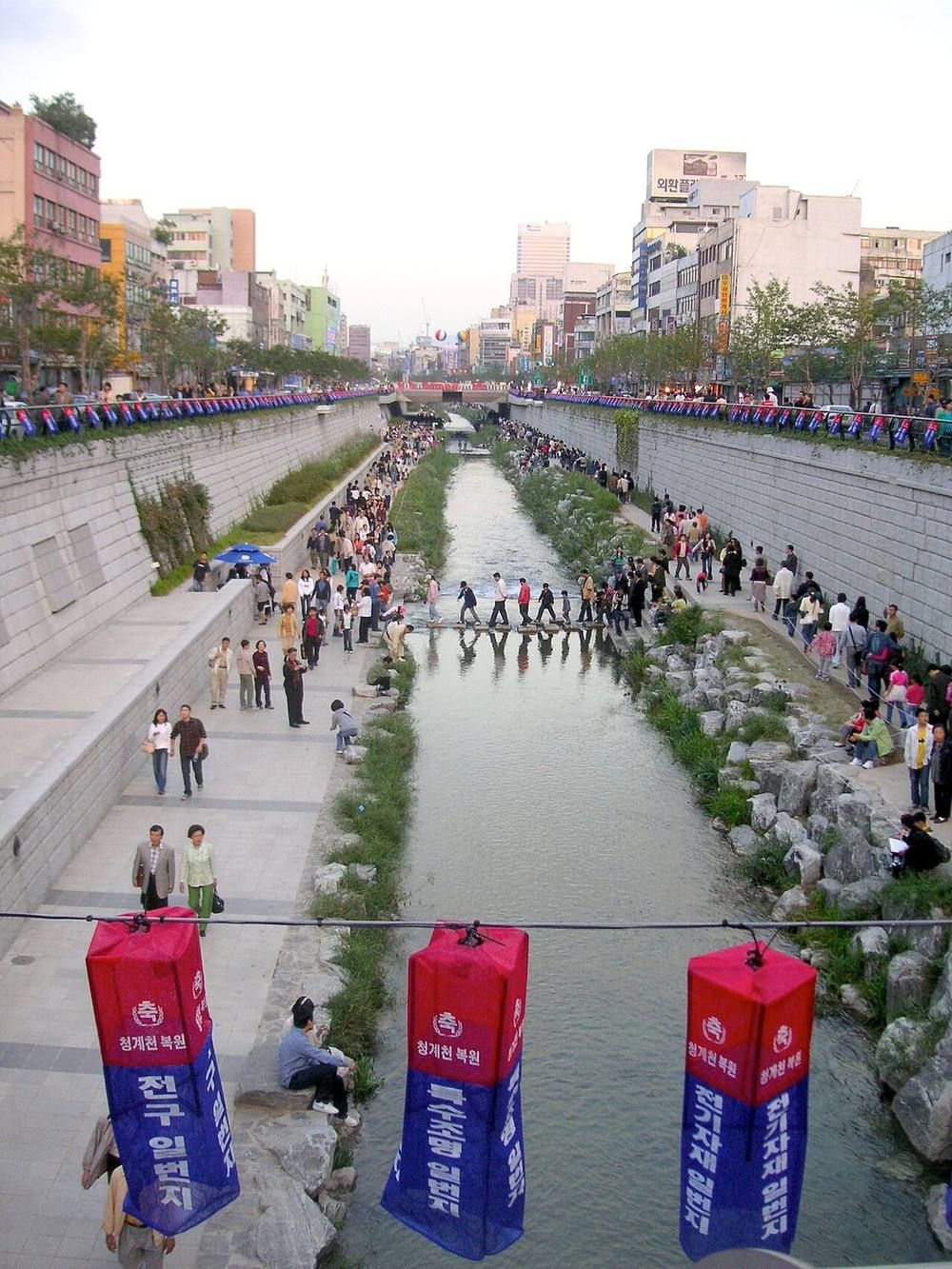
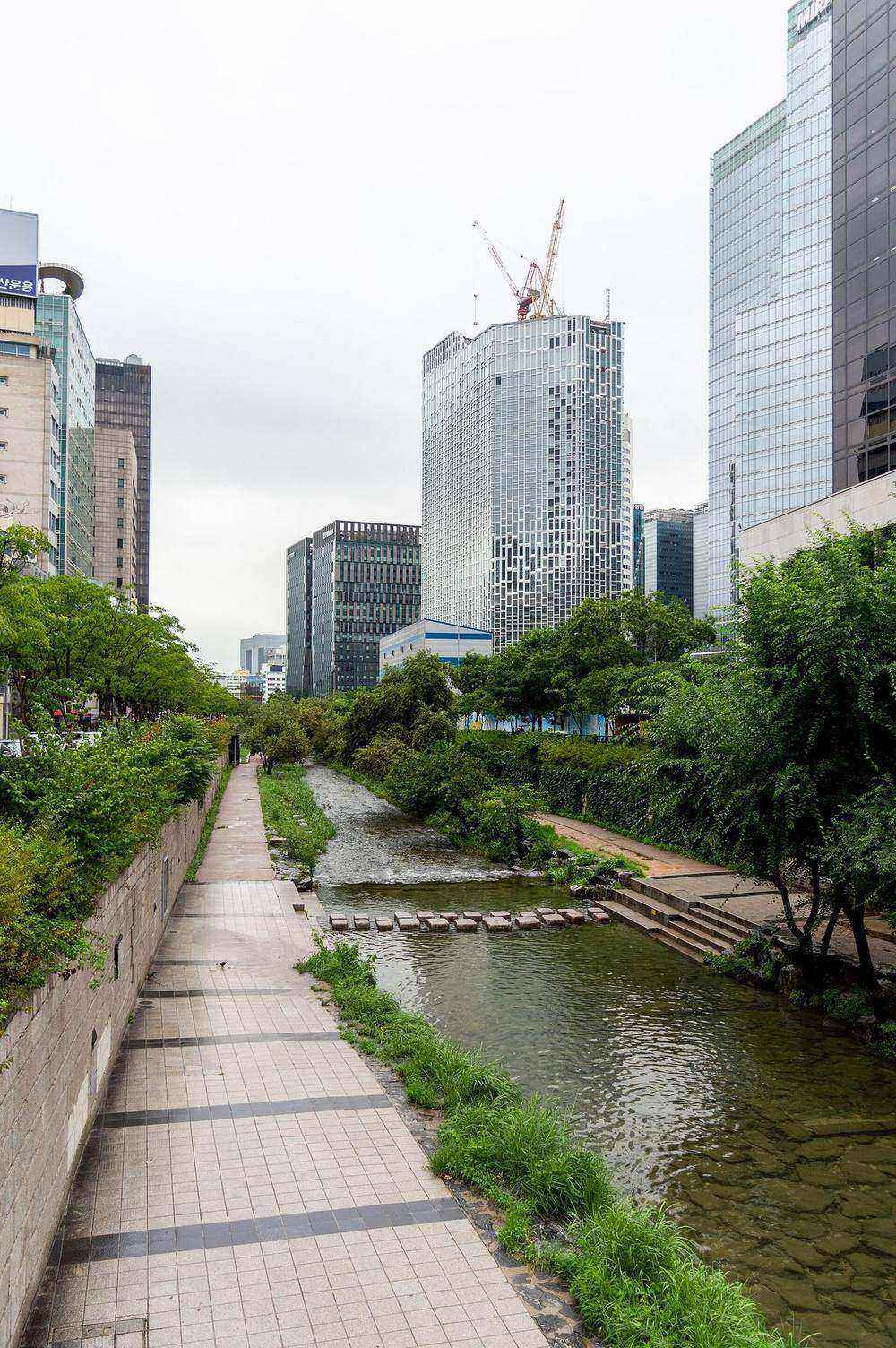
The 5.84 km restored corridor (22 bridges) is maintained with pumped, treated Han River water and groundwater from subway stations; elevators and other accessibility measures were added after protests. It is managed by the Seoul Facilities Corporation under a city ordinance on use and management, with annual maintenance costs published from 2006.9110



Approvals and legal steps
- 2002 Political decision and organisational set-up by the Seoul Metropolitan Government: Restoration Promotion Headquarters (from 2 July 2002), Citizens' Committee and Research Support Group (from 1 July 2002).74
- 2003 Public hearing on the restoration project on 20 February 2003; basic design (July 2003) and detailed design (February 2004) presented to the Citizens' Committee.7
- 2004 Restoration works bureau of the Construction Safety Headquarters merged into the Restoration Promotion Headquarters under the city's administrative-organisation ordinance rules (January 2004).7
- 2009 (full revision) Seoul Metropolitan City Ordinance on the Use and Management of Cheonggyecheon (서울특별시 청계천 이용ㆍ관리에 관한 조례), fully revised 29 September 2009.10
Funding
- 2003–2005 Funded by the Seoul Metropolitan Government ('All budget is from Seoul Metropolitan Government'). Construction cost was estimated at 349,423 million won before work began and reached 386,739 million won by 2005 because of design changes, price changes and added tasks (Seoul Facilities Corporation).64
- c.2003–2004 An SMG presentation gives a total project cost of US$305 million (design 1.7, construction 294.0, land acquisition 2.3, project management 6.1, administration 0.5, apparently in US$ million).4
- 2005 LAF gives about US$380 million total and about US$120 million for the landscape portion; ADB gives $380 million (estimated $446 million in 2012), 'government- and partner-funded'.12
- 2003–2005 Financial support and subsidies to affected businesses and special arrangements for street vendors (amounts not stated).21
- 2006–2026 Annual maintenance costs published by the Seoul Facilities Corporation, e.g. 6,769 million won in 2006 and 11,391 million won in 2026.9
People
- Seoul Metropolitan Government Client, funder and executing agency
- Lee Myung-bak Mayor of Seoul (from July 2002) who led the project
- Cheonggyecheon Restoration Promotion Headquarters (SMG) Project planning and execution
- Seoul Development Institute (Restoration Research Support Group) Research and plans
- Cheonggyecheon Restoration Citizens' Committee Public consultation and principles
- SeoAhn Total Landscape Landscape architect
- Cheongsuk Engineering, Saman Engineering, Dongmyung Engineering Main designers, sections 1, 2 and 3
- Daelim, LG Construction, Hyundai Construction Main contractors, sections 1, 2 and 3
- Seoul Facilities Corporation Current manager
Sources for this page
- Landscape Architecture Foundation, Landscape Performance Series, Cheonggyecheon Stream Restoration Project
- Asian Development Bank, Development Asia, Revitalizing a City by Reviving a Stream (13 May 2016)
- Seoul Museum of History, Cheonggyecheon Museum
- Seoul Metropolitan Government presentation, NEAC13 proceedings (Ministry of the Environment, Japan), The Present Condition of CheongGye-Cheon Restoration (Chin Yang Kyo)
- Seoul Facilities Corporation, 청계천역사: 1950년대 이후 (History since the 1950s)
- Seoul Facilities Corporation, 복원사업: 사업의 개요 (Restoration project overview)
- Seoul Facilities Corporation, 복원사업: 추진준비 (Preparation)
- Seoul Facilities Corporation, 복원사업: 사업시행 (Implementation)
- Seoul Facilities Corporation, 청계천 개요 (Overview and statistics)
- Seoul Facilities Corporation (PDF), 서울특별시 청계천 이용ㆍ관리에 관한 조례
- Wikidata, Wikidata item Q495437 (Cheonggyecheon)
Researched on 2026-11-19 from the sources listed; a fact that could not be confirmed in a source was left out. Pictures are public domain or under an open licence, credited as their file page asks.
The question it brings · interpretation
If a road were taken away to reopen a buried stream, where would the water come from, and what would that say about calling the result restoration?
Each question is Field Method’s interpretation, not a claim made by the source.
The date
Completion: opened in October 2005. Demolition of the elevated highway began in July 2003.