1970
Portland Open Space Sequence (Lovejoy Fountain, Pettygrove Park, Ira Keller Fountain)
Lawrence Halprin & Associates (Angela Danadjieva, project designer of the Forecourt Fountain) for the Portland Development Commission · Portland, Oregon, United States
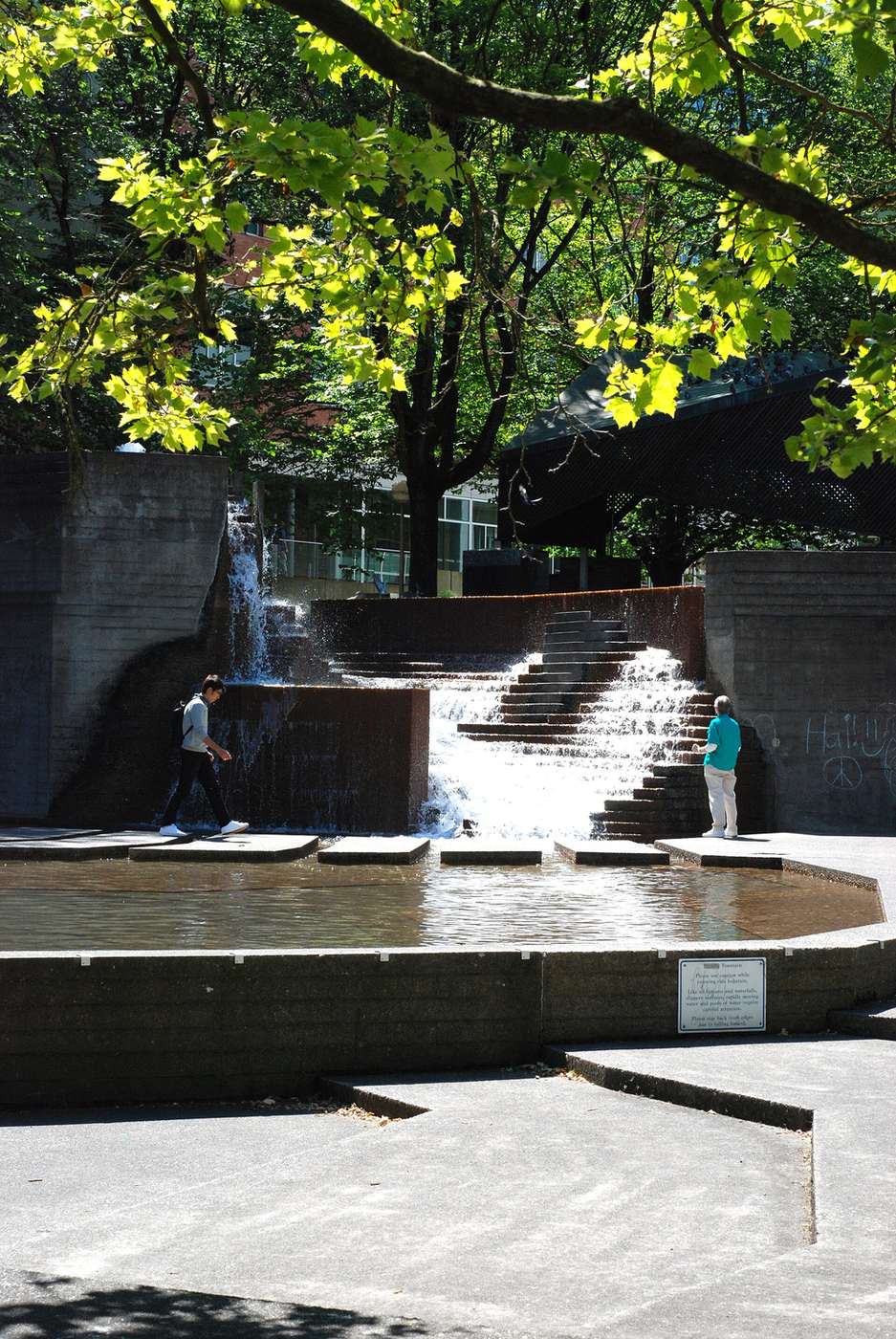
An eight-block chain of plazas and malls built 1966–1970 in Portland, where Halprin abstracted streams and waterfalls into fountains made to be entered. Its National Register nomination calls it the first full expression of concepts he later repeated.
How it came about and changed
- 1958–1962
Portland's first urban renewal project, the South Auditorium district (83.5 acres), was cleared through eminent domain: about 1,500 residents were moved and by the end of 1961, 381 of 385 buildings were gone. Federal Title I urban renewal funding covered two-thirds of site acquisition costs. Skidmore, Owings & Merrill redesigned the scheme as residential superblocks keeping pedestrian ways on the 200-foot block grid.1
- 1963–1965
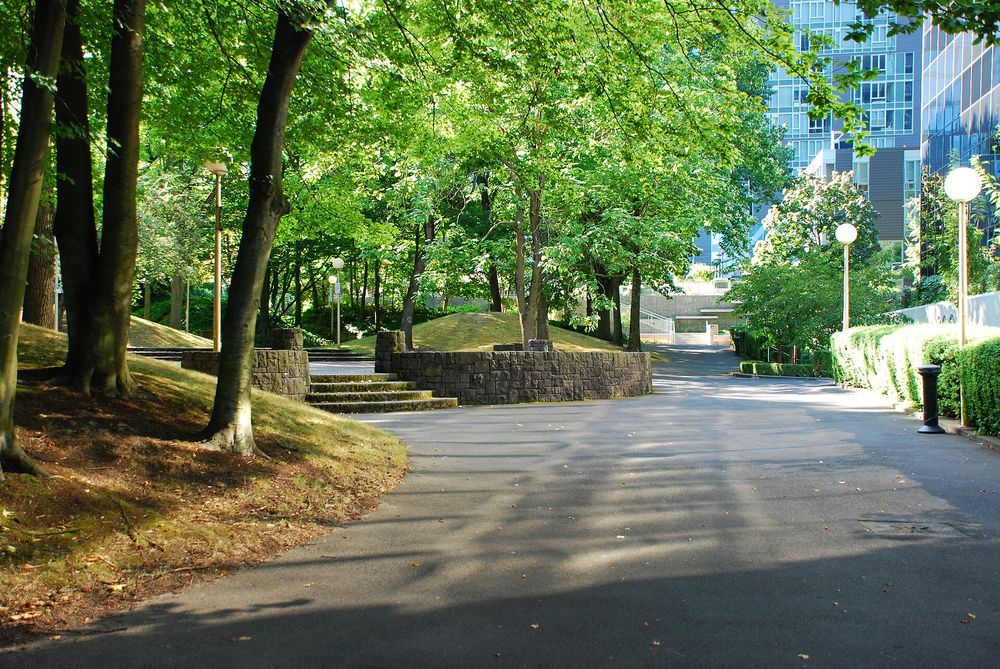
In January 1963 the Portland Development Commission (PDC), supported by its advisory board (Pietro Belluschi, Paul Kirk, George Rockrise) and architectural adviser Walter Gordon, hired Lawrence Halprin to design the public areas of the South Auditorium site. Halprin conceived a sequence of open spaces paralleling a High Sierra nature experience; his first complete design (February 1965) covered a 'hard', active south park and a 'soft', quiet north park linked by pedestrian malls.1
- 1965–1966
Construction started in May 1965 (contractor Shrader Construction; landscaping by Lambert Gardens; stonework by Steve Bonfiglio and Smith Brothers Masonry). The south park's pavilion, an abstracted West Hills ridgeline, was designed with Charles Moore and William Turnbull Jr. The parks were dedicated and named Lovejoy and Pettygrove on 26 July 1966 by a toss of the city's founding coin.15
- 1967–1968
Halprin produced plans for the Source Fountain in July 1967; the Source Fountain Plaza and the Second Avenue, Mill and Montgomery pedestrian malls were completed in 1968.1
- 1966–1970
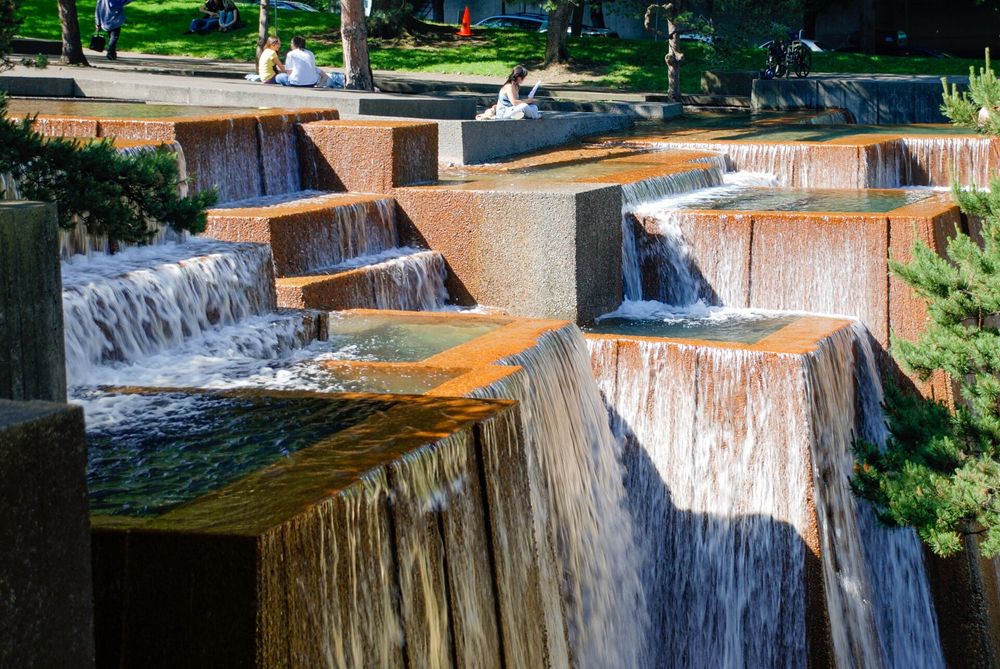
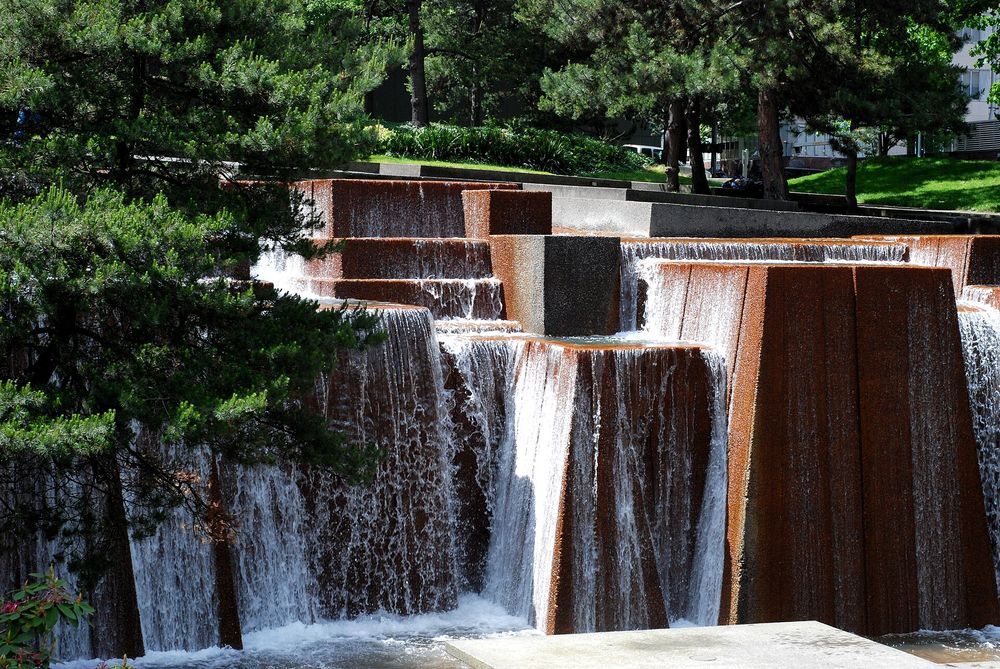
After federal approval of a northward extension of the urban renewal district in 1966, SOM proposed a car drop-off circle in front of the Civic Auditorium; Halprin argued for a people's space and was hired in January 1968. PDC endorsed the design by May 1969; construction began in June 1969 and the Forecourt Fountain, with project designer Angela Danadjieva, was dedicated on 23 June 1970. Its 80-foot-wide, 25-foot-high falls carry 13,000 gallons per minute.14
- 1978–2011
The Forecourt Fountain was renamed in 1978 after Ira C. Keller, first PDC chairman. A 1979 ordinance divided operation and maintenance among city bureaus; ageing and deferred maintenance followed. The Halprin Landscape Conservancy, formed in 2001, worked toward a preservation plan, and Ordinance No. 184646 (8 June 2011) authorised an agreement for it to fundraise for and undertake repairs.436
- 2013–2019
Listed in the National Register of Historic Places in March 2013 as the Halprin Open Space Sequence. A voluntary local improvement district created in December 2016 funded, with the City, a historic restoration of Keller Fountain Park, Pettygrove Park, Lovejoy Fountain Park and the Source Fountain, completed in summer 2019. The Conservancy is pursuing National Historic Landmark designation.32



Approvals and legal steps
- 1966 Federal government approved the northward extension of the South Auditorium urban renewal district, which made the Auditorium Forecourt possible.1
- 1968–1969 Halprin's Forecourt proposal unanimously approved in 1968 (Portland Parks); PDC endorsed the design and put it out to bid by May 1969.41
- 1979 City ordinance assigning operation and maintenance of elements of the sequence to various city bureaus.3
- 2011 City Council Ordinance No. 184646 (8 June 2011) authorised an agreement with the Halprin Landscape Conservancy to fundraise and undertake repair and maintenance.3
- 2013 Listed in the National Register of Historic Places as the Halprin Open Space Sequence (NRIS 13000058), a non-contiguous district; areas of significance landscape architecture and community planning and development.21
- 2016 Voluntary Portland Open Space Sequence Local Improvement District created (December 2016) to fund restoration.3
Funding
- 1950s–1960s South Auditorium land assembly used federal Title I urban renewal funds, under which the federal government paid two-thirds of site acquisition cost and the local government one-third (as the nomination describes the programme).1
- 1963 PDC paid Halprin a fee of $15,000 for the public-area design.1
- 1965 Construction of the first phase (parks and malls) started in May 1965 with a budget of $440,000.1
- 1969 Shrader Construction won the Forecourt Fountain bid at $468,164; the nomination states the urban renewal expansion funded the Forecourt Fountain.1
- 2016–2019 Restoration funded by the Portland Open Space Sequence Local Improvement District ($2.15 million) and the City of Portland ($1.7 million), in partnership with the Halprin Landscape Conservancy.3
People
- Lawrence Halprin (Lawrence Halprin & Associates) Landscape architect; designer of the sequence
- Angela Danadjieva Project designer, Auditorium Forecourt (Keller) Fountain
- Satoru Nishita Credited designer, Lawrence Halprin & Associates (per TCLF)
- Charles Moore and William Turnbull Jr. Collaborated on the Lovejoy Fountain pavilion
- Portland Development Commission (now Prosper Portland) Client; urban renewal agency
- Ira C. Keller First PDC chairman (1958–72); fountain renamed for him in 1978
- Pietro Belluschi, Paul Kirk, George Rockrise; Walter Gordon PDC advisory board and architectural adviser who supported hiring Halprin
- Skidmore, Owings & Merrill Redesigned the urban renewal scheme; architects for Portland Center
- Shrader Construction Company General contractor for the parks (1965) and Forecourt Fountain (1969–70)
- Lambert Gardens Landscape installation, 1965–66
- Halprin Landscape Conservancy Non-profit (2001) that led the NRHP nomination and the restoration
- Portland Parks & Recreation Current park manager
Sources for this page
- National Park Service (NPGallery), National Register of Historic Places Registration Form: Halprin Open Space Sequence
- National Park Service (NPGallery), Halprin Open Space Sequence (NRIS 13000058) asset record
- Portland Parks & Recreation, City of Portland, Portland Open Space Sequence Restoration Project
- Portland Parks & Recreation, City of Portland, Keller Fountain Park
- Portland Parks & Recreation, City of Portland, Pettygrove Park
- The Cultural Landscape Foundation, Portland Open Space Sequence
- Wikidata, Pettygrove Park (Q7179404)
Researched on 2026-11-19 from the sources listed; a fact that could not be confirmed in a source was left out. Pictures are public domain or under an open licence, credited as their file page asks.
The question it brings · interpretation
How can a sequence of public spaces be choreographed so that movement, pause and participation are designed as deliberately as the forms themselves?
Each question is Field Method’s interpretation, not a claim made by the source.
The date
1970 marks the dedication of the Auditorium Forecourt (now Ira Keller) Fountain on 23 June 1970, completing the sequence; Lovejoy and Pettygrove parks were dedicated 26 July 1966 and the Source Fountain and remaining malls built by 1968 (National Register nomination, 2013). Halprin hired January 1963; listed in the National Register March 2013; restoration completed summer 2019.