1804
Père-Lachaise Cemetery
Alexandre-Théodore Brongniart; Nicolas Frochot, Prefect of the Seine · Paris, France
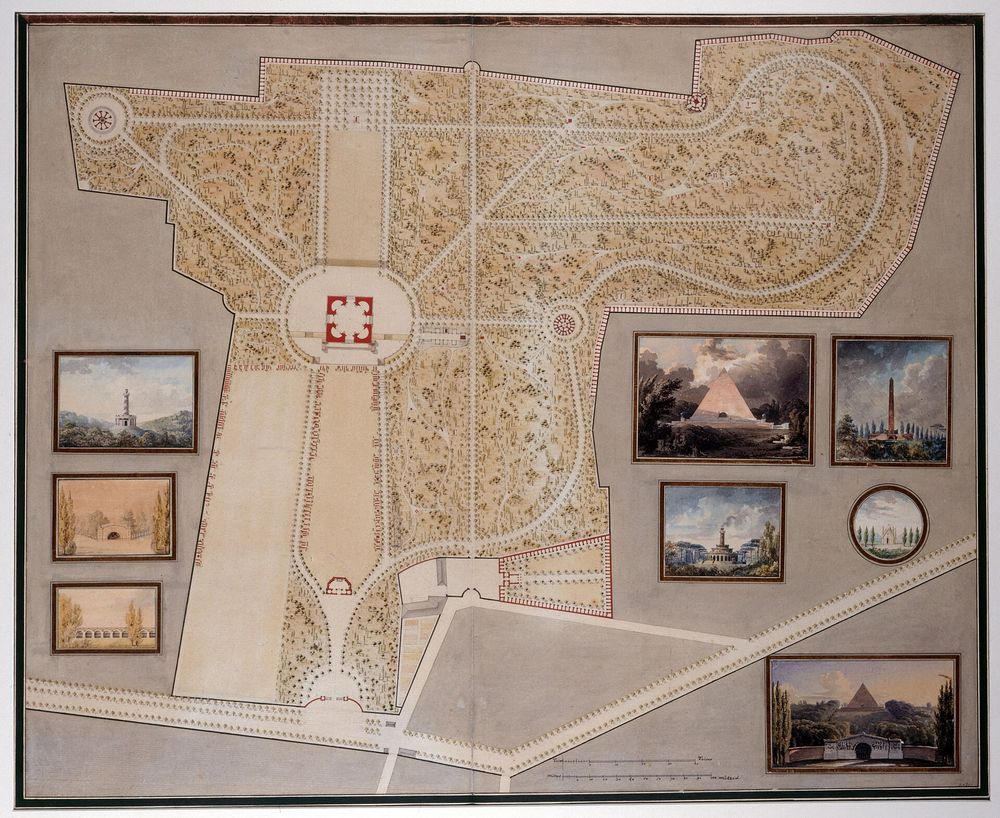
A cemetery opened on a hillside estate bought by the Prefect of the Seine and laid out by Brongniart; its older part is a garden cemetery with winding paths. The City of Paris says Parisians soon came there to walk.
How it came about and changed
- 1626–1762
The Jesuits acquired the property on the flank of the Charonne hill in 1626 as a house of rest, known as Mont-Louis; Father François de La Chaise d'Aix, confessor to Louis XIV, enlarged and embellished it. After the Jesuits' expulsion in 1762 the estate was sold several times and lost its formal parterres and kitchen garden but kept cultivated land and a wooded character.1
- 1804
Nicolas Frochot, Prefect of the Seine, acquired the estate on 10 January 1804 to create the first of the large cemeteries he planned outside Paris; the Cemetery of the East opened in 1804 and the first burial, of a five-year-old girl, took place on 21 May 1804. The Montparnasse (1824) and Montmartre (1825) cemeteries followed.12
- 1804–c.1813
Frochot gave the architect Alexandre-Théodore Brongniart the task of laying out the site. Brongniart worked with the existing structure: planted avenues were doubled for funeral processions, path crossings were marked by mausoleums and surviving groves framed the first tombs; his proposed pyramid on the old château terrace (and, per the Fondation Napoléon, a covered gallery for uniform burials) was not built.123
- 1805–1830
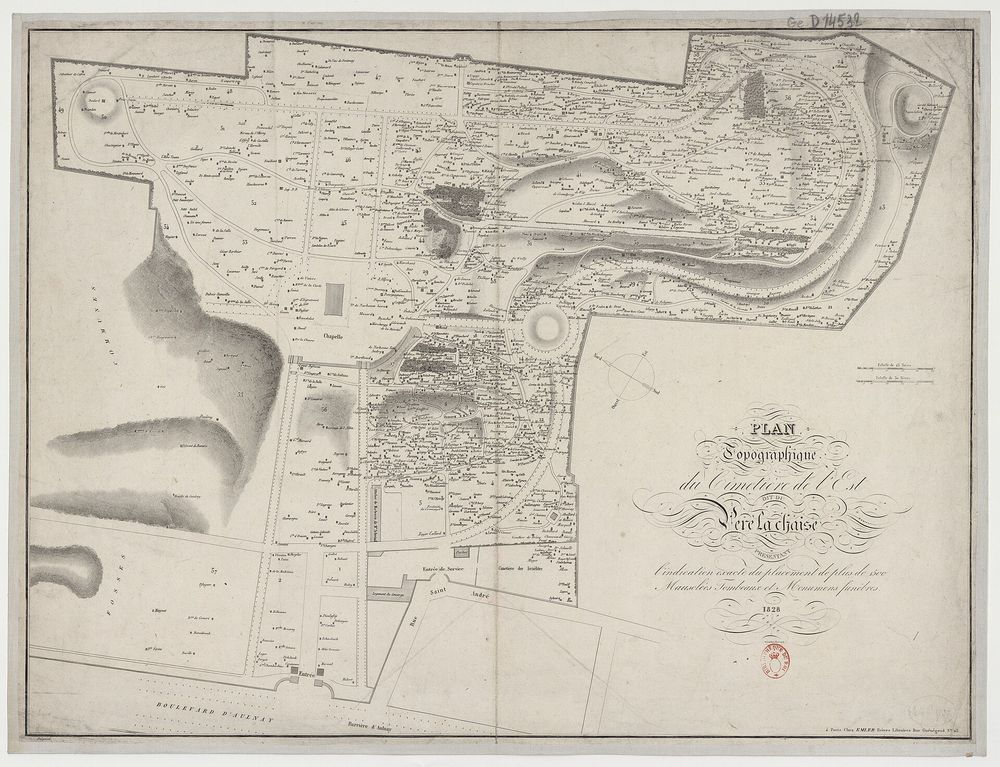
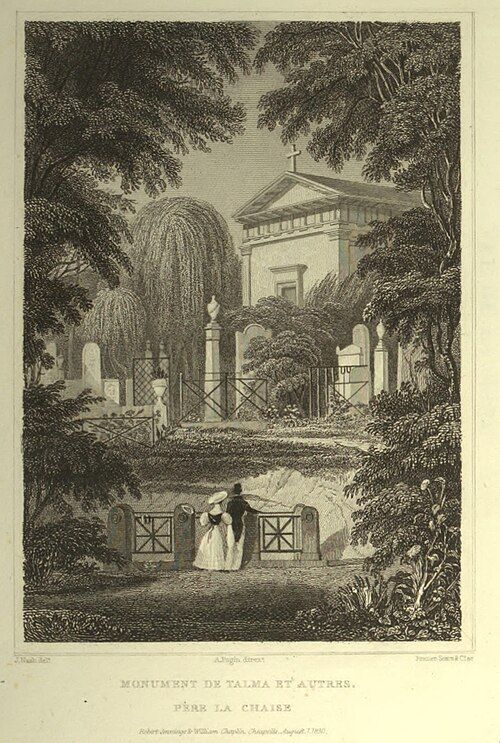
Perpetual concessions appeared in 1805; reinterments ordered or arranged to attract the elite (Louise de Lorraine in 1806; the supposed remains of Molière and La Fontaine and the tomb of Héloïse and Abélard in 1817) raised the cemetery's prestige, and perpetual concessions rose from 49 in 1806 to 833 by 1812. From 1825–1830 family tombs and chapels multiplied along the avenues. The chapel was built under the Restoration on the axis of the new entrance hemicycle (1820–1824).21
- 1804–1850
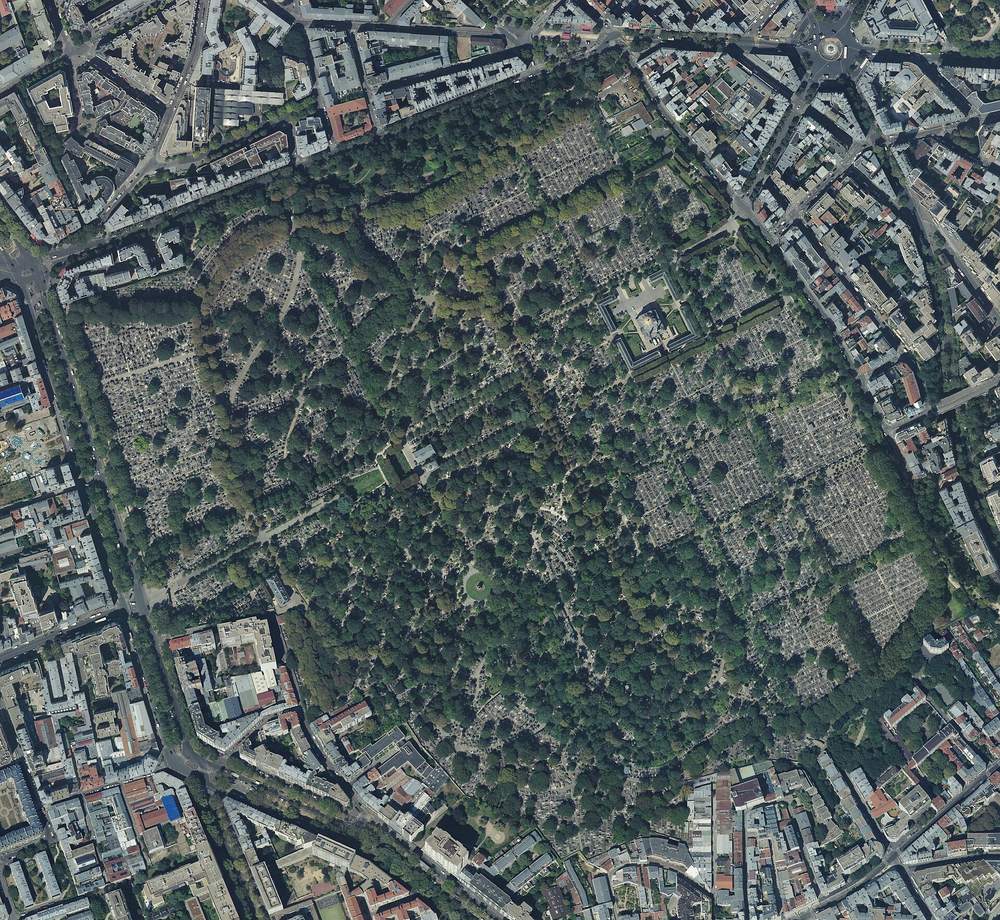
Demand for concessions led the administration to enlarge the site and to remove planting, densifying the cemetery. It was enlarged six times, reaching its present area of 44 ha in 1850; the last extension, of 17 ha on the Charonne plateau, created a second zone laid out as a rational grid with paving, pavements, benches and fountains, in contrast to the winding romantic hillside.12
- 1856–1914
A Muslim enclosure with a mosque was established in 1856; it was later partly replaced by the columbarium and the mosque was demolished in 1914. The columbarium and crematorium were built to designs by the architect Jean-Camille Formigé from 1886.23
- 1962–present
The older romantic part was protected as a classified site in 1962 and its pre-1900 funerary monuments as historic monuments from 1983. The cemetery remains an active municipal cemetery managed by the City of Paris; according to the Association pour la Préservation du Père-Lachaise no space has been available since the mid-20th century, and abandoned concessions are reallocated (about 300 a year).34



Approvals and legal steps
- 1804 Imperial decree on burials of 12 June 1804 (law of 23 Prairial year XII) banned burial in churches and within towns and required dedicated burial grounds outside them; the Paris page states Frochot bought the Mont-Louis estate in anticipation of it.21
- 1962 Ministerial order of 17 December 1962 under the law of 2 May 1930 on natural monuments and sites classified the oldest part of the cemetery (about half its area) as a site classé.34
- 1983–2008 Historic-monument protection: funerary monuments built before 1900 in the romantic part (divisions 1–58, 65–71 and 91) inscribed by order of 21 March 1983; entrance gate, chapel, Mur des Fédérés, Bartholomé's monument to the dead and several tombs classified on 14 November 1983; further classifications and inscriptions in 1990, 1995 (including columbarium and crematorium, inscribed 17 January 1995) and 2008 (Chopin's tomb).3
- 1995 A municipal order of 13 February 1995 established two sets of specifications (cahiers des charges) applying to the protected zones.4
Funding
- 1804 The Fondation Napoléon states that the City of Paris bought a 17-hectare green space on the Mont-Louis estate for 180,000 francs; the City of Paris page says Prefect Frochot acquired the property on 10 January 1804.21
- 1984–present Funerary monuments are private property maintained by their owners; monuments owned by the City of Paris can be restored through a funerary architecture commission created in 1984 with a City of Paris budget, and listed monuments can receive state (Ministry of Culture) restoration grants.4
- 1911–1914 Oscar Wilde's tomb by Jacob Epstein was funded by Helen Carew, an admirer of the writer (an example of privately funded monuments).3
People
- Nicolas Frochot Prefect of the Seine; acquired the site and commissioned the cemetery
- Alexandre-Théodore Brongniart Architect who designed the original layout (from 1804)
- François de La Chaise d'Aix Jesuit confessor of Louis XIV after whom the former estate and cemetery are named
- Jean-Camille Formigé Architect of the columbarium and crematorium (from 1886)
- City of Paris (Direction des Parcs, Jardins et Espaces Verts) Owner of the ground and manager of the cemetery, per APPL
- Association pour la Préservation du Père-Lachaise (APPL) Heritage association documenting and advocating for the cemetery
Sources for this page
- Ville de Paris, Cimetière du Père-Lachaise : plus de 200 ans d'histoire
- Fondation Napoléon, Cimetière du Père-Lachaise - Paris
- Ministère de la Culture, POP – Plateforme ouverte du patrimoine, Cimetière de l'Est dit cimetière du Père Lachaise (notice Mérimée PA00086780)
- Association pour la Préservation du Père-Lachaise (APPL), Protection du Père Lachaise
- Wikidata, Père Lachaise Cemetery (Q311)
Researched on 2026-11-19 from the sources listed; a fact that could not be confirmed in a source was left out. Pictures are public domain or under an open licence, credited as their file page asks.
The question it brings · interpretation
What would it take for a burial ground you design to serve the living as everyday open space without losing its purpose?
Each question is Field Method’s interpretation, not a claim made by the source.
The date
Opened 1804 as the cimetière de l'Est. The City of Paris records purchase of the estate on 10 January 1804; the Fondation Napoléon dates the first burial to 21 May 1804.