1831
Mount Auburn Cemetery
Jacob Bigelow, Henry A. S. Dearborn and Alexander Wadsworth; Massachusetts Horticultural Society · Cambridge and Watertown, Massachusetts, United States
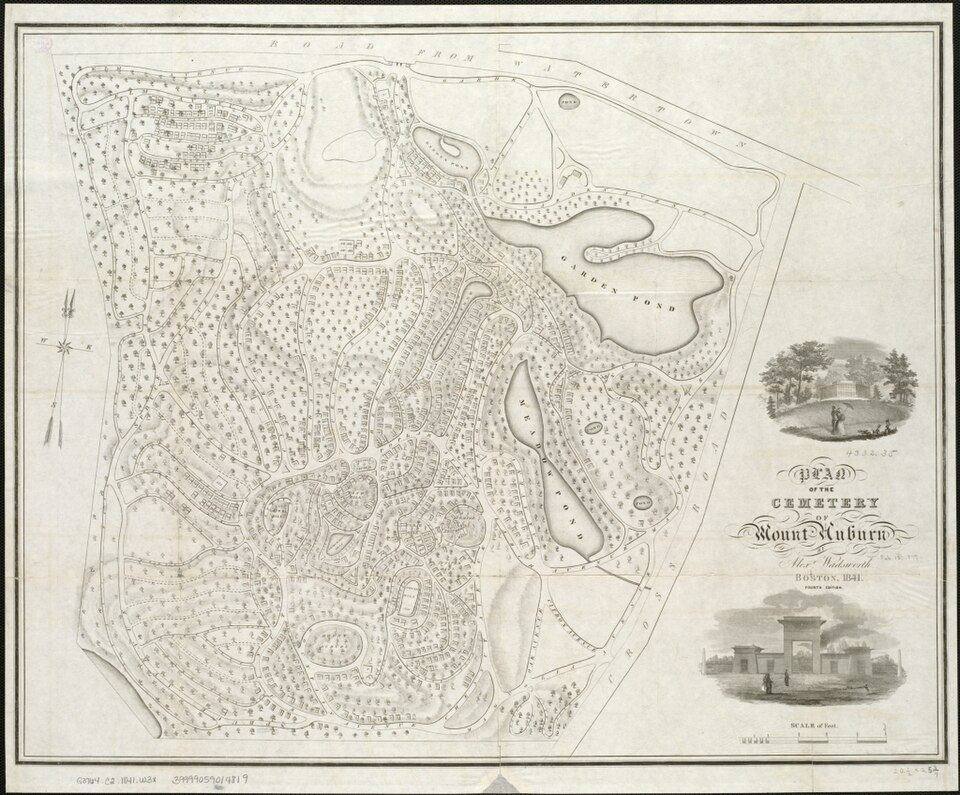
A rural cemetery founded in 1831 after physician Jacob Bigelow argued that crowded city burial grounds endangered health. Dearborn and Wadsworth laid out rolling ground, ponds and planting that drew visitors and later helped build support for public parks.
How it came about and changed
- 1825
Dr Jacob Bigelow, a Boston physician and Harvard professor, invited civic leaders to his house and proposed a new kind of cemetery outside the city: family lots set in a landscape of trees, shrubs and flowers. He was concerned that crowded urban burial grounds spread disease.15
- 1830–1831
George W. Brimmer offered the Massachusetts Horticultural Society 72 acres known as 'Sweet Auburn' (formerly Stone's Woods) for 6,000 dollars. A meeting in June 1831, chaired by Judge Joseph Story, accepted the offer. The Society bought the land for a rural cemetery with an experimental garden.6241
- 1831
The legislature passed an act on 23 June 1831. Henry A. S. Dearborn, first president of the Horticultural Society, laid out the grounds with the surveyor and civil engineer Alexander Wadsworth, who drew the first plan; they worked with Bigelow and George Brimmer. Following English landscape principles, the winding avenues followed the land's contours. Thirty-two of the 72 acres were set aside for the Experimental Garden.6231
- 1831 (24 September)
The cemetery was consecrated in Consecration Dell. Joseph Story, its first president, gave the address, and newspapers reported a crowd of more than 2,000.4
- 1833–1835
The trustees created the post of superintendent and gardener in 1833; the first holder was David Haggerston. After disputes between the cemetery and garden interests, a new corporation of lot-holders, the Proprietors of the Cemetery of Mount Auburn, took ownership from the Society in June 1835. The Experimental Garden ended at that point.31
- 1857–1870s
A cemetery gardener post was created in 1857. In the 1870s the cemetery moved towards open, park-like space, with smaller lots, fewer monuments, and curbs and cast-iron fences removed. By 1870 the trustees had a Committee on Birds that recommended plantings to attract birds.21
- 1920s–1930s
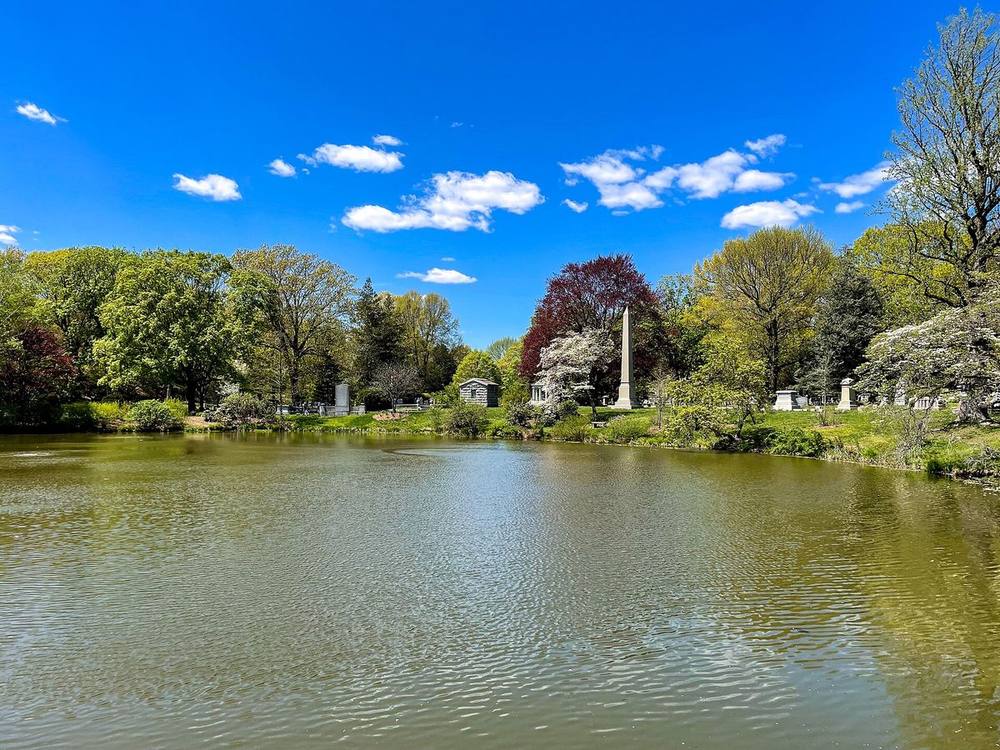
Landscape architects Laurence Caldwell and then Sidney and Arthur Shurcliff kept the park-like, estate-garden character. Willow Pond was built around 1935 to a Shurcliff design. Oakes Ames, president from 1934 to 1963, developed the grounds as an arboretum and bird sanctuary.21
- 1938
The Great New England Hurricane destroyed more than 800 trees at the cemetery.2
- 1975–2003
The cemetery was listed in the National Register of Historic Places in 1975 and designated a National Historic Landmark in 2003.51
- 1993–present
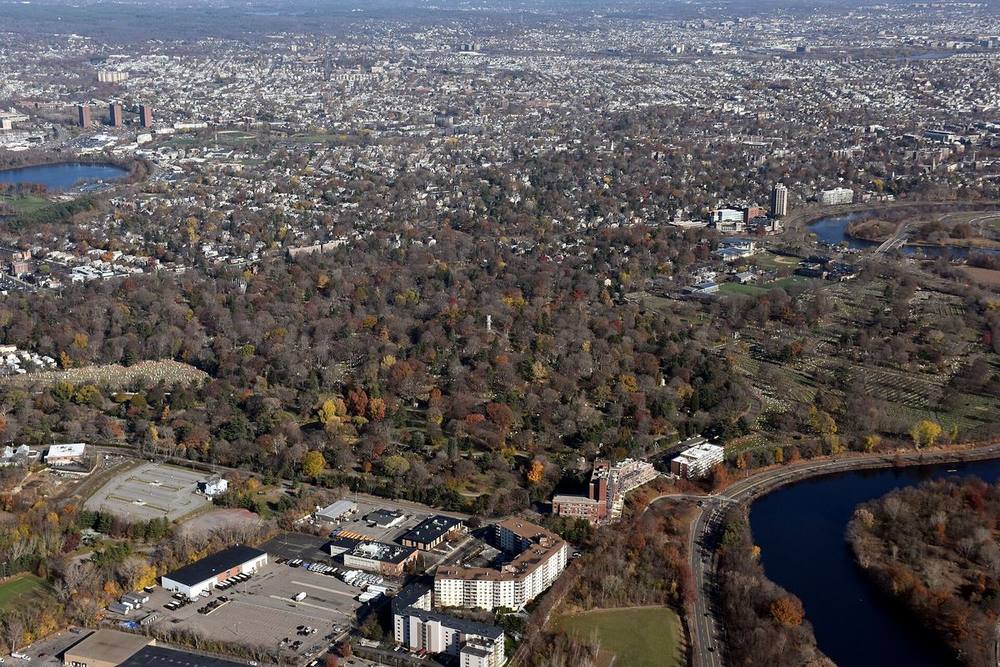
The Halvorson Company completed a master plan in 1993. Later projects include Reed Hilderbrand's 1998 rehabilitation plan around the Mary Baker Eddy Memorial, work by Julia Moir Messervy Design Studio at Spruce and Willow Knoll, and woodland restoration in Consecration Dell from 1997. The cemetery still operates as a private non-profit, with over 5,500 trees, shrubs and other plants on 175 acres.541



Approvals and legal steps
- 1831 (23 June) Act of the Massachusetts legislature letting the Massachusetts Horticultural Society establish the cemetery and experimental garden. An 1843 history says 'an act of incorporation was obtained of the legislature of the state, June 23 1831'. Mount Auburn's own article cites 'An Act to Incorporate the Proprietors of the Cemetery of Mount Auburn,' 1831.63
- 1831 The Horticultural Society bought the 72-acre Brimmer property.246
- 1835 (June) Ownership passed from the Horticultural Society to the newly established Proprietors of the Cemetery of Mount Auburn, a lot-holders' corporation.31
- 1975 Listed in the National Register of Historic Places.5
- 2003 Designated a National Historic Landmark by the Secretary of the Interior.15
Funding
- 1830–1832 The 72-acre property was bought from George W. Brimmer for 6,000 dollars (about $83.33 per acre, as stated in the 1843 history).6
- 1831–1835 The project was financed through the Massachusetts Horticultural Society and the sale of burial lots. NPS says new lots sold quickly; the 1835 transfer was to a corporation of lot-holders.13
- 1835–1976 A percentage of lot-sale income went to the Massachusetts Horticultural Society.3
People
- Jacob Bigelow Physician and botanist; originated the rural-cemetery idea (1825); founder; later wrote The History of Mount Auburn (1860)
- Henry A. S. Dearborn First president of the Massachusetts Horticultural Society; largely responsible for the design and the Experimental Garden
- Alexander Wadsworth Surveyor and civil engineer; drew the first plan (1831)
- George W. Brimmer Seller of the land; also involved in the early design
- Joseph Story Associate Justice of the US Supreme Court; chaired the 1831 meeting; first president; gave the consecration address
- Massachusetts Horticultural Society Founding sponsor and first owner (1831–1835)
- Proprietors of the Cemetery of Mount Auburn Non-profit corporation that has owned and run the cemetery since 1835
- David Haggerston First superintendent and gardener (1833–1834)
- Laurence Caldwell; Sidney and Arthur Shurcliff Landscape architects, 1920s–1930s (Willow Pond)
- Oakes Ames President 1934–1963; developed the arboretum and bird-sanctuary character
- Halvorson Company; Reed Hilderbrand; Julia Moir Messervy Design Studio Master plan (1993) and later landscape projects
Sources for this page
- US National Park Service, Mount Auburn Cemetery
- Mount Auburn Cemetery, Horticulture and a Tradition of Landscape Design (Melissa Banta, 2012)
- Mount Auburn Cemetery, The Genesis of the Experimental Garden at Mount Auburn Cemetery (2022)
- Mount Auburn Cemetery, Consecration Dell
- The Cultural Landscape Foundation, Mount Auburn Cemetery
- Internet Archive, A concise history of, and guide through Mount Auburn (Nathaniel Dearborn, Boston, 1843)
- Wikidata, Mount Auburn Cemetery (Q1950363)
Researched on 2026-11-19 from the sources listed; a fact that could not be confirmed in a source was left out. Pictures are public domain or under an open licence, credited as their file page asks.
The question it brings · interpretation
Mount Auburn was built for burial and used for strolling; which single-purpose landscapes in your city are already working as parks, and what would it take to plan for that?
Each question is Field Method’s interpretation, not a claim made by the source.
The date
Founding, 1831, when the Massachusetts Horticultural Society took on the project and acquired the site. Bigelow had proposed the idea in 1825.