1938
Gardens for the Ministry of Education and Health building (Palácio Gustavo Capanema)
Roberto Burle Marx · Rio de Janeiro, Brazil
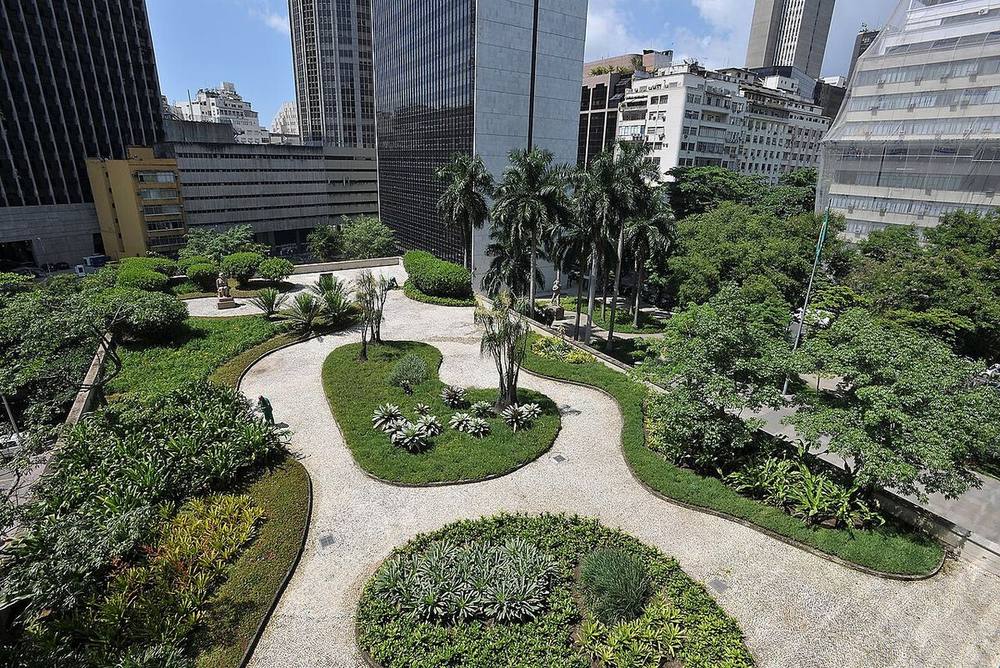
Gardens at pilotis level and on terraces of a modernist ministry building in Rio de Janeiro. Accounts differ on how Burle Marx's schemes for it changed between 1938 and the mid-1940s, and on which forms were built.
How it came about and changed
- 1935–1937
On 11 February 1935 Minister Gustavo Capanema requested a public competition for the new Ministry of Education and Public Health headquarters; the result was set aside and Lucio Costa's team was commissioned, with Le Corbusier as consultant during his July–August 1936 visit. The foundation stone was laid on 24 April 1937.32
- 1937–1945
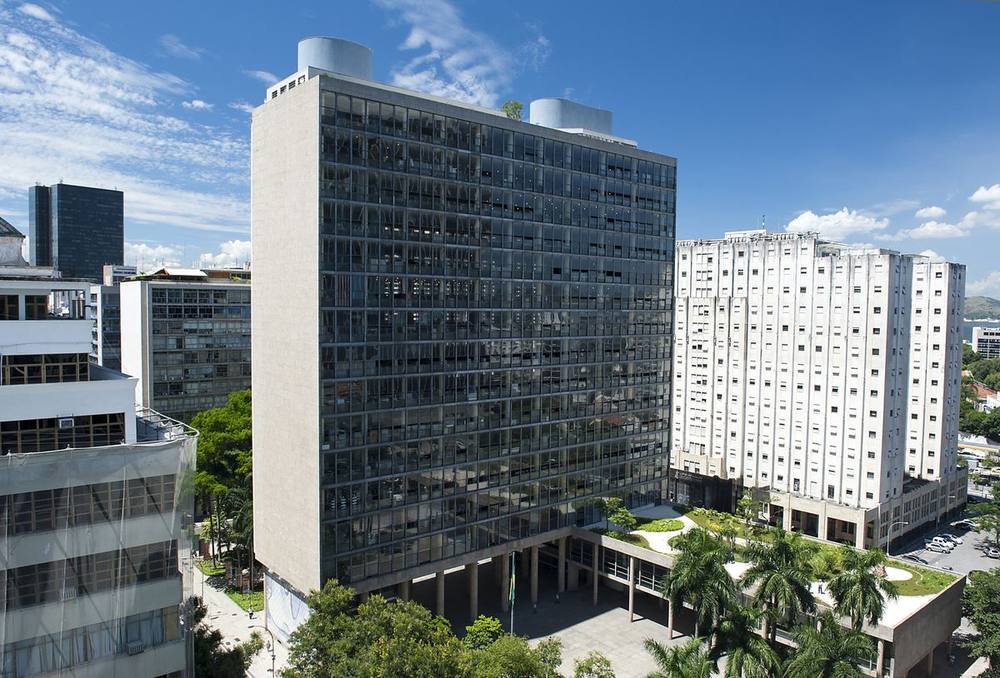
The building was constructed between 1937 and 1943 (some sources say 1945) and inaugurated on 3 October 1945. The design team was coordinated by Lucio Costa with Oscar Niemeyer, Affonso Eduardo Reidy, Carlos Leão, Jorge Moreira and Ernani Vasconcellos.321
- 1938
Invited by Costa, Roberto Burle Marx presented his first garden proposal: Cartesian flowerbeds aligned with the architecture.1
- 1942–1944
Burle Marx developed a second proposal using, for the first time, the curvilinear forms that came to characterise his work, for the pilotis area and the terrace gardens on the second floor and the 16th floor; he also assisted Cândido Portinari on the second-floor hall panels.1
- 1955
The MAM project inventory lists 1955 as a date of adaptation ('adequacy') of the implemented gardens; details are not given.1
- 1971, 1988
Reforms by the Burle Marx office; in 1988 Burle Marx with Haruyoshi Ono and José Waldemar Tabacow made the latest revision of the implemented project.1
- 2015
The gardens were recovered and revitalised.1
- 2019–2025
Conservation and modernisation works by IPHAN began in February 2019 and included recovery of the gardens; the building was reinaugurated in May 2025 and reopened to visitors in August 2025, combining public areas with Ministry of Culture offices.24

Approvals and legal steps
- 1935–1937 Federal competition called for the ministry headquarters (1935), then annulled in favour of a direct commission to Costa's team; Capanema justified the annulment administratively at the 24 April 1937 foundation-stone ceremony.3
- 1948 Federally listed (tombado) by the national heritage service (now IPHAN); the gardens are part of the federally listed property.21
Funding
- 1937–1945 A federal government building for the Ministry of Education and Public Health; construction costs are not stated in the sources read.32
- 2019–2025 Restoration, including the Burle Marx gardens, financed by the federal government through the Novo PAC programme: R$ 84 million (federal government news agency) or R$ 83 million (Brasil de Fato).24
People
- Roberto Burle Marx Landscape architect of the pilotis and terrace gardens (1938 and 1942–1944 proposals; 1988 revision)
- Gustavo Capanema Minister of Education and Public Health; client who commissioned Costa's team
- Lucio Costa Coordinating architect
- Oscar Niemeyer, Affonso Eduardo Reidy, Carlos Leão, Jorge Moreira, Ernani Vasconcellos Architects in Costa's team
- Le Corbusier Consultant (visit July–August 1936)
- Cândido Portinari Artist of the panels; Burle Marx assisted him
- Haruyoshi Ono and José Waldemar Tabacow Burle Marx office associates on the 1988 revision
- IPHAN Federal heritage agency; conducted the 2019–2025 restoration
- Ministry of Culture Current occupant and manager
Sources for this page
- Museu de Arte Moderna do Rio de Janeiro (Burle Marx project inventory), Ministry of Education and Health Building (MES)
- Agência Gov (Government of Brazil), Presidente Lula entrega Ordem do Mérito Cultural e reinaugura Palácio Capanema no Rio (20 May 2025)
- ANPUH, Em defesa do moderno: arte e política nos anos 1930 – a escolha do projeto do edifício-sede do Ministério da Educação e Saúde Pública (1935-1937), L. H. J. de A. Rechdan, Anais do XXVI Simpósio Nacional de História, 2011
- Brasil de Fato, Ministério da Cultura reabre Palácio Capanema... (6 Aug 2025)
- Wikidata, Gustavo Capanema Palace (Q2598551)
Researched on 2026-11-19 from the sources listed; a fact that could not be confirmed in a source was left out. Pictures are public domain or under an open licence, credited as their file page asks.
The question it brings · interpretation
On a roof or podium seen mostly from the floors above, should the planting follow the building's grid or set up a pattern of its own?
Each question is Field Method’s interpretation, not a claim made by the source.
The date
Year of Burle Marx's first garden proposal for the Ministry of Education and Health building. His second, curvilinear proposal dates from 1942-1944. MAM Rio dates the building 1938-1944; other sources give different construction dates. The gardens were revised in 1988 and restored in 2015.