2010
Houtan Park (Shanghai Expo 2010)
Turenscape and Peking University Graduate School of Landscape Architecture (Kongjian Yu, design principal); client Shanghai Expo Bureau with Shanghai Landscape Bureau · Shanghai, China
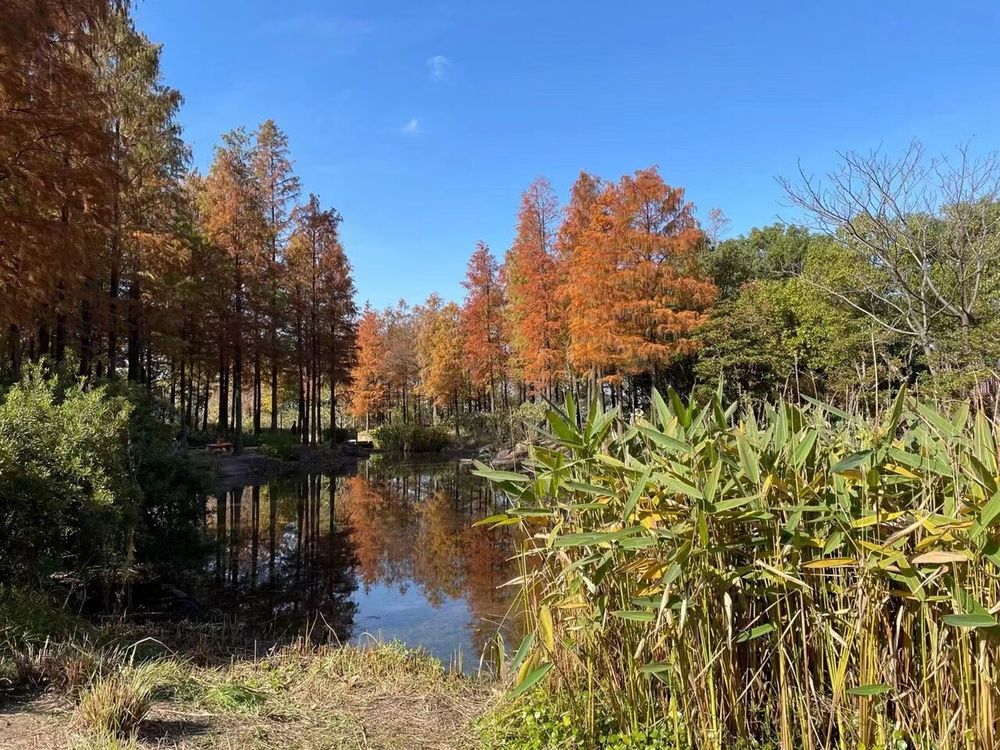
On a 14-hectare former steel factory and shipyard on the Huangpu River, a 1.7 km constructed wetland treats river water and buffers floods. ASLA gave it a 2010 Award of Excellence as a demonstration of ecological infrastructure.
How it came about and changed
- before 2007
The narrow riverside site had belonged to a steel factory and a shipyard; few industrial structures remained, and the site was used as a landfill and lay-down yard. A concrete floodwall and daily tides left an inaccessible, muddy shoreline, and Huangpu River water was highly polluted.12
- 2007
Turenscape designed the park for the 2010 Shanghai World Expo ('Better City, Better Life'). The brief was to show green technologies, handle large Expo crowds and then become a permanent public waterfront park.312
- 2007-2010
Construction (contractor: Shanghai Landscape Construction Company) created the 1.7 km constructed wetland with cascades, terraces and treatment stages. Agricultural terraces took up the 3-5 m level change. Riprap replaced the floodwall, about 37 tons of on-site steel and some 34,000 bricks were reused, and 585 trees were planted.12
- 2010
The park served the Expo (May to October 2010), receiving some 590,500 visitors according to LAF, and won the ASLA Award of Excellence for General Design.213
- 2011
A Landscape Architecture Foundation team led by Nancy Rottle (University of Washington) published a performance case study. It reports treatment of up to 634,000 gallons (2,400 m3) of river water a day from Grade V to Grade II, 93 plant and over 200 animal species observed, and estimated carbon and cost savings.2
- after 2010
The park continued as a permanent public waterfront park after the Expo, according to LAF.2
Approvals and legal steps
No planning approvals, land-transfer decisions or protection designations for the park were found in the sources read. The park was delivered within the Shanghai World Expo programme with the Shanghai Expo Bureau as client.
Funding
People
- Kongjian Yu Design principal, Turenscape / Peking University Graduate School of Landscape Architecture
- Turenscape Landscape architect, architect, urban planner, hydrological, lighting engineering and research lead
- Shanghai Expo Bureau (Lin Guixiang, Zhao Keping, Lin Li) Client
- Shanghai Landscape Bureau (Zhang Rang) Client team
- Shanghai Landscape Construction Company Contractor
- Shanghai Ocean University (listed by ASLA as 'Shanghai University of Ocean University'; by LAF as Shanghai University of Oceanography) Wetland plant science
- Nancy Rottle and University of Washington team Authors of the 2011 LAF performance case study
Sources for this page
- American Society of Landscape Architects, ASLA 2010 Professional Awards: Shanghai Houtan Park
- Landscape Architecture Foundation, Shanghai Houtan Park (Landscape Performance Series case study, 2011)
- The Cultural Landscape Foundation, Shanghai Houtan Park
Researched on 2026-11-19 from the sources listed; a fact that could not be confirmed in a source was left out. Pictures are public domain or under an open licence, credited as their file page asks.
The question it brings · interpretation
Can a park's main spatial structure also be the system that treats water and absorbs floods, and how would you show that it performs?
Each question is Field Method’s interpretation, not a claim made by the source.
The date
2010 marks completion and opening for the Shanghai World Expo (May-October 2010); LAF gives completion 2010. TCLF says the park was designed in 2007; it received the ASLA Award of Excellence (General Design) in 2010. A secondary source reports completion as May 2010 in one place and October in another (not verified).