1976
Freeway Park
Lawrence Halprin & Associates, with Angela Danadjieva (Tzvetin) as project designer; City of Seattle (Parks Department) with the Washington State Highway Department and developer R. C. Hedreen · Seattle, United States
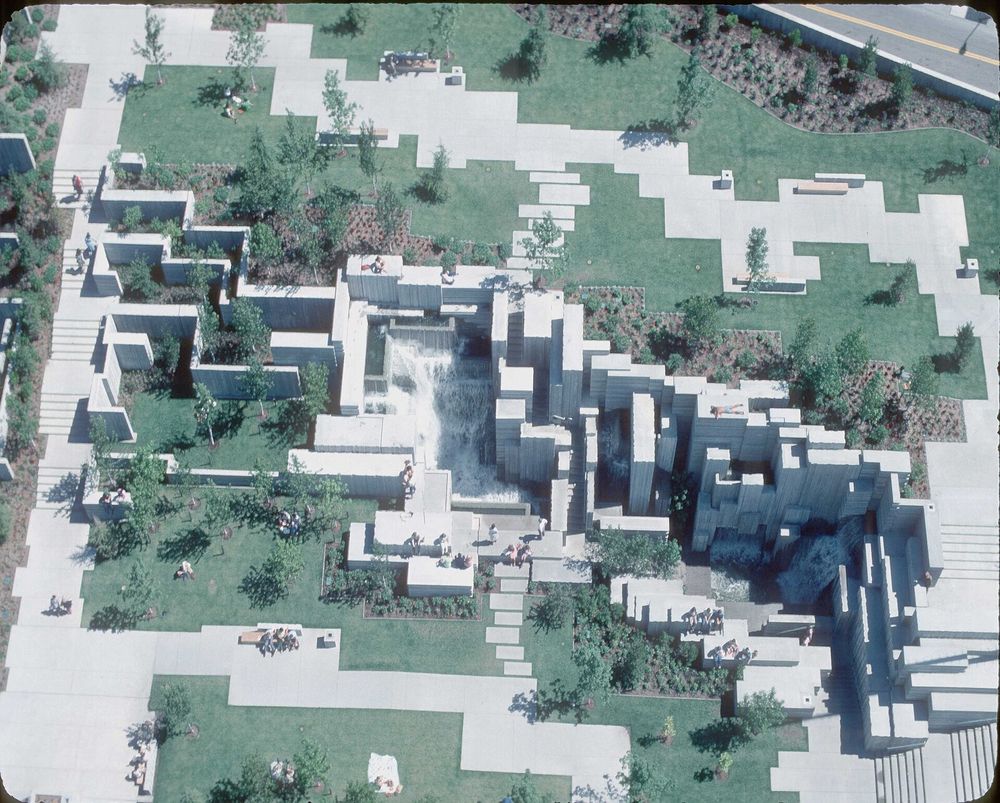
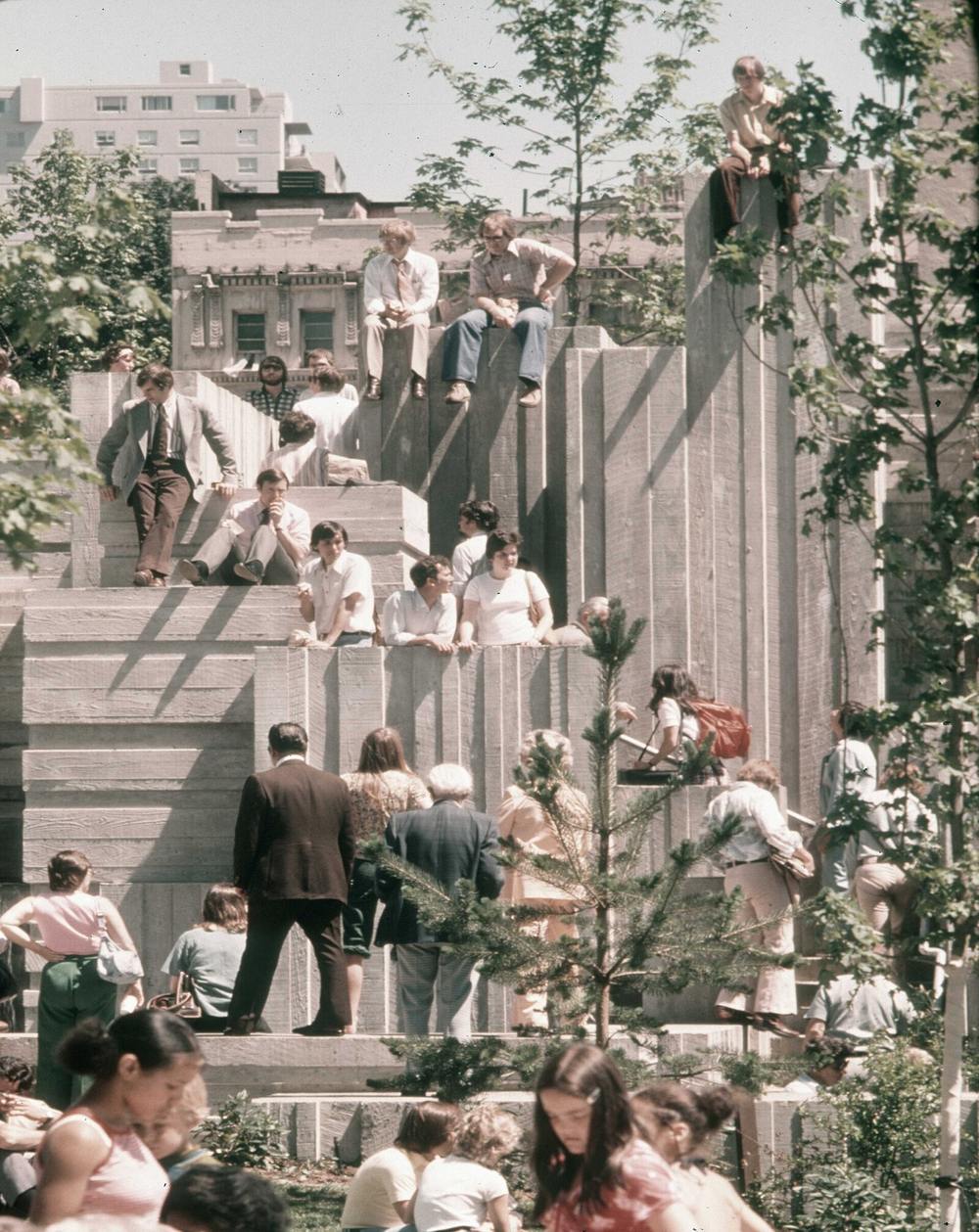
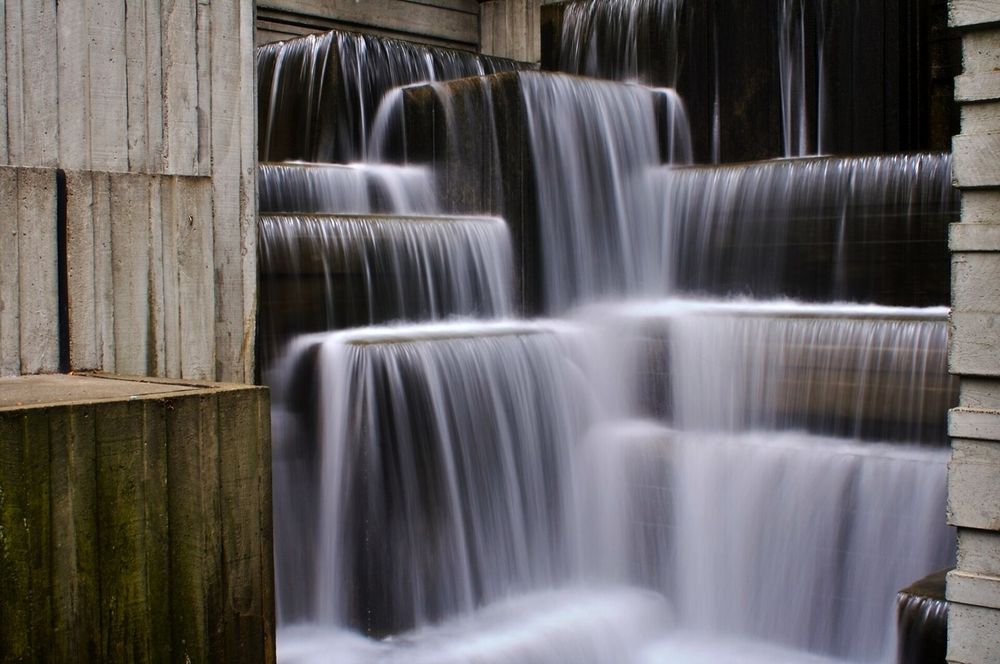
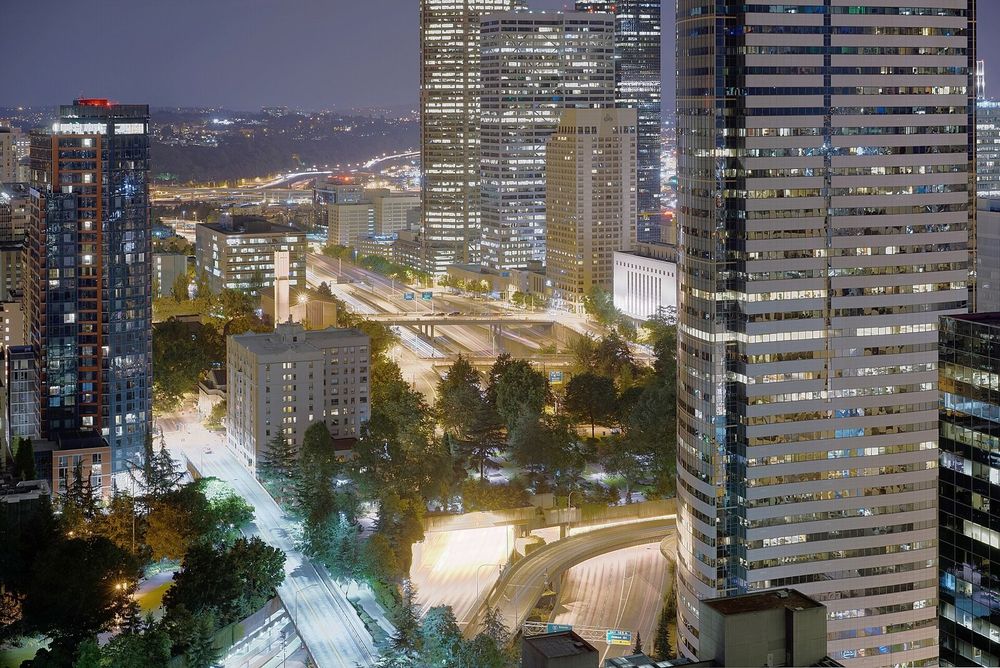
A park of about five acres built over Interstate 5 in downtown Seattle, opened in 1976, reconnecting First Hill to downtown with plazas, concrete planters and a canyon of waterfalls. It is described as the first park over an interstate.
How it came about and changed
- 1961–1966
As Interstate 5 was cut through central Seattle, architect Paul Thiry and the First Hill Improvement Club proposed in 1961 lidding parts of the freeway; the proposal was rejected over cost and delay, but the idea persisted. In 1966 architect Floyd A. Naramore anonymously gave $50,000 for a fountain at 6th Avenue and Seneca Street by sculptor George Tsutakawa, completed in 1967 and later incorporated into the park.13
- 1968–1970
Voters approved a $118 million Forward Thrust parks bond in 1968, part of a package organised by attorney James Ellis. The city planned a larger park combining leftover freeway parcels with a private office building (Park Place, R. C. Hedreen), whose garage would sit under the park, and a public garage. In November 1970 Lawrence Halprin & Associates was chosen over firms including Sasaki Dawson DeMay, Richard Haag and Paul Friedberg.1
- 1970–1973
Halprin's team, with Angela Danadjieva Tzvetin as project designer, Jean Walton as horticulturalist and Seattle associates Sakuma & James, designed the park with physical models. The city garage under the East Plaza (NBBJ) was approved in March 1972 with tree pockets in its roof, and the Seattle Design Commission approved the Canyon waterfall in April 1973.13
- 1974–1976
Construction began in early 1974 in four phases: central plaza, Great Box Garden (Peter Kiewit Sons), the bridge over I-5 whose 23 precast girders were set at night in December 1974 (David A. Mowat Company), and the East Plaza on the garage. The park was dedicated on 4 July 1976 as the opening event of the city and county's Bicentennial observance.1
- 1976–2000s
Extensions designed by Danadjieva in 1983 and 1988 linked the park to the Washington State Convention Center. Vegetation grew dense; after assaults in 1982 and public concern about safety, trees were thinned from 1989. The Freeway Park Association, founded in 1994, works to activate and advocate for the park.15
- 2018–present
A 2018 programmatic agreement under Section 106 governs changes; the park was listed in the National Register in 2019 and designated a City of Seattle Landmark in 2022. A Freeway Park Improvements project funded by $10 million from the Washington State Convention Center expansion began its first construction phase in March 2026; the Canyon Cascade fountain was turned back on in May 2026 and the 50th anniversary was celebrated on 22 August 2026.562



Approvals and legal steps
- 1968 King County voters approved the Forward Thrust parks and recreation bond ($118 million, 64.7% of the vote) that provided the first public funds for the park.1
- 1972–1973 Approval of the Freeway Park garage design (March 1972) and of the Canyon waterfall and initial park plans by the Seattle Design Commission (April 1973).1
- 2018 Programmatic agreement under Section 106 of the National Historic Preservation Act requiring the City of Seattle to seek advisory input from consulting parties on projects affecting the park's character-defining features.5
- 2019 Listed in the National Register of Historic Places (NRIS 100004789) on 19 December 2019 at the national level under Criteria A and C.42
- 2022 Designated a City of Seattle Landmark.5
Funding
- 1966 Architect Floyd A. Naramore privately gave $50,000 for the design, construction and installation of the Naramore Fountain.1
- 1969–1976 Public-private partnership: developer R. C. Hedreen resited his Park Place building and built his garage under the West Plaza, contributing to funding and maintaining the park above it; the State Department of Highways provided the lid structure over I-5; the City Council provided $3.5 million for a public parking garage under the East Plaza. A 1974 city report estimated $5,100,000 for the park, from city parks funds, state agencies, federal funds and parking revenue.1
- 1976 A Seattle Times article of 30 May 1976 (cited in the NRHP nomination) put the whole project at $23.5 million: $2.7 million from Forward Thrust bonds; $208,633 HUD open-space grants; $424,655 State Interagency Committee for Outdoor Recreation; $340,000 HUD block grant; $60,000 federal urban-arterial funds; $18,900 from Metro; $155,000 federal interstate highway funds; $70,000 city garage bonds; $35,000 from the American Legion; the bridge over I-5 was paid 90% from federal interstate funds and 10% from state highway funds; $2.5 million for the Great Box Garden; Hedreen's building cost $9.6 million.1
- 1976 Friends of the Freeway Park, a nonprofit, began financing four seasonal plantings a year, with corporate contributors paying $6,000 a year.1
- 2019–2026 Freeway Park Improvements project: $10 million from the Washington State Convention Center expansion project (including $6 million construction budget, $750,000 for activation), delivered by Seattle Parks and Recreation with Walker|Macy as lead landscape architect.6
People
- Lawrence Halprin & Associates Landscape architects (selected November 1970)
- Angela Danadjieva (Tzvetin) Project designer for Halprin; later designed the 1983 and 1988 extensions
- Jean Walton Horticulturalist, Halprin & Associates
- Byron McCulley; Dai Williams; Robert Mendelsohn Project manager; job captain; project administrator
- Sakuma & James; Edward McCleod & Associates Associate landscape architects
- James Ellis Organiser of Forward Thrust and advocate for the park
- Paul Thiry Architect who proposed a freeway lid in 1961
- R. C. (Richard) Hedreen Developer of the Park Place building; partner in the park
- Floyd A. Naramore; George Tsutakawa Donor and sculptor of the Naramore Fountain (1967)
- NBBJ Architects of the East Plaza garage
- Peter Kiewit Sons; David A. Mowat Company Construction contractors
- Washington State Highway Department Provided the lid structure over I-5
- Freeway Park Association; Seattle Parks and Recreation Current advocacy/activation and park owner-manager
Sources for this page
- U.S. National Park Service (NPGallery), Freeway Park, National Register of Historic Places Registration Form (2019)
- U.S. National Park Service, Freeway Park (NRIS 100004789), NPGallery asset record
- The Cultural Landscape Foundation, Freeway Park, Seattle, WA
- The Cultural Landscape Foundation, Halprin's Freeway Park Added to National Register
- The Cultural Landscape Foundation, Freeway Park Turns 50 as Rehabilitation Advances (15 September 2026)
- Federal Highway Administration, Center for Innovative Finance Support, Project Profile: Freeway Park Improvements, Seattle, Washington
- Wikidata, Freeway Park (Q5501246)
Researched on 2026-11-19 from the sources listed; a fact that could not be confirmed in a source was left out. Pictures are public domain or under an open licence, credited as their file page asks.
The question it brings · interpretation
When infrastructure divides a city, can the structure that covers it be designed as landscape from the start, and who must share the cost and long-term care for it to stay welcoming?
Each question is Field Method’s interpretation, not a claim made by the source.
The date
1976 is the opening: the dedication plaque records the opening on 4 July 1976 as the opening event of the Bicentennial observance (NRHP nomination, 2019, citing the plaque; the same nomination's narrative gives opening ceremonies on 5 July 1976). Halprin's firm was chosen in November 1970; construction began in early 1974. Extensions designed by Angela Danadjieva followed in 1983 and 1988. Listed in the National Register of Historic Places on 19 December 2019; designated a City of Seattle Landmark in 2022 (TCLF).
Checked against
- U.S. National Park Service, Freeway Park, National Register of Historic Places Registration Form (Chrisanne Beckner, Historical Research Associates, 2019)
- The Cultural Landscape Foundation, Freeway Park, Seattle, WA
- The Cultural Landscape Foundation, Halprin's Freeway Park Added to National Register (15 January 2020)