1971
Copacabana beach promenade (Avenida Atlântica, Burle Marx)
Roberto Burle Marx (landscape and pavement design); Lúcio Costa (urban design consultant); SURSAN, State of Guanabara (project and execution) · Rio de Janeiro, Brazil
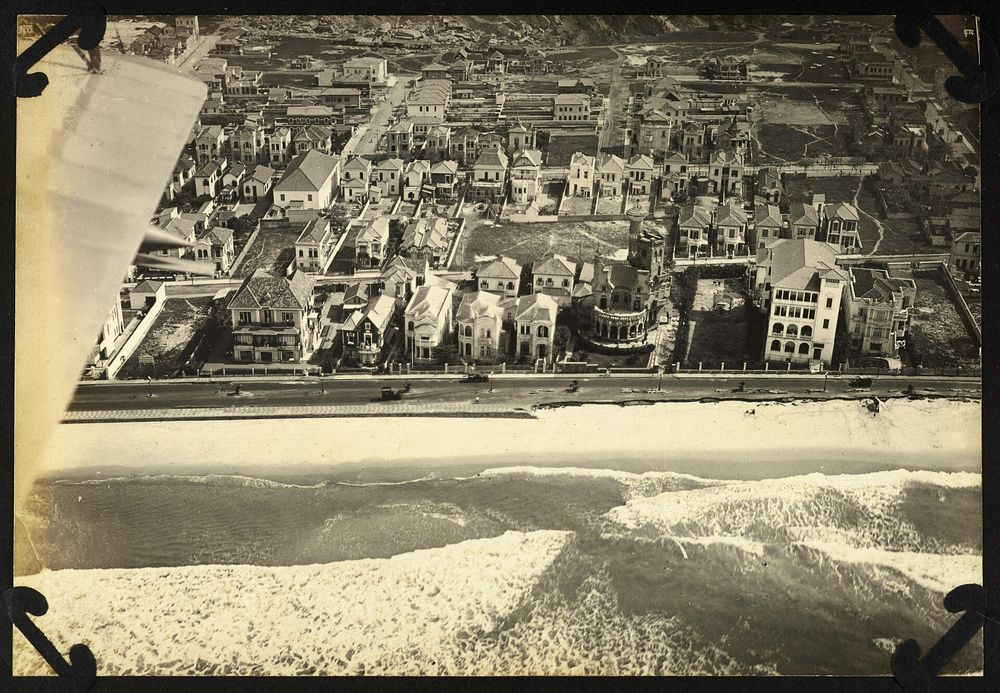
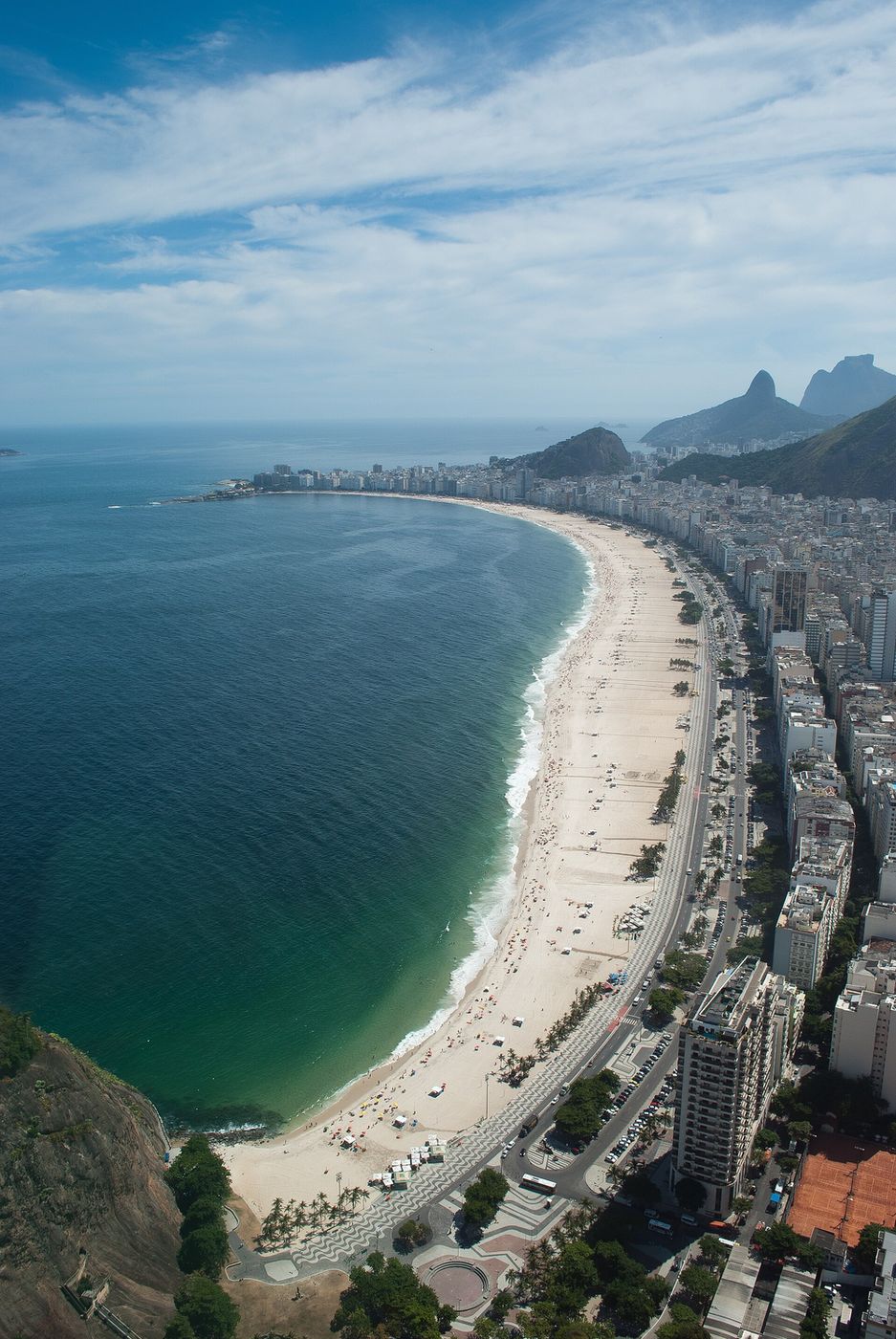
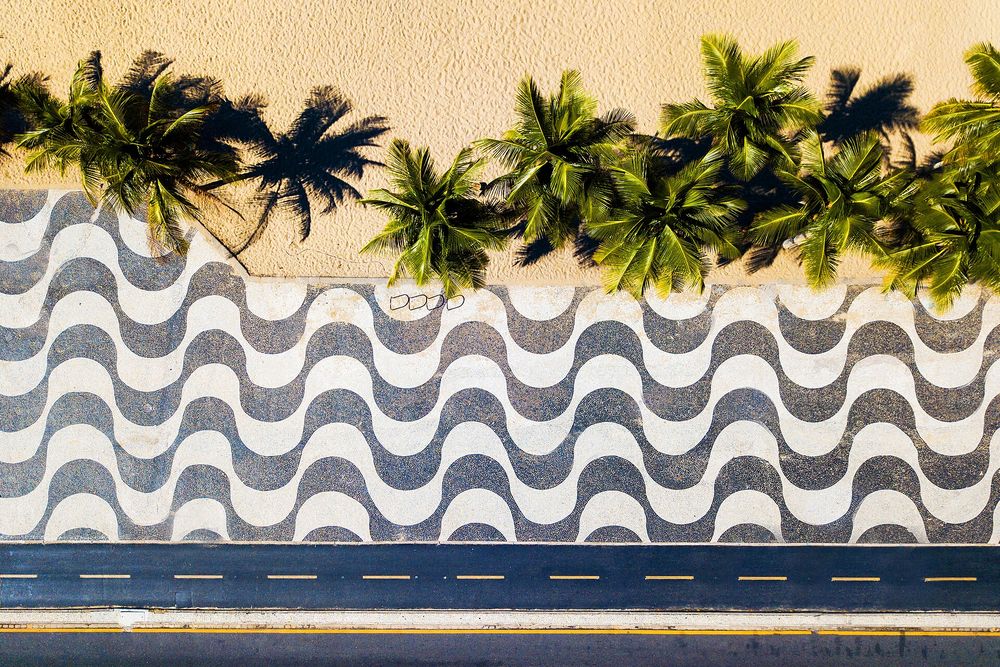
After landfill widened the beach and Avenida Atlântica, Burle Marx designed the roughly 4 km promenade, completed in 1971, as continuous Portuguese stone mosaics and tree groups. It is part of Rio's World Heritage site inscribed in 2012.
How it came about and changed
- 1905-1910
Avenida Atlântica was laid out as an extension of the seafront avenue from Botafogo under Mayor Pereira Passos (alignment project PAA 137, 1905); Yllana's archival research dates its construction to 1910. The seaside pavement used the Portuguese 'mar largo' wave pattern laid perpendicular to the shore.1
- 1919-1960s
Storm surges (ressacas) repeatedly destroyed the road and pavement; a 4,200 m masonry and concrete wall built in 1919 was partly destroyed in 1921, and sandbags and rock armour were used thereafter. In 1958 a commission recommended studies by Lisbon's National Laboratory of Civil Engineering (LNEC).1
- 1964-1969
SURSAN, the State of Guanabara's urbanisation and sanitation agency, commissioned surveys and the LNEC studies (including a reduced-scale model of the beach in Lisbon from 1966). Justifications included the Oceanic sewage interceptor, storm protection, a stable beach width, recreation and tourism. In 1969 it was concluded that an 80 m landfill would give an average sand width of 90 m.1
- 1969-1971
Lúcio Costa acted as consultant on the urban design of the widened avenue; SURSAN, at Costa's suggestion, hired Burle Marx to design the paving of the building-side and central strips and the planting. SURSAN architects drew the enlarged seaside wave pattern at full scale; the seaside strip widened from 3 m to 10 m. Burle Marx presented the project at the 1970 Venice Biennale. The widening and gardens were completed in 1971.123
- after 1971
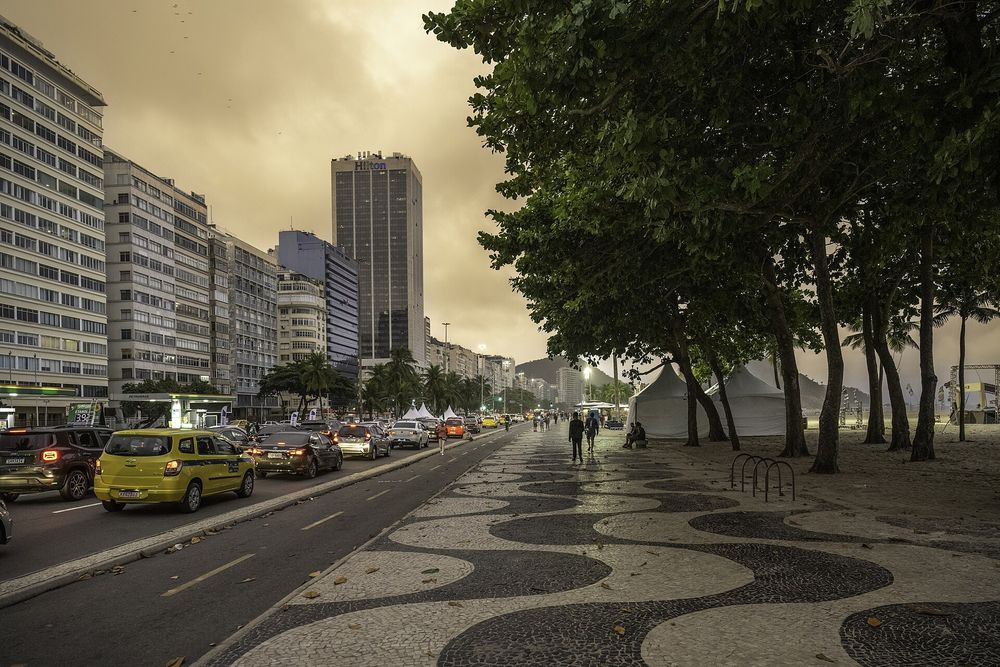
Later changes added parking, a continuous cycle path, lifeguard posts, kiosks and fuel stations; the IPHAN dossier names the extension of seafront restaurants onto the public space as the largest intrusion, handled by the city and the state heritage institute (INEPAC).3
- 2012
Copacabana beach, with its Burle Marx landscaping, became part of the World Heritage site 'Rio de Janeiro: Carioca Landscapes between the Mountain and the Sea', inscribed on 1 July 2012.43



Approvals and legal steps
- 1991 State listing (tombamento) of the urban-landscape ensemble of the Leme, Copacabana, Ipanema and Leblon beaches, dated 25 January 1991; INEPAC is named as guardian of Burle Marx's Portuguese stone mosaics at Copacabana.3
- 2009 Municipal Decree No. 30936 of 4 August 2009 ordered the provisional listing of 84 landscape works by Roberto Burle Marx in Rio de Janeiro, 29 of them inside the World Heritage site or its buffer zone.3
- 2012 Inscription of 'Rio de Janeiro: Carioca Landscapes between the Mountain and the Sea' on the World Heritage List (1 July 2012), with Copacabana beach as an element.43
Funding
- 1964-1971 The widening was a public work of the State of Guanabara, the responsibility of SURSAN from the preliminary studies to execution, and was carried out by SURSAN staff; Burle Marx's office was contracted by SURSAN.1
People
- Roberto Burle Marx Landscape architect: pavement mosaics for the building-side and central strips, and planting
- Lúcio Costa Consultant urban designer for the widened Avenida Atlântica
- SURSAN (Superintendência de Urbanização e Saneamento, State of Guanabara) Responsible agency for studies, design development and execution
- Raimundo de Paula Soares State Secretary of Works, considered author of the widening project
- Francisco Negrão de Lima Governor of Guanabara who championed the widening
- Laboratório Nacional de Engenharia Civil (LNEC), Lisbon Coastal engineering studies and reduced-scale model
- Maria de Lourdes Derenusson Kowarski; Sônia Mattos de Caúla; Augusto Ivan Pinheiro de Freitas SURSAN technical office; full-scale drawing of the seaside wave pattern
- Gilberto Paixão; Mario Sophia; Júlio Pessolani SURSAN execution team
- Haruyoshi Ono; José Tabacow Burle Marx associates (reported in secondary sources; see notes)
- INEPAC and the City of Rio de Janeiro Heritage protection and management
Sources for this page
- PUC-Campinas, Histórias não contadas sobre o calçadão de Copacabana (T. S. Yllana, Oculum Ensaios 19, 2022)
- Universidade Federal de Goiás, O passeio de Copacabana como patrimônio e paisagem cultural (J. Rey Pérez, Revista UFG, 2010)
- IPHAN (PDF hosted by ipatrimonio.org), Rio de Janeiro: Paisagens Cariocas entre a Montanha e o Mar - Dossiê de candidatura (2011)
- Nações Unidas Brasil, Rio de Janeiro é 1ª paisagem cultural urbana declarada Patrimônio Mundial da UNESCO
- National Endowment for the Humanities, Humanities magazine (2019), Making the Promenade Modern
- Wikidata, Piso de Pedra Portuguesa Mosaico de Burle Marx de Copacabana (Q67203977)
Researched on 2026-11-19 from the sources listed; a fact that could not be confirmed in a source was left out. Pictures are public domain or under an open licence, credited as their file page asks.
The question it brings · interpretation
How can paving, planting and street furniture turn a coastal engineering project such as a widened road and a filled beach into a single public landscape at the scale of a whole neighbourhood?
Each question is Field Method’s interpretation, not a claim made by the source.
The date
1971 marks completion of the widening of Avenida Atlântica and execution of Burle Marx's gardens and pavements for the Copacabana promenade (IPHAN World Heritage dossier, 2011; Yllana 2022). Burle Marx's design is dated 1970 and was shown at the 1970 Venice Biennale (Rey Pérez 2010). Works on the widening began 1969-1970; studies by Lisbon's LNEC began in the 1960s; the original Avenida Atlântica dates from 1910 per Yllana (often given as 1906-1908).
Checked against
- IPHAN (PDF hosted by ipatrimonio.org), Rio de Janeiro: Paisagens Cariocas entre a Montanha e o Mar - Dossiê de candidatura (Portuguese, March 2011)
- PUC-Campinas, Histórias não contadas sobre o calçadão de Copacabana (T. S. Yllana, Oculum Ensaios 19, 2022)
- Universidade Federal de Goiás, O passeio de Copacabana como patrimônio e paisagem cultural (J. Rey Pérez, Revista UFG, 2010)
- Nações Unidas Brasil, Rio de Janeiro é 1ª paisagem cultural urbana declarada Patrimônio Mundial da UNESCO