1992
Bryant Park restoration
Hanna/Olin (Laurie Olin), with Lynden B. Miller (planting), for the Bryant Park Restoration Corporation with the New York Public Library and NYC Parks · New York City, United States
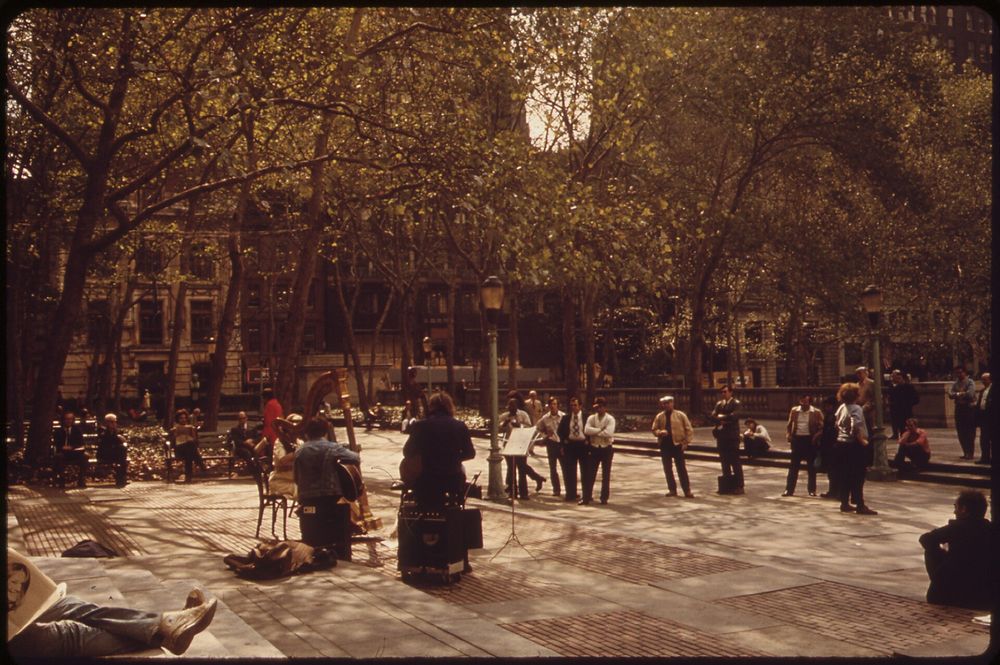
After William H. Whyte found the raised, hedged park cut off from the street, Hanna/Olin opened entrances and sightlines and added movable chairs over new library stacks. Reopened in 1992, it became a model for public-private park revitalisation.
How it came about and changed
- 1823–1911
The site became a potter's field in 1823; the Croton Distributing Reservoir was built alongside (1839–1842) and the square west of it hosted the Crystal Palace (1853, burned 1858). Renamed Bryant Park in 1884; the reservoir was removed by 1900 and the New York Public Library, with its rear terrace by Carrère & Hastings, completed in 1911.29
- 1933–1934
After years of neglect and subway construction, the Architects' Emergency Committee held a 1933 competition won by Lusby Simpson; the classical scheme of a central lawn, raised terraces, balustrades and London plane allées was executed under Parks Commissioner Robert Moses with Gilmore D. Clarke, M. Betty Sprout and Aymar Embury II, and rededicated in September 1934.926
- 1960s–1979
Underfunded maintenance, a business-district location with few evening users, and a design raised above the street behind fences and hedges contributed to decline; by the early 1970s the park was dominated by drug dealing and barricaded at night. In 1979 William H. Whyte, in a report commissioned by the Rockefeller Brothers Fund, argued the problem was under-use and that 'access is the nub of the solution'.361
- 1980–1987
Daniel Biederman and Andrew Heiskell founded the Bryant Park Restoration Corporation in 1980 with support from the Rockefeller Brothers Fund. Interim measures (repairs, graffiti removal, cleaning, security, food carts and events) were credited by BPC with a 92 percent drop in crime and a doubling of visitors over seven years. The library's front-terrace rehabilitation by the same team was completed in 1982.36
- 1986–1992
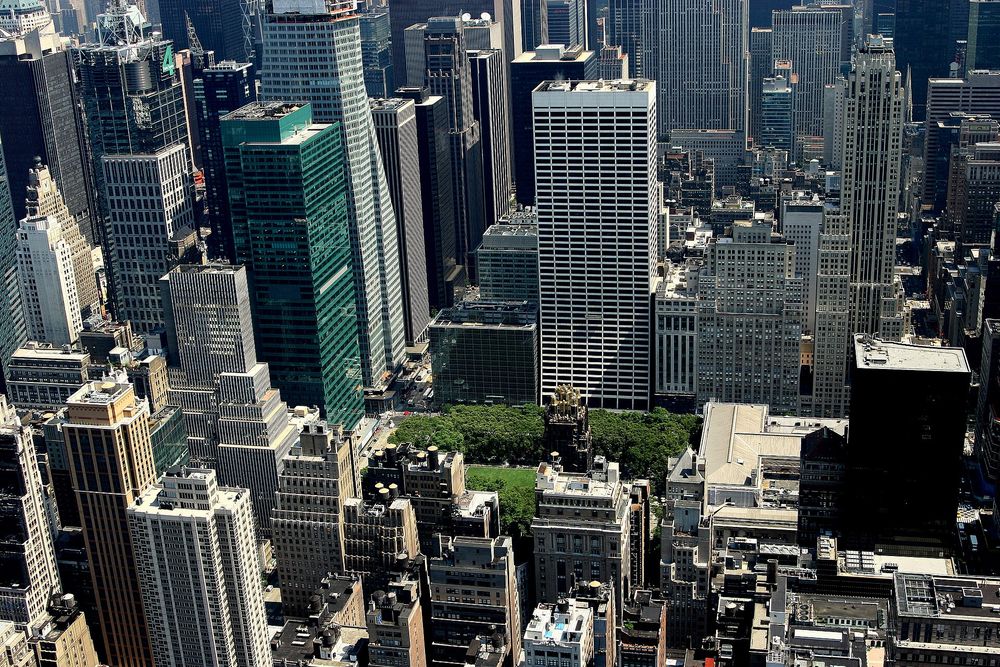
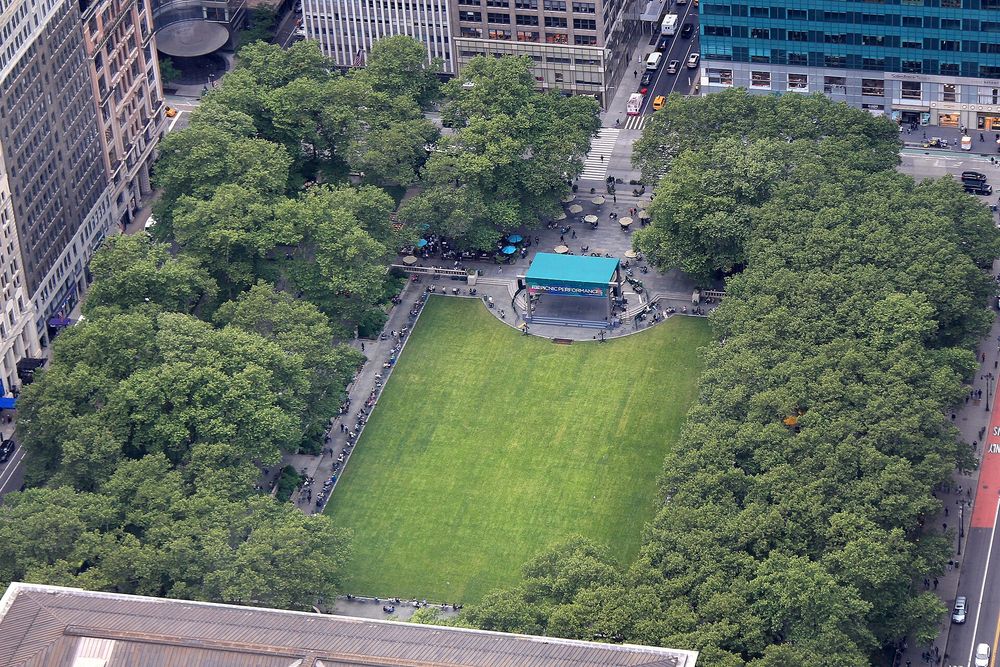
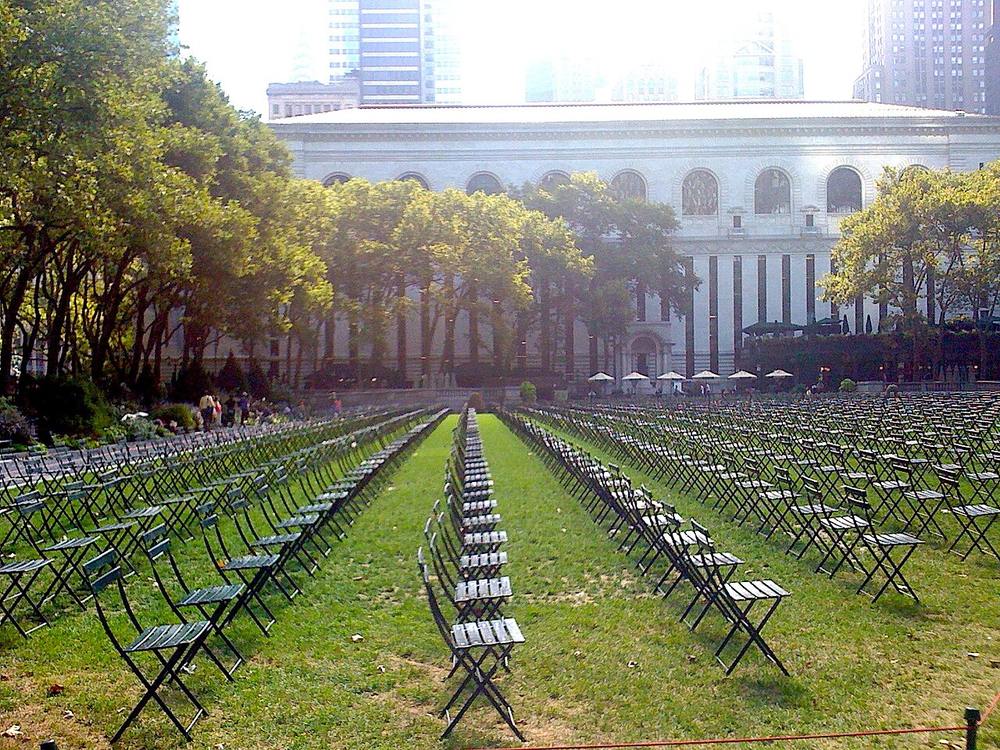
Hanna/Olin was hired in 1986. City agencies approved the park plans and HHPA's two restaurant pavilions and four kiosks in summer 1988, and the park closed for four years while the library's underground stacks were built beneath the lawn. The redesign kept the landmarked plane trees and fence but cut new mid-block entrances and stairs, removed hedges and parterres, enlarged the lawn, added Lynden Miller's perennial borders, reopened the restrooms and introduced about 2,000 movable chairs. The park reopened in April 1992.1236
- 1992–present
BPC runs the park as agent for the City with private funding, programming films (from 1993), concerts and, since 2005, a winter skating rink on the lawn; Le Carrousel was added in 2002 and the Reading Room in 2003. BPC shares its management team with the 34th Street Partnership.536



Approvals and legal steps
- 1966 Bryant Park and the New York Public Library were jointly listed on the National Register of Historic Places.67
- 1974 The NYC Landmarks Preservation Commission designated Bryant Park a Scenic Landmark (LP-0879, 12 November 1974, after a public hearing on 8 October 1974). Archipedia notes the landmark status ruled out lowering the park to street level, which would have meant felling the mature plane trees.96
- 1983 Bryant Park Management Corporation was organised as a District Management Association to carry out a plan approved by the New York City Board of Estimate, funded by assessments on property in the district capped at 3% of general city taxes.10
- 1985 / 1988 Lease and management agreements transferred management of the park from the City to BPRC, with a 35-year lease of the library terrace for commercial facilities (NY4P dates these 29 July 1985); BPC states that a 15-year management agreement was signed in 1988. City agencies approved the redesign and the kiosks and pavilions in summer 1988.1052
Funding
- 1980–1987 BPRC's early management and programming were paid for with private donations, including from the Rockefeller Brothers Fund.64
- 1988–1992 The rehabilitation was funded by the City, private donors and a business improvement district that assessed adjacent property owners; BPC states the park reopened with a budget six times the level under prior city management.625
- 1990–2001 New Yorkers for Parks reports that BPRC and BPMC received over $31.2 million in revenue from 1990 through 2001: assessments from abutters $10.6 million (34%), grants and contributions $6.7 million (22%), small concessions and park usage fees $5.7 million (18%), restaurant and rental income $5.0 million (16%), and maintenance-of-effort contribution $2.2 million (7%).10
- 2001 In 2001 revenue exceeded $3.7 million: concessions and usage fees $1,323 thousand (35%), restaurant and rental income $994 thousand (27%), assessments $950 thousand (25%), grants and contributions $362 thousand (10%).10
- Present BPC describes itself as privately funded and operating the park as agent for the City of New York; ASLA states maintenance is financed entirely by private funds, much of it from local merchants, property owners, neighbours and citizens.51
People
- Laurie Olin / Hanna/Olin Ltd. Landscape architects for the redesign (hired 1986)
- Hardy Holzman Pfeiffer Associates Architects of the restaurant pavilions and concession kiosks
- Lynden B. Miller Perennial planting design
- Davis Brody (Davis Brody Bond) Architects of the library's underground stacks
- William H. Whyte Urbanist whose 1979 report for the Rockefeller Brothers Fund set the strategy
- Daniel A. Biederman Co-founder and president of the Bryant Park Restoration Corporation
- Andrew Heiskell Co-founder; chairman of Time Inc. and the New York Public Library
- Rockefeller Brothers Fund Commissioned Whyte's report and supported BPRC
- Arthur Rosenblatt Oversaw the library's terrace project
- New York Public Library Neighbouring institution and party to the management agreements; built stacks under the park
- NYC Department of Parks and Recreation Owner agency; supervises BPC under the agreements
- Bryant Park Management Corporation District Management Association (BID) funded by assessments
- Lusby Simpson; Gilmore D. Clarke; M. Betty Sprout; Aymar Embury II; Robert Moses Designers and commissioner of the 1934 scheme that the restoration adapted
Sources for this page
- American Society of Landscape Architects, Bryant Park (2010 ASLA Professional Awards, Landmark Award)
- Bryant Park Corporation, History
- Bryant Park Corporation, History of Bryant Park: Modern Times
- Bryant Park Corporation, About Us
- Bryant Park Corporation, Management and Board
- Society of Architectural Historians / University of Virginia Press, Bryant Park (Daniel Jost, SAH Archipedia)
- The Cultural Landscape Foundation, Bryant Park
- OLIN, Bryant Park
- New York City Landmarks Preservation Commission, Bryant Park designation report, LP-0879 (12 November 1974)
- New Yorkers for Parks, Analysis of Secondary Economic Impacts: New York City Parks Capital Expenditures, Final Report
- Wikidata, Bryant Park (Q995174)
Researched on 2026-11-19 from the sources listed; a fact that could not be confirmed in a source was left out. Pictures are public domain or under an open licence, credited as their file page asks.
The question it brings · interpretation
When a park feels unsafe, which problems can design solve through visibility, access and seating, and which depend on long-term management and programming funding?
Each question is Field Method’s interpretation, not a claim made by the source.
The date
1992 marks the reopening of the park in April 1992 after renovation (ASLA 2010 Landmark Award page; Bryant Park Corporation history). Other dates: Whyte's report for the Rockefeller Brothers Fund 1979; Bryant Park Restoration Corporation founded 1980; city approval of plans summer 1988; closure 1988; phased openings 1991, 1992 and 1995 per New Yorkers for Parks.