2010
Brooklyn Bridge Park
Michael Van Valkenburgh Associates for Brooklyn Bridge Park Corporation, with the City and State of New York · Brooklyn, New York, United States
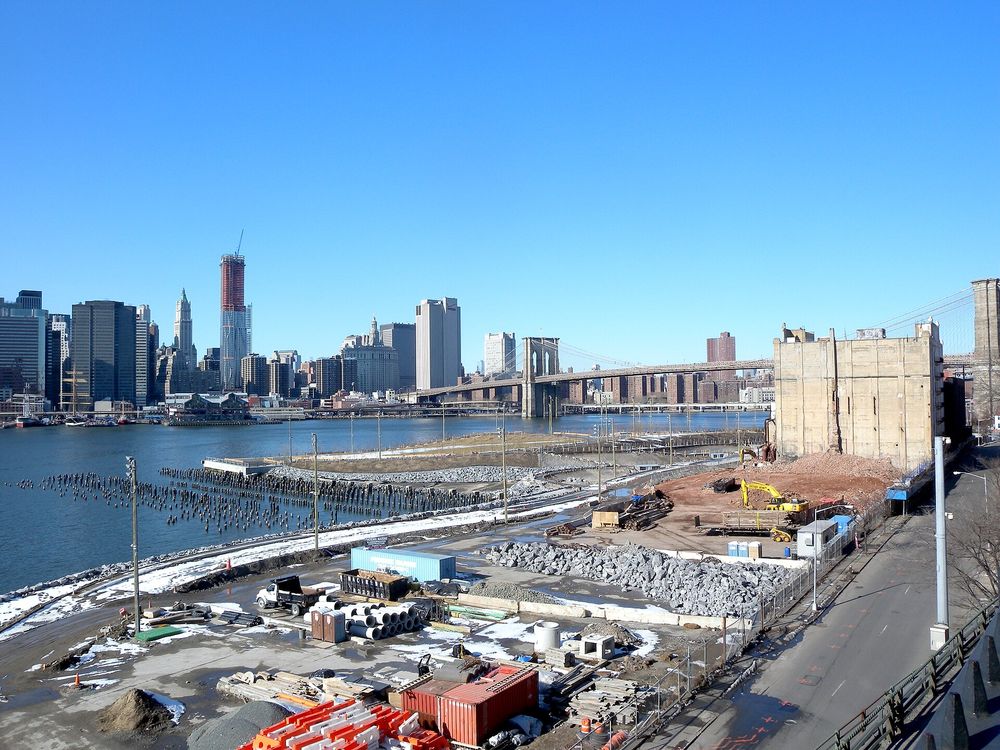
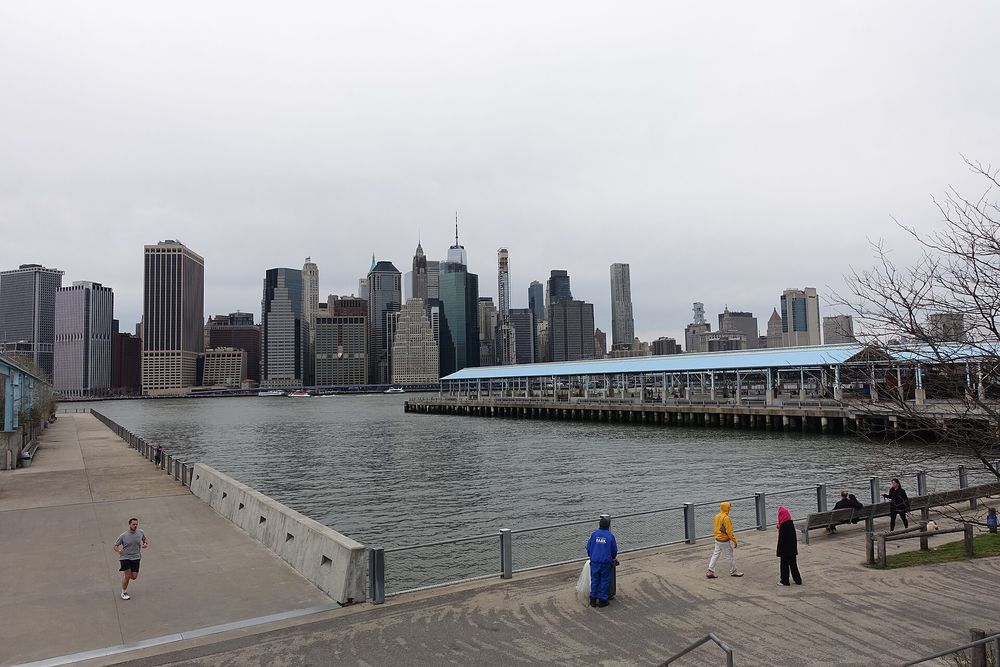
Michael Van Valkenburgh Associates turned 1.3 miles of former cargo piers on the East River into an 85-acre park, opened in phases from 2010. It must pay for its own upkeep, mostly from development sites at its edges.
How it came about and changed
- 1814–1970s
The site was a ferry, rail and warehouse waterfront from the Fulton Ferry era; in the 1950s the Brooklyn-Queens Expressway was built and the finger piers replaced with wider cargo piers, but by the 1970s much of the waterfront was disused.1
- 1984–2001
In 1984, after ending cargo operations, the Port Authority of New York and New Jersey announced plans to sell the piers for commercial development, prompting a decades-long community campaign, carried forward by the Brooklyn Bridge Park Coalition (now Conservancy), for a public park. MVVA has been involved since the project's inception in 1999.12
- 2002–2006
A 2002 Memorandum of Understanding between Governor George Pataki and Mayor Michael Bloomberg established the park with a mandate to be financially self-sustaining. The Brooklyn Bridge Park Development Corporation, a subsidiary of Empire State Development, prepared a General Project Plan and a Final Environmental Impact Statement (2005); the plan, its maintenance budget and revenue programme were adopted in 2006 after community participation.61
- 2008–2010
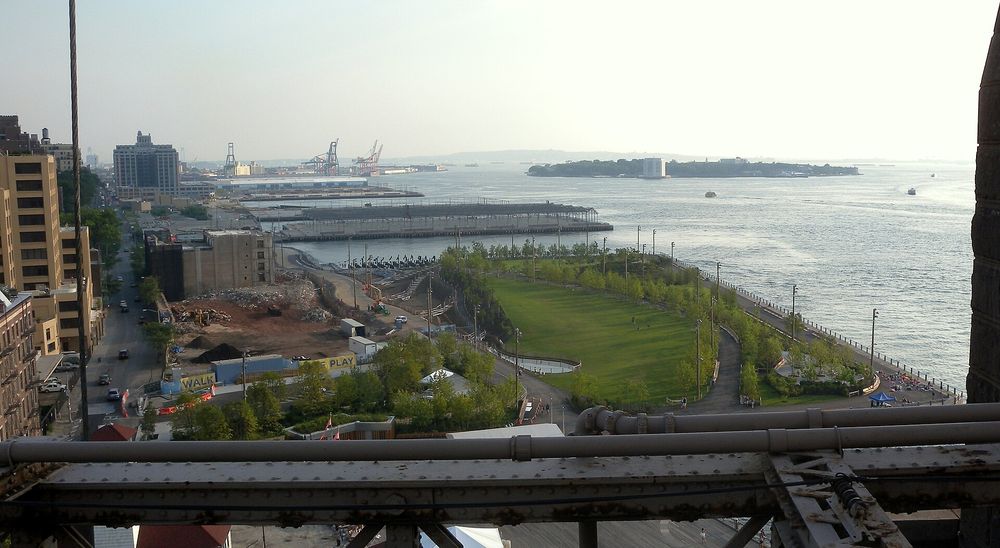
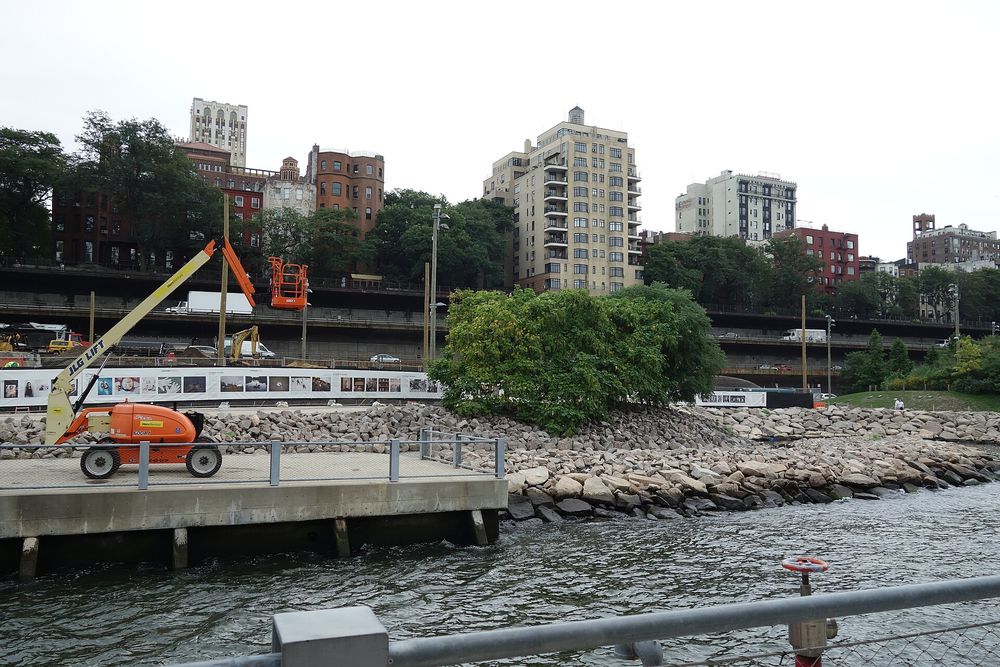
Demolition of the abandoned piers began in February 2008. The first six acres of Pier 1 opened on 22 March 2010, with lawns, a playground, a promenade and the 'Granite Prospect' steps of granite salvaged from the Roosevelt Island Bridge; Pier 1 is the only pier built on landfill, allowing a central hill. In March 2010 the City and State agreed to create a City-controlled not-for-profit entity, Brooklyn Bridge Park Corporation, which took control of the park through a 99-year master ground lease on 29 July 2010.346
- 2010–2019
The park was built in phases, with 'urban junction' entries and the 30-foot promenade prioritised. The National Cold Storage warehouses were demolished in 2010; edge developments followed (Pier 1 hotel and residences opened 2017; John Street and Empire Stores completed 2016; Pier 6 residences completed 2019). After FEMA's post-Sandy flood maps (2013), the Pier 1 development was redesigned with a base plane raised 3.55 feet. Pier 3, the last pier converted, opened on 10 July 2018, bringing the park to 90% complete.215
- 2021–present
The park was completed as designed with the dedication of Emily Roebling Plaza under the Brooklyn Bridge in December 2021. MVVA reports about 5 million visitors a year. Brooklyn Bridge Park Corporation plans, maintains and operates the park, governed by a 17-member board appointed by the Mayor, 8 of them nominated by the Governor and local elected officials.26



Approvals and legal steps
- 2002 Memorandum of Understanding between the State (Governor Pataki) and the City (Mayor Bloomberg) creating the park project with a self-sustaining financial mandate.61
- 2005 Final Environmental Impact Statement prepared by Brooklyn Bridge Park Development Corporation, with the Empire State Development Corporation as lead agency, and a Findings Statement under the State Environmental Quality Review Act.1
- 2006 (modified 2010 and 2013) General Project Plan adopted in 2006; modified in 2010 to recognise Brooklyn Bridge Park Corporation and the transfer from BBPDC, and in 2013 for the adaptive reuse of the Tobacco Warehouse. The GPP sets a 100-foot height limit for the Pier 1 development.1
- 2010 City–State agreement and MOU (announced 10 March 2010) creating the City-controlled operating entity; changes approved by the BBPDC board, with a Public Authorities Control Board vote expected in June 2010. Master Ground Lease from BBPDC to Brooklyn Bridge Park Corporation, 29 July 2010, expiring 28 July 2109.46
- 2013 Environmental Assessment for converting about 2.652 acres of the former Empire Fulton Ferry State Park (Empire Stores and Tobacco Warehouse) under Section 6(f)(3) of the federal Land and Water Conservation Fund Act, with 0.863 acres added as replacement parkland; the action required National Park Service approval.1
Funding
- 2010 (cumulative commitments) Capital funding for construction: USD 139 million committed by the City and USD 85 million by the State, plus up to USD 55 million in new City capital funds under the March 2010 agreement (contingent on approval of the Pier 6 and John Street developments or agreed alternatives).43
- 2010 The 2010 agreement also committed USD 2 million for the Squibb Park Bridge (contingent on local elected officials funding the balance) and up to USD 750,000 for a year-round recreation bubble on Pier 5 and an ice rink.4
- 2002–present Operations and maintenance: the park must be financially self-sustaining; a small share comes from permits and concessions and the majority from ground rents and payments in lieu of taxes (PILOT) from development sites within the project footprint (One Brooklyn Bridge Park, Pier 1, John Street, Empire Stores, Pier 6).16
- projection (stated by BBP) BBP projects the Pier 1 development to yield USD 119.7 million in net present value of revenue over its 97-year lease and about USD 3.3 million a year in rent and PILOTs once complete.1
People
- Michael Van Valkenburgh Associates Landscape architects; master planning from 1999 and design of all phases
- Brooklyn Bridge Park Coalition (now Brooklyn Bridge Park Conservancy) Community advocates who carried the campaign for the park
- Brooklyn Bridge Park Development Corporation (subsidiary of Empire State Development) Prepared the GPP and FEIS; oversaw early construction
- Brooklyn Bridge Park Corporation Not-for-profit responsible for planning, construction, maintenance and operation since 2010
- Regina Myer President of BBPDC and then of Brooklyn Bridge Park Corporation (2010)
- Eric Landau President of Brooklyn Bridge Park Corporation (2018)
- City of New York and State of New York Capital funders and parties to the 2002 MOU and 2010 agreement
- Port Authority of New York and New Jersey Former owner/operator of the cargo piers
- AECOM; Margie Ruddick Landscape; Architecture Research Office; Maryann Thompson Architects; Cerami Associates; Richmond So Engineers Selected consultants named by MVVA (engineering, ecological planning, architecture, acoustics, structures)
Sources for this page
- Brooklyn Bridge Park, History
- Michael Van Valkenburgh Associates, Brooklyn Bridge Park
- Brooklyn Bridge Park, Governor Paterson and Mayor Bloomberg Open First Section of Brooklyn Bridge Park (22 March 2010)
- Brooklyn Bridge Park, Mayor Bloomberg, Governor Paterson, Senator Squadron and Assembly Member Millman Announce Agreement on Funding and Governance of Brooklyn Bridge Park (10 March 2010)
- Brooklyn Bridge Park, Brooklyn Bridge Park Opens Pier 3 (10 July 2018)
- New York City Comptroller (posted document), Brooklyn Bridge Park Corporation financial statements, years ended June 30, 2018 and 2017
- Wikidata, Brooklyn Bridge Park (Q929440)
Researched on 2026-11-19 from the sources listed; a fact that could not be confirmed in a source was left out. Pictures are public domain or under an open licence, credited as their file page asks.
The question it brings · interpretation
When a park must pay for its own upkeep, how should the size, siting and height of revenue-producing development be fixed so that it funds the landscape without eroding the views, access and public character that justify it?
Each question is Field Method’s interpretation, not a claim made by the source.
The date
2010 marks the opening of the first section of the park, part of Pier 1, on 22 March 2010 (Brooklyn Bridge Park press release). Other key dates: Port Authority plan to sell the piers 1984; MVVA involved from 1999; City–State MOU 2002; FEIS 2005; General Project Plan adopted 2006; pier demolition began February 2008; Pier 3 opened 10 July 2018; park completed with Emily Warren Roebling Plaza in December 2021 (MVVA).