1893
Report of the Board of Metropolitan Park Commissioners (Boston metropolitan park system)
Board of Metropolitan Park Commissioners, with reports by Sylvester Baxter, secretary, and Charles Eliot, landscape architect · Boston metropolitan district, Massachusetts, United States
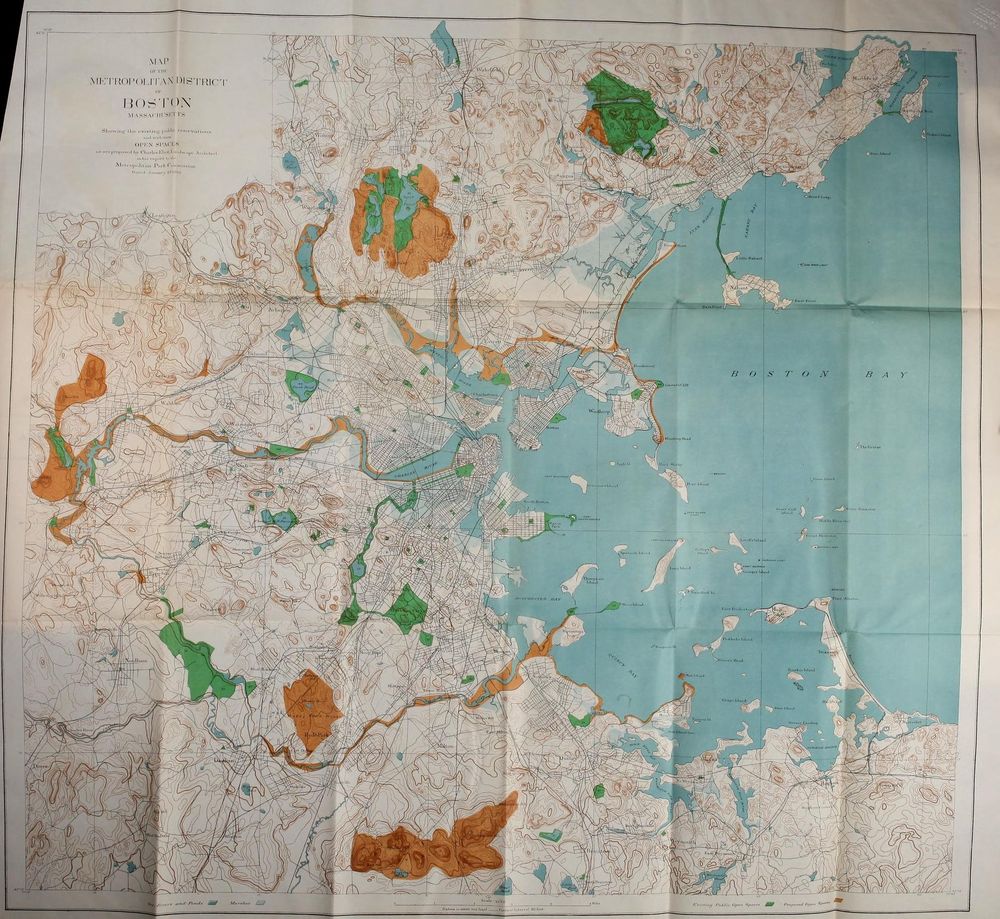
A legislative report for a district of thirty-six cities and towns around Boston, with Sylvester Baxter's secretary's report and Charles Eliot's landscape report, which named rock-hills, stream banks, and bay and sea shores as the sites for public open space.
How it came about and changed
- 1892
Chapter 342 of the Acts of 1892 directed the governor to appoint three unpaid Metropolitan Park Commissioners to consider 'laying out ample open spaces for the use of the public' in the towns and cities near Boston and to report a comprehensive plan to the next General Court. The commissioners (Charles Francis Adams, Philip A. Chase and William B. de las Casas) were appointed in July and organised in August 1892; they engaged Sylvester Baxter as secretary, Charles Eliot as landscape architect and Conrad Reno as legal adviser.12
- 1892
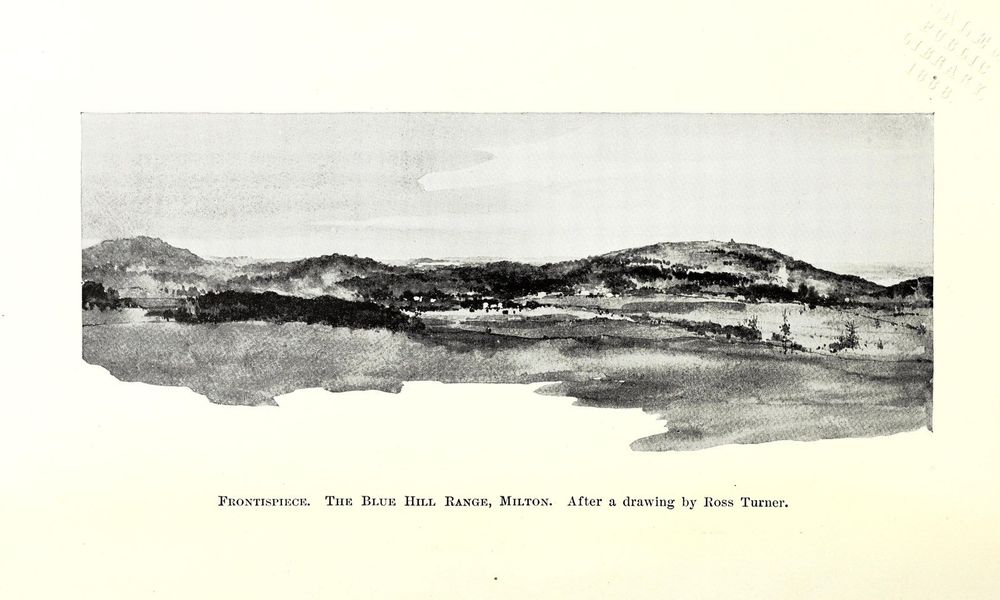
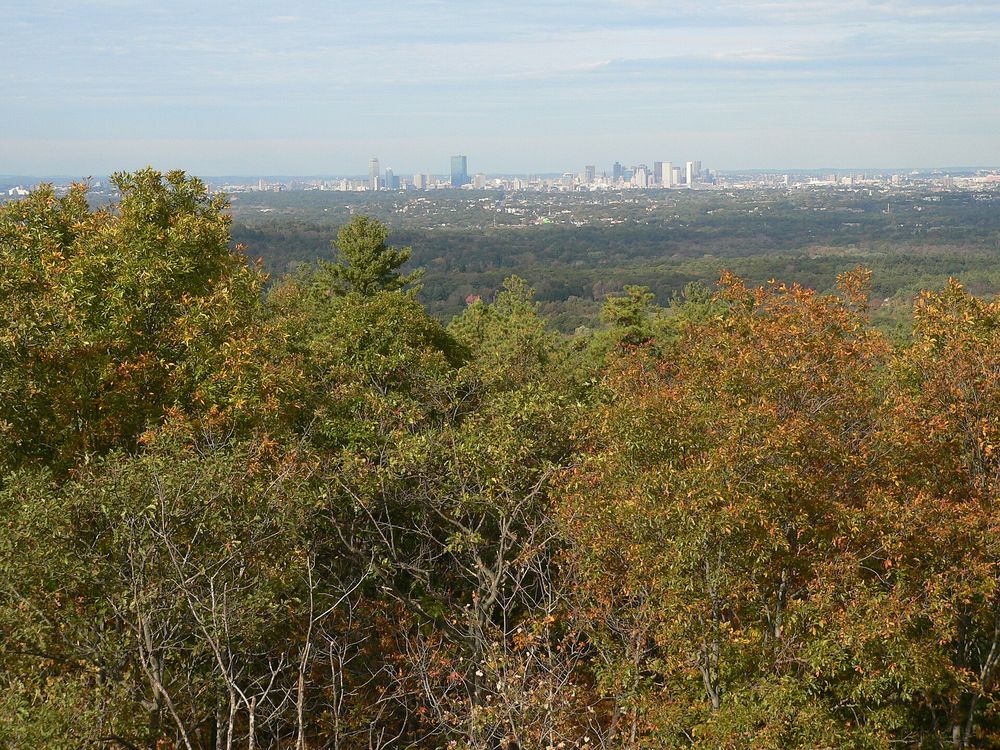
From September to early November 1892 the commissioners, with Baxter and Eliot, visited sites within ten miles of Boston, including the harbour islands, Revere and Nantasket beaches, Lynn Woods, the Middlesex Fells, the Blue Hills, the Charles, Mystic and Neponset river basins and the Waverley Oaks, and met local park boards.2
- January 1893
The report (House No. 150) combined the commissioners' recommendations, Baxter's secretary's report and Eliot's landscape architect's report (dated 2 January 1893) with a map of the metropolitan district. It proposed a metropolitan parks district of 12 cities and 24 towns, urged immediate acquisition of the Middlesex Fells and the Blue Hills (together about 5,000 acres) and treated the ocean shores, river banks and wooded highlands as one regional system; it submitted a draft bill modelled on the metropolitan sewerage act of 1889.2
- 1893
The Park Act, chapter 407 of the Acts of 1893, created the permanent Metropolitan Park Commission and defined its powers; the commission's 1902 report says the woods reservations (Blue Hills, Middlesex Fells, Stony Brook, Beaver Brook), the banks of the Charles, Mystic and Neponset rivers and seashore at Revere Beach, King's Beach, Winthrop and Quincy had been acquired under the Park Acts.3
- 1894–1902
Chapter 288 of the Acts of 1894 began appropriations for boulevards and parkways, and further acts funded Revere Beach (1894, 1895), the Charles River (1894) and Nantasket Beach (1899). The NPS notes that parkways in the system were designed and landscaped by, among others, the firm of Olmsted, Olmsted & Eliot and Arthur A. Shurcliff.34
- 1919–2003
In 1919 the Metropolitan Park Commission (1893–1919) was succeeded by the Metropolitan District Commission (1919–2003). Chapter 41 of the Acts of 2003 merged the MDC and the Department of Environmental Management into the Department of Conservation and Recreation (DCR), whose Division of Urban Parks and Recreation represents the Metropolitan Park System dating from 1893.5
- Today
The NPS describes the Metropolitan Park System of Greater Boston as the first regional park system in the United States, managed by DCR, with nearly 20,000 acres of parkland in 37 communities (seven forested, three river and ten ocean reservations) linked by 162 miles of parkways; many components are listed in the National Register of Historic Places.4

Approvals and legal steps
- 1892 Acts of 1892, chapter 342: establishment of the (preliminary) Board of Metropolitan Park Commissioners and its duty to report a comprehensive open-space plan.2
- 1893 Acts of 1893, chapter 407 (the Park Act): created the Metropolitan Park Commission and defined its powers, following the report's draft bill.3
- 1894–1899 Acts of 1894, chapter 288 (boulevards and parkways); chapter 483 of 1894 and chapter 305 of 1895 (Revere Beach); chapter 509 of 1894 (Charles River); chapter 464 of 1899 (Nantasket Beach), as listed in the commission's 1902 report.3
- 1919 Statutes of 1919, chapter 350: the Metropolitan Park Commission's span ends in 1919 and the Metropolitan District Commission begins (the cited chronology gives the agency date ranges; the specific section number for the park merger was not checked).5
- 2003 Statutes of 2003, chapter 41: MDC and DEM merged into the Department of Conservation and Recreation.5
Funding
- 1892 The preliminary commissioners served without compensation; the 1892 act let them spend on assistants and expenses such sums as the governor and council determined.2
- 1893 (proposal) The draft bill appended to the report proposed Commonwealth scrip or certificates of debt up to one million dollars for up to forty years at no more than 4% interest, with interest, sinking-fund and expenses assessed on the cities and towns of the district; for the first five years Boston's share was fixed at one-half, which the commissioners justified by Boston's own outlay of about $11,000,000 on its park system. Baxter's report expected such a loan to be supplemented by local co-operation and private gifts.2
- 1893–1902 The commission's January 1902 report states that appropriations, added year by year to the original loan, formed three loans (Metropolitan Parks Loan from chapter 407 of 1893; Metropolitan Parks Loan Series II from chapter 288 of 1894; Nantasket Beach Loan from chapter 464 of 1899) aggregating about $10,000,000; the original Park Act also provided a trust fund for gifts, held by the Treasurer of the Commonwealth.3
People
- Charles Francis Adams Metropolitan Park Commissioner (1892–93 board), signatory of the report
- Philip A. Chase Metropolitan Park Commissioner, signatory
- William B. de las Casas Metropolitan Park Commissioner, signatory
- Sylvester Baxter Secretary to the commission; author of the secretary's report
- Charles Eliot Landscape architect engaged by the commission; author of the landscape architect's report and the scheme of reservations
- Conrad Reno Legal adviser who researched precedents and drafted the bills
- Frederick Law Olmsted His 1887 report on tree-growth on the Boston harbour islands is reprinted as an appendix
- Olmsted, Olmsted & Eliot; Arthur A. Shurcliff Landscape architects of parkways in the system (per NPS)
- Metropolitan Park Commission / Metropolitan District Commission / Department of Conservation and Recreation Successive state agencies responsible for the system (1893–1919, 1919–2003, 2003–present)
Sources for this page
- Internet Archive (copy from the Getty Research Institute), Report of the Board of Metropolitan Park Commissioners : January, 1893
- Internet Archive (OCR text of the same item), Full text of Report of the Board of Metropolitan Park Commissioners : January, 1893
- Internet Archive (copy from the Getty Research Institute), Report of the Board of Metropolitan Park Commissioners, January 1902 (Public Document No. 48)
- U.S. National Park Service, Metropolitan Park System of Greater Boston
- Forest Ecosystem Monitoring Cooperative, University of Vermont (hosted document), A Chronology of Government Bodies Which Managed the Commonwealth's Gypsy Moth Problem (DCR chronology)
- Wikidata, Massachusetts State House (Q1150259)
Researched on 2026-11-19 from the sources listed; a fact that could not be confirmed in a source was left out. Pictures are public domain or under an open licence, credited as their file page asks.
The question it brings · interpretation
If you chose open space by landform and water first and by jurisdiction second, which parcels on your current project area would change priority?
Each question is Field Method’s interpretation, not a claim made by the source.
The date
Publication: report dated January 1893 (Massachusetts House No. 150); Charles Eliot's landscape architect's report within it is signed Boston, 2 January 1893.
Checked against
- Internet Archive (copy from the Getty Research Institute), Report of the Board of Metropolitan Park Commissioners : January, 1893
- Internet Archive (OCR text of the same item), Full text of Report of the Board of Metropolitan Park Commissioners : January, 1893
- MIT OpenCourseWare (student project), Boston's Metropolitan Past: Baxter & Eliot's 1893 Plan